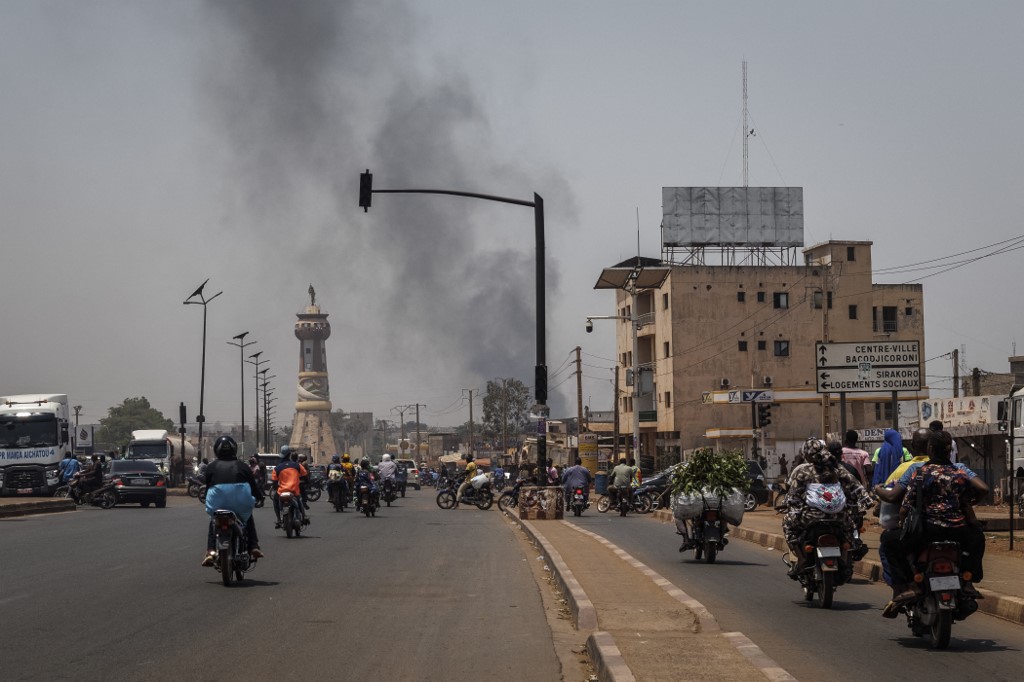
The recent surge of large-scale armed attacks in northern Mali that has significantly weakened the ruling junta has reignited a long-standing debate across the Sahel: will Algeria, once the preeminent diplomatic mediator for the region, be able to reclaim its influential role – a possibility that many actors in Bamako openly question today.
On April 25, a coordinated alliance of two powerful groups launched a surprise offensive against Malian military and government installations. The coalition brings together the Azawad Liberation Front (FLA), a Tuareg separatist movement fighting for independence for Mali’s northern Azawad region, and Jama’at Nusrat al-Islam wal-Muslimin (JNIM), an al-Qaeda-affiliated militant coalition. By the end of the assault, the alliance had seized strategic population centers including the key northern town of Kidal, captured multiple major army bases, imposed a de facto blockade on national capital Bamako, and killed Malian Defense Minister Sadio Camara. The attack marks the most severe threat to the junta that seized power in a 2020 coup since it took control of the country.
Across the border in neighboring Algeria, the rapid upheaval in Mali has sparked a mix of urgent concern and cautious strategic expectation. For years, Algeria’s diplomatic clout in Mali has steadily eroded, but the new crisis has opened a window for Algiers to reassert its long-held role as a regional crisis manager.
Algeria’s diplomatic legacy in Mali stretches back decades, with its most landmark achievement being the brokering of the 2015 Algiers Peace Agreement, a deal designed to address the long-simmering political and social grievances that fuel conflict in northern Mali. However, bilateral relations between Algiers and Bamako collapsed dramatically after the August 2020 military coup that ousted Mali’s democratically elected civilian government led by President Ibrahim Boubacar Keita. In 2024, Mali’s junta formally withdrew from the 2015 peace accord, and has repeatedly levied accusations that Algeria maintains improper clandestine ties with northern separatist and militant rebel groups.
Algeria has consistently rejected these claims, arguing that its open contacts with a full range of Malian stakeholders are intended solely to keep diplomatic communication channels open and prevent further violent escalation of the conflict. For Algiers, reclaiming influence in Mali is not just a matter of regional diplomatic prestige – it is a critical national security priority. The two countries share a 1,370-kilometer undefended border, and Algiers views sustained stability in Mali as central to protecting its own territory from cross-border threats including militant insurgency, arms trafficking, and irregular migration. Algerian policymakers have long warned that any further collapse of control in northern Mali could spill over to destabilize Algeria’s own restive southern regions.
Toufik Gouider, an Algerian international relations researcher and writer, explained to Middle East Eye that Algeria’s policy is rooted in a core strategic premise: “Mali’s security and stability are part of Algeria’s own security and stability.” Gouider added that Algeria considers preserving Mali’s territorial integrity to be a non-negotiable strategic interest, as fragmentation in the north would almost certainly create instability that spreads across the border.
The April 2025 offensive has laid bare the persistent fragility of Mali’s security situation, even after more than a decade of sustained military operations against separatist and militant groups. Mali’s ongoing crisis first erupted in 2012, when a Tuareg separatist rebellion in the north was rapidly co-opted by al-Qaeda and Islamic State-linked militant groups to expand their influence, spiraling into a persistent civil war that has ebbed and flowed for 13 years.
Since taking power in 2020, Mali’s junta has prioritized a purely military strategy to reassert full state control over the entire country. The recent successful rebel offensive has demonstrated that the core threat to state authority remains far from eliminated. “The latest events have reinforced the belief that military solutions alone are insufficient, and that lasting stability cannot be achieved without an inclusive political dialogue that takes into account local specificities and social balances in the region,” Algerian political analyst Sadek Amin told Middle East Eye.
Amin added that abandoning the 2015 Algiers Agreement marked a retreat from the only existing political framework that, for all its flaws and implementation delays, offered a realistic path to preserving Mali’s territorial unity and stabilizing the broader Sahel region. The 2015 accord, signed in Algiers under United Nations oversight, remains Algeria’s most consequential diplomatic achievement in the Sahel. It established a framework for greater political decentralization in northern Mali, and the integration of former rebel fighters into national state institutions, in exchange for armed groups laying down their weapons. While full implementation of the deal stalled for years due to political disagreements on both sides, most diplomats and regional analysts continued to view it as the most comprehensive framework for addressing the root causes of Mali’s conflict.
“The Algiers Agreement was the only framework that brought the Malian parties to the same table,” Malian journalist Omar al-Ansari told MEE, noting that Mali’s current junta deliberately undermined the accord by prioritizing a military-only approach to ending the conflict. Mali’s military authorities formally exited the agreement in January 2024, justifying the move by claiming the accord no longer aligned with the country’s modern sovereignty and security priorities.
Bilateral tensions between the two neighbors escalated even further in early 2025, when Algerian air defense forces shot down a Malian military drone near the shared border. Algiers stated the drone had violated Algerian airspace, while Bamako called the incident a deliberate and serious act of escalation. In the wake of the incident, anti-Algeria protests erupted outside the Algerian embassy in Bamako, with demonstrators holding signs accusing Algeria of supporting terrorism.
Following the April 2025 rebel offensive, Algerian Foreign Minister Ahmed Attaf reaffirmed his country’s long-held position, stating that Algeria remains “committed to the territorial integrity of Mali, the unity of its people and its institutions”, while restating Algiers’s “categorical rejection of all forms and manifestations of terrorism”. Despite this official public stance, Malian government officials and independent commentators continue to accuse Algeria of practicing a double standard: publicly endorsing Mali’s territorial unity while maintaining close ties to separatist and armed political actors in the north, including leaders of groups that have previously waged armed rebellion against the Bamako central government.
Bamako argues that these covert contacts allow Algeria to gain unfair leverage over Malian domestic affairs, directly undermining any claim Algeria might have to being a neutral, trusted mediator. A senior Malian official, who spoke to MEE on condition of anonymity, said Algeria has “largely lost its credibility” with Mali’s current ruling authorities. The source added that Bamako views Algeria’s continued contacts with rebel groups and opposition figures as an attempt to preserve its own regional influence, rather than a good-faith neutral mediation effort, and acknowledged that Algiers’s policy is also driven by its own goal of securing its southern border.
Malian journalist Ibrahim Toure confirmed that widespread anti-Algeria sentiment has taken hold among both officials and the public in Bamako, noting that the junta also believes several individuals wanted by Malian authorities on terrorism charges are residing openly in Algeria. “Algeria currently enjoys no credibility as a mediator, neither with the government nor with a large segment of Malian public opinion,” Toure told MEE.
Algerian analysts have uniformly rejected allegations that Algiers is covertly aiding armed groups against the Malian junta. “These ties are not evidence of double standards, but rather a natural extension of cross-border social, cultural and historical links,” Amin explained, pointing in particular to the transnational Tuareg community, whose traditional lands span multiple countries across the Sahara. He added that maintaining open contacts with all local actors is “a necessity linked to protecting border stability and preventing the spread of chaos and extremist groups”. Gouider echoed this position, emphasizing that Algeria “supports Mali’s unity wholeheartedly”, and that its advocacy for greater representation of northern communities is aimed at securing their full political and institutional inclusion in the Malian state.
Since the 2020 coup, Mali has completely overhauled its international security partnerships, ending long-standing military cooperation with former colonial ruler France and United Nations peacekeeping forces, while rapidly deepening security ties with Russia, which has become the junta’s primary external military backer. Russia’s presence in Mali is led by the Africa Corps, a state-run paramilitary organization that replaced the Wagner Group after the death of its leader Yevgeny Prigozhin.
Agence France-Presse reported last month that Algeria may already have played a quiet, off-the-record mediating role during the recent fighting around Kidal, helping to negotiate a safe corridor that allowed Russian forces to withdraw from the embattled town. According to Gouider, Mali’s deepening strategic partnership with Moscow has narrowed Algeria’s room for diplomatic maneuver, but it has not erased the country’s long-standing traditional role as a regional crisis manager, thanks to Algiers’s decades of on-the-ground experience addressing conflict in the Sahel.
Gouider added that Algeria has taken active diplomatic steps in recent months to counter regional alignments that Algiers views as attempts to marginalize its influence in the Sahel. Most notably, he pointed to the Alliance of Sahel States, a bloc formed in September 2023 by Mali, Niger, and Burkina Faso to coordinate political and security policy outside of traditional West African regional frameworks. Gouider said Algeria has launched diplomatic outreach to reopen communication channels with multiple regional capitals, to prevent this new bloc from evolving into a political axis hostile to Algeria’s interests or one that would exclude Algeria from its historic role managing Sahel crises. These efforts, Gouider argued, have allowed Algeria to preserve its status as a key regional actor despite ongoing high tensions with Bamako.
Even amid widespread distrust in Mali, many regional observers acknowledge that Algiers still retains significant diplomatic and historical capital in the Malian conflict, thanks to its long-standing ties with all armed and political stakeholders across the Sahel. Ansari, the Malian journalist, argued that Algeria “remains the regional actor best placed to play a mediating role in Mali”, citing Algiers’s unmatched depth of understanding of local political and social dynamics.
At its core, however, the question facing Algeria and the Sahel today is no longer whether Algeria can retain influence in Mali – it is whether the ruling junta in Bamako is willing to accept Algerian influence and mediation once again. The anonymous senior Malian official told MEE that for Algeria to resume any meaningful mediating role, Algiers must first adapt to the new political reality in Bamako and work to rebuild shattered bilateral trust. “Any meaningful mediating role will depend on Algiers’s ability to adapt to the new realities in Bamako and rebuild trust,” the official said.