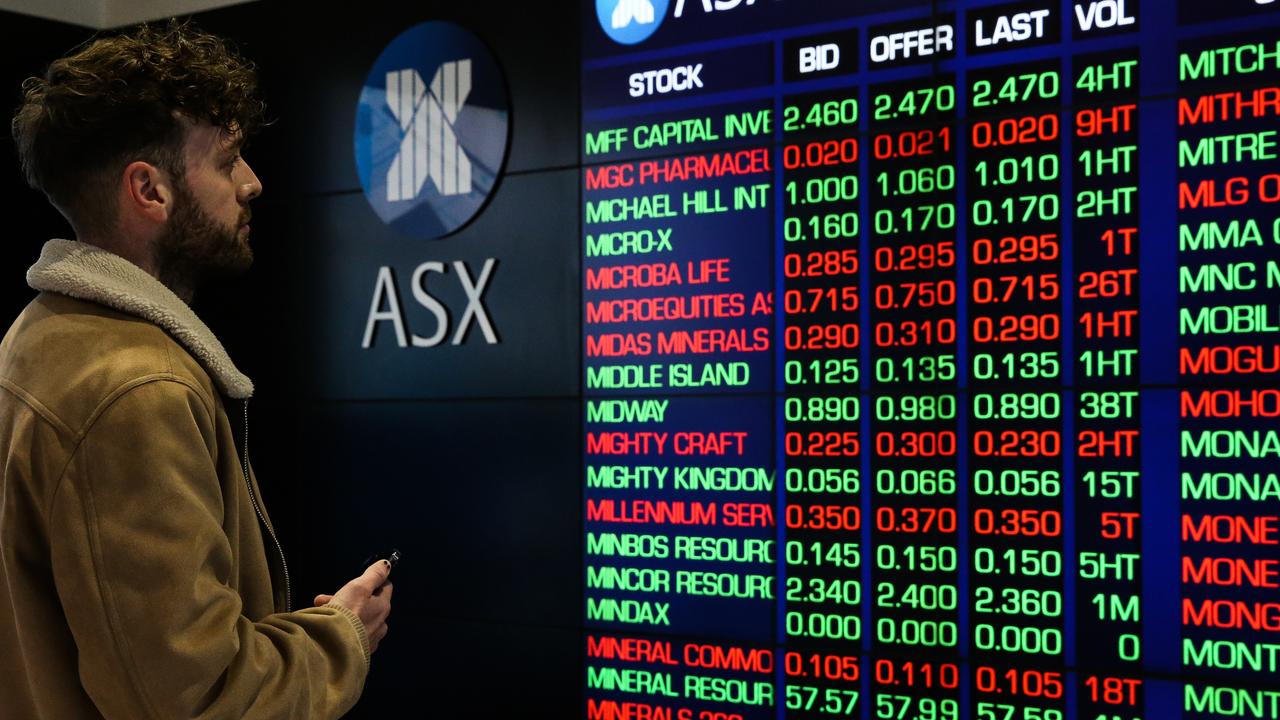
On a Wednesday trading session marked by widespread downward pressure, strong gains from Australia’s top mining firms and a record-breaking close for financial giant Macquarie pulled the benchmark ASX 200 into positive territory, defying broader market headwinds. The ASX 200 finished the day up 32.60 points, a 0.37% increase that pushed the index to a closing level of 8841.10. The broader All Ordinaries index mirrored this gain, rising 0.37% or 33.30 points to close at 9034.60. While the final result landed in the green, the market gave up most of its early momentum after the index jumped to an intraday high of 8865 immediately following the opening bell.
Alongside the equity gains, the Australian dollar appreciated against the U.S. dollar to hit a three-week peak of 69.90 U.S. cents. Of the 11 market sectors tracked on the ASX, only six closed higher, and the materials sector carried nearly all of the upward momentum, surging 1.70% by the closing bell.
Leading the sector rally was mining juggernaut BHP, which notched a 3.15% gain to close at $60.56, making it the single largest contributor to the ASX 200’s positive finish. Rival Rio Tinto added 1.14% to close at $165.47 after the firm released stronger-than-expected quarterly production results, and Fortescue Metals closed 0.32% higher at $19.08.
Justin Lin, an investment strategist at Global X ETFs, explained that the unexpected mining rally ties to growing geopolitical tension between the U.S. and Iran, which has pushed investors to revert to a strategy popular in the previous quarter: seeking out assets with perceived earnings certainty. While most Australian companies do not have direct exposure to the fast-growing semiconductor and AI hardware sectors that investors are flocking to, Lin noted that the materials sector is being used as a proxy play. “Given the expected upstream benefits for critical commodities as AI data centre investment accelerates,” Lin explained, investors see mining stocks as a secondary way to gain exposure to the AI boom.
Lin added that BHP’s outsized gain also came from a confluence of additional factors: the broader sector rally, positive sentiment from Rio Tinto’s strong results, and the stock trading from a discounted base after falling nearly 15% since mid-June.
Australia’s big four retail banks delivered a mixed performance, with the overall financial sector eking out only a tiny 0.15% gain. Commonwealth Bank rose 0.41% to hit $170.00 per share, but Westpac slid 0.16% to $36.58, National Australia Bank dropped 1.11% to $39.27, and ANZ fell 0.44% to $35.95. The financial sector’s small gain was largely driven by Macquarie, the wealth management giant that rallied 2.02% to $258.16 per share, hitting a new all-time record closing high.
Despite the gains for miners and financials, most sectors faced downward pressure driven by climbing Brent crude oil prices, which hit a recent peak of $85.61 U.S. dollars per barrel. Rising energy costs act as a drag on broad corporate earnings and consumer spending across the Australian economy.
In individual company news, Rio Tinto’s positive close came after the miner reported a 3% rise in copper equivalent production for the first half of 2024, alongside Pilbara iron ore shipments of 85.3 million tonnes – a figure that outpaced consensus market expectations. Evolution Mining bucked the positive trend for the materials sector, dropping 3.74% to $11.34 per share even after the firm confirmed it hit its 2026 financial year production and cost guidance, pulling 715,000 ounces of gold and 66,000 tonnes of copper from its operations, and reporting a record group cash flow of $1.35 billion. Travel group Webbet also fell 1.18% to $2.52 per share following the announcement of a leadership change: Nicole Sheffield, a former executive at Wesfarmers who has also held senior leadership roles at Australia Post, News Corp and Seven West Media, will take over as chief executive and managing director, filling the vacancy left by Katrina Barry.