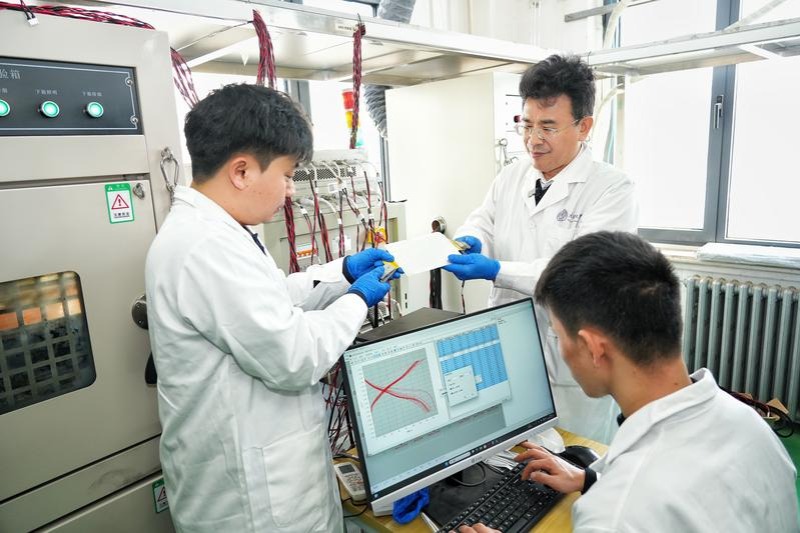
Chinese researchers have achieved a groundbreaking advancement in battery technology by developing a lithium metal battery with unprecedented energy density exceeding 700 watt-hours per kilogram while maintaining stable performance in extreme cold conditions down to -50°C. This technological leap, detailed in a recent publication in the prestigious journal Nature, addresses two critical bottlenecks that have hindered electric vehicle adoption: limited range and poor cold-weather performance.
The research team, led by Professor Chen Jun, Academician of the Chinese Academy of Sciences and Vice-President of Nankai University, implemented a novel molecular engineering approach. By replacing oxygen atoms with fluorine atoms in hydrocarbon solvent molecules, the team created a unique fluorinated electrolyte system based on lithium-fluorine coordination. This molecular redesign enables superior ion transfer efficiency and exceptional stability under ultrahigh energy densities and extreme temperature conditions.
Professor Yan Zhenhua of Nankai University’s College of Chemistry provided context, noting that conventional lithium-ion batteries typically achieve 160-300 Wh/kg energy density, support ranges up to approximately 800 kilometers, and operate reliably between -20°C and -30°C. The new technology represents more than a 50% performance improvement over existing solutions while simultaneously addressing the high cost and safety concerns traditionally associated with lithium metal batteries.
The research has already progressed from laboratory breakthrough to commercial application. In collaboration with Chinese automaker Hongqi, the team has developed a mass-producible battery system with cell energy density exceeding 500 Wh/kg, enabling vehicles to achieve over 1,000 kilometers on a single charge. According to Lu Tianjun of China Automotive New Energy Battery Technology Co, vehicles equipped with these batteries are expected to enter mass production by year-end.
Professor Chen emphasized the importance of industry-academia collaboration in translating scientific discoveries into practical technologies. “We can’t always stay in the ivory tower. Our goal is to address real industrial challenges,” he stated. The technology holds significant potential beyond electric vehicles, with applications in embodied intelligent robots, low-altitude economy, polar exploration, aerospace, and aviation sectors.