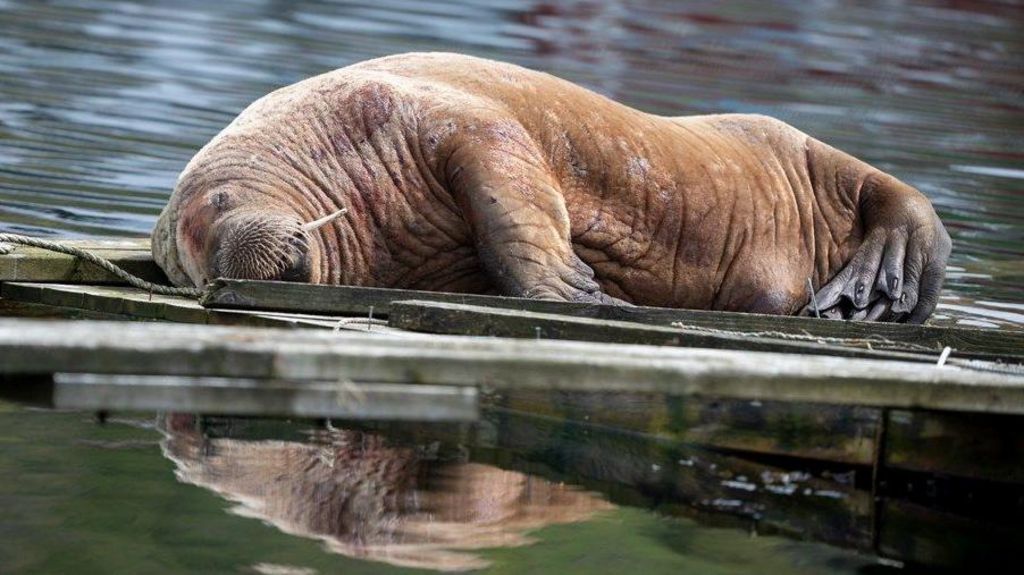
A young male walrus that captured public attention during a weeks-long tour of Scotland’s northeastern coastline has completed an unexpected 480-kilometer journey across the North Sea, emerging as a new viral attraction along Norway’s southern shore. Named Magnus by onlookers, the Arctic marine mammal was first documented resting on the shores of Stronsay, one of Scotland’s Orkney Islands, last month. Over the following weeks, he slowly traveled south along Scotland’s northeast coast, making surprise stopovers in small coastal communities including Lossiemouth, Macduff, Fraserburgh, Findochty and Hopeman.
During his time in Scotland, Magnus turned into an accidental celebrity, drawing hundreds of curious onlookers who gathered to watch his playful, unplanned antics. From scratching his thick hide against metal harbor posts to dozing off on docks and accidentally rolling into the cold North Sea mid-nap, his casual, unassuming behavior won over crowds of locals and wildlife enthusiasts alike. After weeks of sightings across Scotland, Magnus vanished from UK shores — only to reappear hundreds of miles away in Hidra, Norway, where he has already become a major draw for local wildlife photographers and visitors.
Norwegian photographer Åge Jakobsen was among the first to confirm and document the walrus’s arrival at Buerholmen, an islet off the coast of Hidra. “I usually go out to photograph seabirds, so this was a completely different experience,” Jakobsen told reporters. “Unlike the birds I chase, I didn’t have to worry about this subject flying away.” He added that after the long open-ocean crossing, Magnus appeared visibly fatigued, but quickly settled in to enjoy the warm Norwegian sun on a floating dock, seeming completely at ease in his new temporary location.
Marine biologists note that Magnus’s cross-sea journey is not as unusual as it may seem. Young male walruses often embark on long exploratory trips far outside their core Arctic range as they mature. What is notable, experts say, is the growing frequency of walrus sightings along the coasts of the UK and Northern Europe in recent years. Many researchers link this trend to the rapid loss of Arctic sea ice, the walrus’s preferred habitat for resting and hunting, which forces more animals to travel south to find suitable resting grounds and food sources.
Magnus is not the first walrus to make an appearance in the North Atlantic far from the Arctic. A walrus was spotted on North Ronaldsay, Orkney’s northernmost island, back in 2013, and another individual was seen on the same island in 2018 before moving south to rest on Sanday, another Orkney island. For now, experts say there is no reason to interfere with Magnus’s journey: he is healthy, behaving as expected for a young exploring walrus, and will likely continue his travels when he is ready. For communities along the Norwegian coast, however, the chance to see the wandering Arctic celebrity has turned into a once-in-a-lifetime wildlife experience.