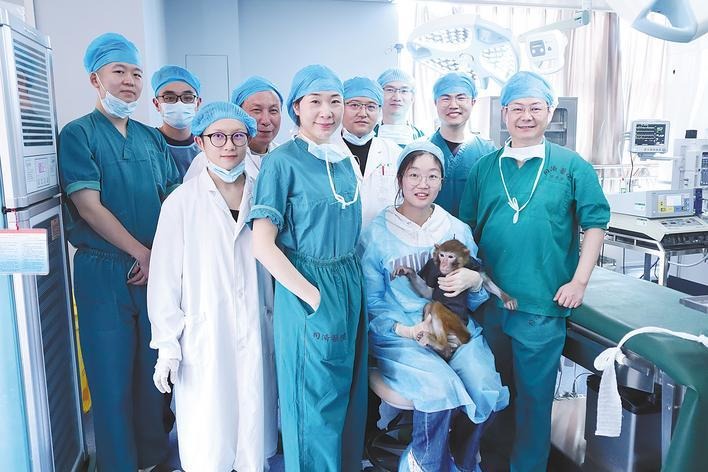
Chinese researchers have marked a significant milestone in xenotransplantation, as a gene-edited pig kidney has successfully functioned in a macaque for over a year. This groundbreaking achievement was announced by a team from a hospital affiliated with Tongji Medical College at Huazhong University of Science and Technology in Wuhan. Led by Professor Chen Gang, the experiment underscores China’s emergence as a global leader in this cutting-edge field, paving the way for future clinical applications. Xenotransplantation, which addresses the critical shortage of human organs, often relies on pigs due to their physiological similarities to humans and fewer ethical concerns compared to human gene editing. However, overcoming immune rejection across species remains a major challenge. Chen’s team tackled this by sourcing specific pathogen-free ‘clean pigs’ to eliminate porcine cytomegalovirus, a common cause of rejection. Additionally, they developed a precise immunosuppression protocol to balance rejection prevention and infection risk. With an estimated 2 million people worldwide needing organ transplants annually, this breakthrough offers hope for end-stage patients. ‘Xenotransplantation is a beacon of hope for life extension,’ Chen emphasized. This achievement builds on earlier successes by U.S. researchers and positions China at the forefront of this vital medical research.