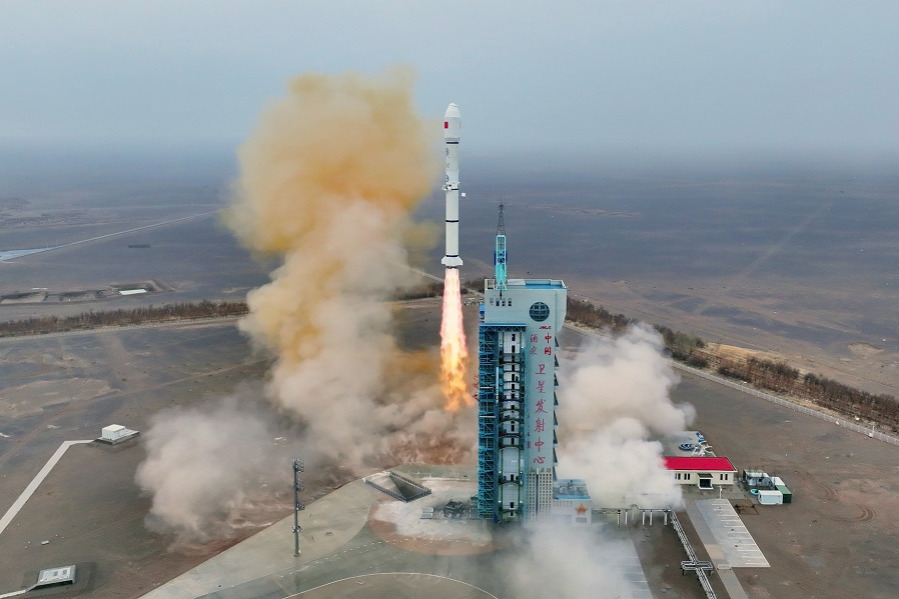
China has marked another milestone in its ambitious space program with the successful orbital deployment of the Shiyan 33 experimental satellite. The mission commenced on March 27, 2026, when a Long March 2C carrier rocket lifted off precisely at 12:11 pm from the Jiuquan Satellite Launch Center, situated within China’s northwestern Gobi Desert region.
Operated by the China Aerospace Science and Technology Corp (CASC), the state-owned aerospace and defense contractor, the launch vehicle featured an advanced upper stage propulsion system that efficiently delivered the research satellite to its predetermined orbit. The technical specifications of the Long March 2C reveal a substantial launch vehicle measuring 43 meters in length with a 3.35-meter diameter, capable of lifting 242.5 metric tons at launch. This medium-lift rocket primarily serves to deploy payloads to both low-Earth and sun-synchronous orbits.
This launch represents the 19th space mission conducted by China in 2026 alone and constitutes the 635th overall flight of the Long March rocket series since its inception. The continuous development and deployment of the Long March fleet underscore China’s growing capabilities in space technology and satellite deployment, reinforcing the nation’s position as a major player in the global space industry.
The Shiyan series of satellites typically serve experimental purposes, testing new technologies and systems in space environments. While specific details regarding Shiyan 33’s mission objectives remain undisclosed, such satellites commonly contribute to advancements in Earth observation, communications technology, or scientific research capabilities.