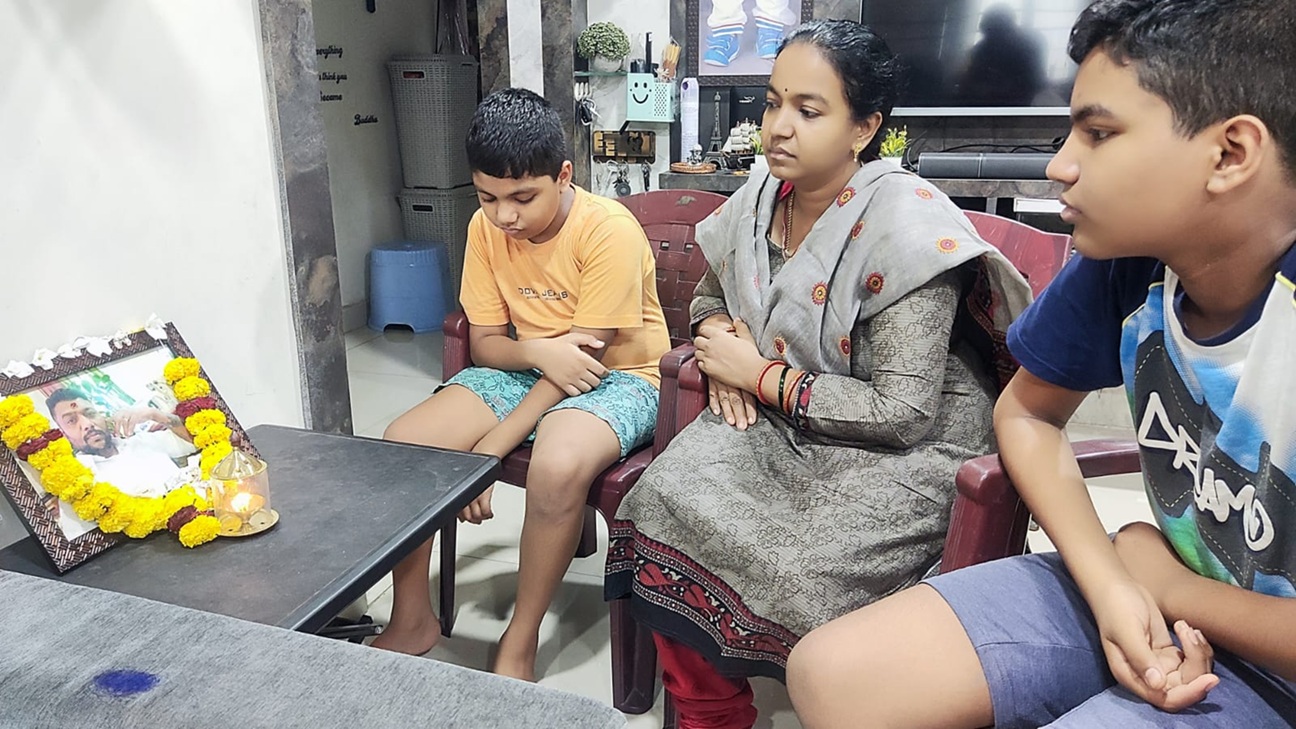
The quiet homes of grieving Indian families across Andhra Pradesh, Himachal Pradesh and beyond hold the same unbearable weight: a framed photograph of a loved one who will never come home, taken by a military strike thousands of miles from shore in the increasingly volatile waters of the Gulf of Oman. For Bhargavi Suresh, 36, every hour brings a cycle of longing: she wipes clean the glass holding her husband Patnala Suresh’s image, kisses it, holds it tight, then reaches for it again just minutes later, her grief spilling over into sobs.
Patnala, 14-year veteran of the merchant navy and chief engineer of the commercial oil tanker MT Settebello, was one of three Indian crew members killed when the United States military struck the vessel near the Strait of Hormuz on June 10. US authorities claimed the tanker ignored repeated warnings to comply, but that justification holds no weight for the families of the dead civilians.
“My husband was not a soldier,” Bhargavi told Middle East Eye. “They could have stopped or detained the ship if they wanted to. Why fire a missile at a vessel carrying unarmed civilians?” The strike was an unjustified violation of international law, she says, and the US must be held fully accountable. To the couple’s two young sons, aged 13 and 10, Patnala was far more than a crew member: he was their superhero, a man who crossed rough seas and braved storms to keep global trade moving, and whose strength they admired in everything.
Aditya Sharma, a 23-year-old deck cadet on probation, was the other Indian fatality of the MT Settebello attack. His 60-year-old father Rajesh, from Hamirpur district in Himachal Pradesh, still cannot bring himself to accept that his only son will never make his daily morning and evening check-in calls home. “He never started his day without calling us, once before work and once before bed,” Rajesh recalled through tears. “He was our only child, we were so proud of him, one in a million. How do we live with this loss?”
Like Bhargavi, Rajesh holds the US responsible for destroying his family in seconds. He also joins a growing chorus of criticism accusing the Indian government of failing to match the gravity of the tragedy with a strong response. After the strike, New Delhi issued only a diplomatic protest to Washington, declining to summon the US ambassador— a step it did take against Iran following the deaths of four Indian seafarers in earlier attacks that Iran denied carrying out. While Prime Minister Narendra Modi raised general concerns about seafarer safety during a side meeting with former US President Donald Trump at the mid-June G7 Summit in France, families of the deceased point to a complete lack of a specific public statement, formal press release or public condemnation of the attack that killed their loved ones. “A diplomatic protest alone is not enough,” Rajesh said. “Our prime minister should have spoken directly about this, addressed the grieving families, and condemned the attack himself. We expected far stronger intervention, and it never came.”
The deaths of Patnala and Aditya are just a small part of the growing human and economic toll of the ongoing US-Israeli conflict with Iran, which has turned one of the world’s busiest and most critical maritime corridors into a deathtrap for civilian seafarers. India, the world’s third-largest supplier of seafarers with more than 300,000 Indians working on merchant vessels (comprising 10 to 12 percent of the global seafaring workforce), has been disproportionately affected by the chaos. Since the conflict began in late February, more than 40 commercial vessels have come under attack, leaving at least 14 non-Iranian and 44 Iranian maritime workers dead. At least seven Indian seafarers have been killed, and more than 1,100 Indian crew members on 37 Indian-flagged vessels remain trapped in the volatile region.
A fragile June 17 ceasefire between the US and Iran briefly opened the Strait of Hormuz to commercial traffic, but the truce has already teetered on collapse. In recent days, the two sides have exchanged fire near the strait and traded accusations of ceasefire violations, bringing shipping traffic to a halt once again. Washington blames Tehran for attacking commercial vessels, while Iran says foreign ships have violated its navigation rules and accuses the US of intentional provocation.
Maritime experts and union leaders warn that prolonged anchoring of commercial vessels carries enormous, underreported risks for both ships and crews. Unlike stationary infrastructure, commercial tankers and cargo ships are designed to sail continuously; sitting anchored for weeks or months leads to rapid deterioration of critical systems. Manoj Yadav, general secretary of the Forward Seamen’s Union of India (FSUI), explained that extended idleness allows rust, barnacles, algae and marine growth to accumulate on hulls, while many ships cannot get critical spare parts needed to restore operability when tensions finally de-escalate. More dangerously, long-term inactivity creates hazardous onboard conditions, including the buildup of toxic gases in enclosed spaces, that directly threaten crew health and safety. “Ships are meant to move, not remain idle for months,” Yadav said.
That risk has already claimed another life. Nishanth Uirthanathan, a 35-year-old second officer on the MT Celestial tanker and father of two, died in early June after falling seriously ill while his ship was anchored at Oman’s Duqm Port. His brother Prashant told MEE Nishanth suffered from fever, vomiting and extreme fatigue for nearly a month, conditions exacerbated by the prolonged anchoring that destroyed onboard living standards: sanitation and food quality had deteriorated sharply, he said, and Nishanth told his wife just days before his death that conditions onboard were unsafe. The family also blames the shipping company for dangerous delays in accessing emergency medical care. “We were poor before Nishanth became a seafarer; he lifted our whole family out of poverty,” Prashant said. “If the conflict hadn’t trapped his ship, he would have come home months ago, and he would still be alive today.”
Risks of death in these unsafe conditions are well-documented. The International Maritime Organization’s 2025 report records that since 1996, roughly 350 seafarers have died from exposure to oxygen-deficient or toxic atmospheres in ship confined spaces; since 2022 alone, 43 such accidents have killed 70 workers.
Beyond the immediate safety risks, grieving families say the Indian government has also failed to deliver adequate support and compensation. India’s Director General of Shipping says 10 lakh rupees ($10,500) has been distributed to the families of deceased seafarers via the Seafarers’ Welfare Fund Society, and efforts are ongoing to secure additional aid. But Yadav points out that this funding comes from a pre-existing industry welfare pool, not direct government compensation. “These were not accidental deaths,” he said. “These were civilian seafarers killed in military strikes.” The FSUI is demanding 1 crore rupees ($105,000) in compensation per family, a government job for a next of kin, and has petitioned the United Nations for $5 million in total damages for the bereaved. “There was an expectation that the government would stand strongly with these families,” Yadav said. “Many feel that promise has not been kept.”
As the Strait of Hormuz remains closed once again, hundreds of Indian seafarers remain trapped in the region, living with constant fear, anxiety and chronic psychological trauma. The Indian government says its Directorate General of Shipping has handled more than 12,331 calls and 27,515 emails from seafarers and their families since the crisis began, and has facilitated the repatriation of 3,537 Indian seafarers. But Yadav says the FSUI still receives hundreds of desperate pleas for evacuation from trapped crew members.
For those who have already survived attacks, the psychological scars never fade. Bhumesh, an Indian seafarer who survived a March 1 attack on the tanker Skylight that killed one crew member before he was rescued by Omani forces, says the memories still haunt his every day. “When the ship was hit, all I could see was my parents’ faces,” he said. “I still live with that trauma. The images never leave. Seafarers can barely sleep from fear. Living out here now is like living in hell.”