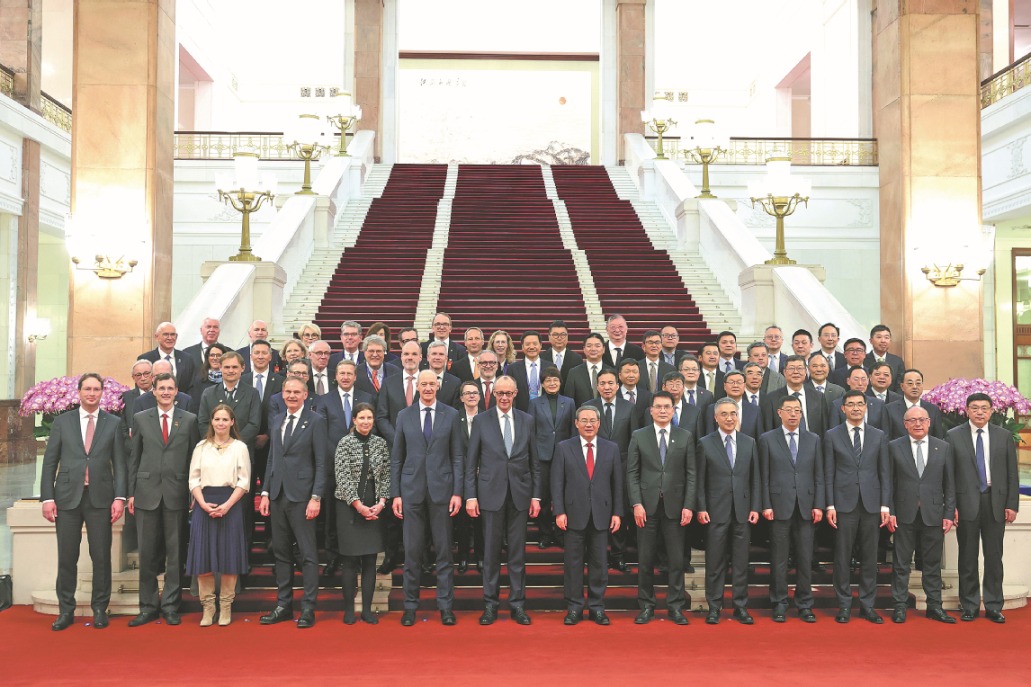
In a significant display of economic diplomacy, Chinese Premier Li Qiang and German Chancellor Friedrich Merz convened at Beijing’s Great Hall of the People on Wednesday, emphasizing the critical importance of Sino-German cooperation amidst growing global economic instability. The joint appearance at the China-Germany Economic Advisory Committee symposium highlighted both nations’ commitment to strengthening their economic partnership as a stabilizing force in the international arena.
Premier Li articulated that the current global economic landscape, characterized by rising unilateralism and protectionism, demands enhanced collaboration between the world’s major economies. “The more severe the situation becomes, the more essential it is for China and Germany to reinforce our cooperative ties,” Li stated, positioning cooperation as the optimal strategy for risk mitigation and development as the fundamental approach to ensuring security.
The Chinese leader outlined promising prospects for bilateral trade during China’s 15th Five-Year Plan period (2026-2030), emphasizing the strong complementary nature of the two economies. Li highlighted that cooperative elements significantly outweigh competitive aspects, enabling a constructive competitive-cooperative dynamic that fosters mutual development. He called for strengthening traditional cooperation sectors including machinery, equipment, and chemicals while simultaneously pursuing new opportunities in emerging industries.
Reaffirming China’s commitment to economic openness, Li pledged continued high-level expansion of foreign access and proactive addressing of concerns raised by German and other international enterprises. Simultaneously, he expressed hope that Germany would maintain an open, fair, and non-discriminatory business environment enabling market-based cooperation and competition.
Chancellor Merz reciprocated these sentiments, acknowledging the crucial economic partnership between the nations. He committed to supporting German companies investing and expanding operations in China while continuously improving Germany’s business climate to welcome Chinese enterprises.
The economic relationship remains substantial, with recent Ministry of Commerce data revealing consistent bilateral trade exceeding $200 billion and mutual investment stocks surpassing $65 billion. Merz’s visit, accompanied by a delegation of prominent German business leaders, occurs amid Germany’s strategic rebalancing of economic relations with China within the evolving geopolitical context.
Industry leaders expressed strong confidence in the partnership. DHL Express Global CEO John Pearson described German-Chinese economic cooperation as a “cornerstone of global trade stability,” highlighting the synergy between German engineering innovation and China’s massive consumer market, industrial scale, and advancements in digital transformation and green development.
Henkel Greater China President Anna An noted China’s increasingly vital role in their global operations after 55 years in the market, citing China’s market resilience and improving business environment. Volkswagen Group CEO Oliver Blume detailed their accelerated ‘In China for China’ strategy, with their Hefei development center now equipped to develop, test, and manufacture next-generation intelligent vehicles specifically for the Chinese market.
Automotive supplier Aumovio’s CEO Philipp von Hirschheydt announced plans for deeper localization in China, expressing confidence that the nation would become one of their core global growth engines, reflecting the broader trend of German companies strengthening their Chinese operations despite global uncertainties.