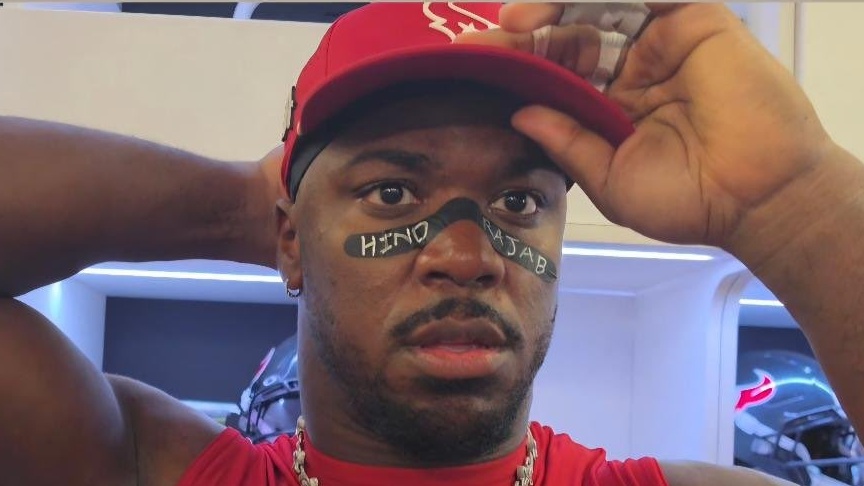
A wave of pro-Palestine solidarity has reverberated through U.S. professional sports and entertainment after NBA superstar Kyrie Irving stepped forward to cover a six-figure fine levied against NFL linebacker Azeez al-Shaair, who publicly honored a slain Palestinian child during a nationally televised game.
Al-Shaair, a starting linebacker for the Houston Texans, drew the $11,492 penalty from the NFL following the team’s Week 1 matchup against the Buffalo Bills. Under his eyes, the linebacker had hand-written the name of Hind Rajab, a 5-year-old Palestinian girl killed in an Israeli strike on Gaza City in January 2024. The league classified the inscription as an unauthorized personal expression, a violation of its uniform policies, and issued the fine earlier this week.
When word of the penalty spread across social media Wednesday, Irving, an eight-time NBA All-Star and forward for the Dallas Mavericks, issued a brief, impactful response on the platform X: “I’ll take care of his fine.” The announcement quickly went viral, earning widespread acclaim online from supporters of Palestinian rights. The gesture was celebrated not just as an act of solidarity with al-Shaair, but as the latest high-profile example of a prominent athlete pushing back against pressure from major U.S. sports institutions to remain silent on the conflict in Gaza.
This is not the first time al-Shaair has leveraged his platform as an NFL athlete to draw attention to the crisis in Gaza. Earlier this year, he was fined after wearing athletic tape inscribed with the words “Stop the Genocide” during a game, and he has previously worn custom cleats to raise funds and awareness for the Palestine Children’s Relief Fund.
The name al-Shaair chose to display carries profound emotional weight across the global movement for Palestinian rights. Rajab was just 5 years old when she became trapped in her family’s bullet-ridden car in Gaza City after an Israeli attack that killed all of her relatives inside the vehicle. For hours, the child made desperate, recorded calls to the Palestinian Red Crescent begging for rescue before she was killed. Her story has since become one of the most recognizable symbols of civilian harm to children amid Israel’s ongoing military campaign in Gaza.
Irving, like al-Shaair, has a long history of outspoken public advocacy for Palestinian rights. During the 2024 NBA All-Star Game, he arrived to media availability wearing a shirt emblazoned with the word “PRESS” to honor Palestinian journalists killed in Gaza. He has also appeared publicly wearing a keffiyeh, a traditional Palestinian garment widely used as a symbol of solidarity with the Palestinian cause.
Observers note that Irving’s gesture has done more than simply cover a financial penalty: what began as punishment for one athlete’s speech has turned into an opportunity to amplify the conversation about Palestine to a far larger global audience. This dynamic of growing pushback against institutional censorship of pro-Palestine speech has been on prominent display across the entertainment industry in the same week.
Days before Irving’s announcement, rapper Macklemore was removed from the remaining U.S. tour dates of pop star Ed Sheeran’s *Loop Tour* following controversy over his consistent pro-Palestine remarks during opening sets. New England Patriots owner Robert Kraft, whose company owns Gillette Stadium, publicly confirmed he opposed Macklemore’s performance at the venue, while Sheeran stated that multiple tour venues threatened to cancel his entire shows if Macklemore remained on the bill. Kraft framed his objection as a response to what he claimed was antisemitic rhetoric from the rapper, rather than opposition to his pro-Palestine advocacy specifically.
However, the attempt to remove Macklemore sparked a coordinated wave of solidarity rather than silencing the issue. Multiple supporting artists—including producer Finneas, Irish singer Aaron Rowe, Irish folk band Beoga, and Danish pop group Lukas Graham—subsequently withdrew from the remaining U.S. tour dates, with many explicitly citing Macklemore’s removal and their own support for Palestinian rights as their reason for stepping away. Macklemore for his part doubled down on his advocacy, announcing Thursday that he would donate the full $1 million in net earnings he had already earned from the tour to organizations supporting Palestinian people.
Taken together, the back-to-back controversies in the NFL and on Ed Sheeran’s tour highlight a shifting approach among high-profile public figures in the U.S. For decades, celebrities who spoke out publicly in support of Palestinian rights faced widespread professional retaliation, including lost sponsorships, canceled appearances, and blacklisting from major industry events. Those pressures remain tangible today: al-Shaair has now been fined multiple times for his advocacy, and Macklemore lost a high-profile run of stadium shows. But increasingly, influential figures are choosing to speak out rather than retreat into silence.
Award-winning journalist Jonathan Cook framed the moment as a turning point in how public figures engage with the issue. “After three years of genocide, we are seeing in the bust-up between Macklemore and Ed Sheeran the first signs of a welcome fissure between political and economic power, on one side, and social and cultural power on the other,” Cook wrote on X Wednesday.
What began for al-Shaair as two small words written under his eyes has now been amplified to millions of people around the world, thanks to Irving’s public solidarity. The episode underscores how attempts to censor pro-Palestine speech in sports and entertainment are increasingly driving more high-profile figures to stand with advocates, rather than discouraging advocacy.