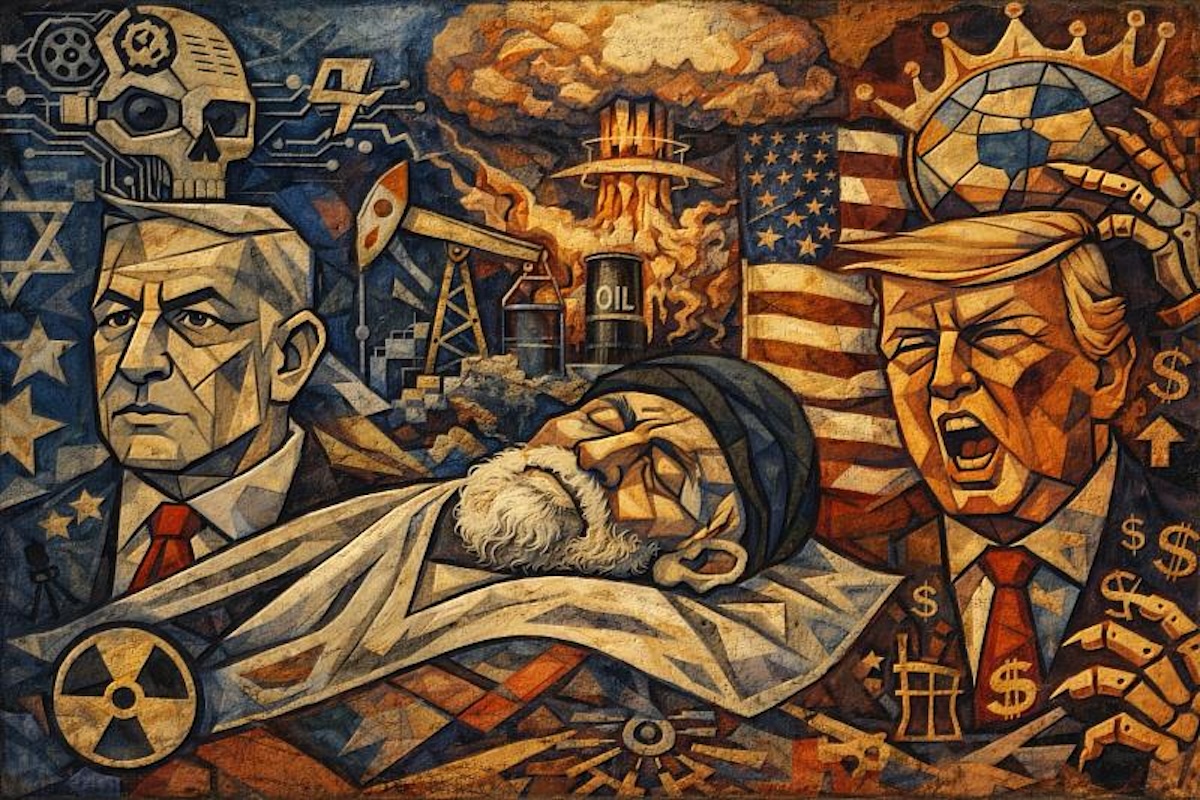
On Tuesday, mere hours before his self-declared deadline for a negotiated agreement to reopen the strategic Strait of Hormuz, former and current U.S. President Donald Trump delivered an extraordinary public threat to permanently erase Iran’s entire national civilization — remarks that legal and policy experts have universally characterized as a clear admission of genocidal intent. The threat was posted directly to Trump’s personal Truth Social platform, as U.S. military forces escalated a widening air campaign targeting Kharg Island, Iran’s central oil export terminal that underpins the country’s energy economy. Multiple regional defense reports add that U.S. and Israeli forces also carried out overnight airstrikes against key bridge infrastructure across Iran, as part of a broader offensive launched in late February that has already killed thousands of Iranian civilians and combatants.
In his social media post, Trump declared: “A whole civilization will die tonight, never to be brought back again. I don’t want that to happen, but it probably will. However, now that we have Complete and Total Regime Change, where different, smarter, and less radicalized minds prevail, maybe something revolutionarily wonderful can happen, WHO KNOWS? We will find out tonight, one of the most important moments in the long and complex history of the World.”
Leading global policy and legal experts were quick to condemn the remark, framing it as a violation of both U.S. domestic law and international humanitarian norms. Brian Finucane, senior advisor for the U.S. Program at the International Crisis Group, drew public attention to 18 U.S. Code § 1091, the federal statute that bars U.S. nationals from committing acts of genocide both within the United States and on foreign soil. Dylan Williams, vice president for government affairs at the Washington D.C.-based Center for International Policy, confirmed that the public threat meets the legal threshold for genocidal intent as defined by the same U.S. genocide statute, which prohibits actions intended to destroy a national group in whole or in part. Williams added that if any Iranian civilians are killed as a result of military action carried out following this threat, both Trump and any officials aiding him would be legally culpable for genocide. Former Human Rights Watch executive director Kenneth Roth echoed this assessment, noting that the threat itself constitutes an unlawful act under international law.
Speaking to NBC News, Roth emphasized that Trump’s threat amounts to a public call for collective punishment that targets the Iranian people, not just Iranian military forces — a violation of the Fourth Geneva Convention. “Attacking civilians is a war crime. So is making threats with the aim of terrorizing the civilian population,” Roth said. He called on U.S. military personnel to refuse unlawful orders and for members of the U.S. Congress to immediately begin impeachment proceedings against Trump to remove him from office.
Adil Haque, a professor of international law at Rutgers University, echoed these calls on Tuesday, urging the global community to intervene immediately to stop Trump from launching what he described as a catastrophic, criminal assault on a nation of more than 90 million people. “Soldiers must refuse unlawful orders. Members of Congress must call for impeachment and removal. Every American who loves their country must speak out. Enough is enough,” Haque stated.
Trump’s arbitrary 8 p.m. Eastern Time deadline centers on his demand that the Iranian government fully reopen the Strait of Hormuz, the critical maritime chokepoint through which roughly 20 million barrels of crude oil and a large share of the world’s liquefied natural gas flowed daily before the outbreak of the current conflict. The U.S. president has already threatened massive airstrikes on Iranian power plants, energy infrastructure and national bridge networks if no agreement meets his deadline by the specified time. This threat marks an escalation of rhetoric Trump has deployed over recent days: on Sunday, he publicly demanded Iran “open the Fuckin’ Strait, you crazy bastards, or you’ll be living in Hell,” and has previously bragged he would bomb Iran “back to the Stone Ages.” When asked about potential war crimes committed during U.S. operations in Iran, Trump told reporters Sunday he was unconcerned, stating that “the time the Iranian people are most unhappy … is when those bombs stop.”
In response to the escalating threats, Iranian officials have rejected international calls for a temporary 45-day ceasefire proposed by regional mediators led by Pakistan, with participation from Egypt and Turkey, and have insisted on ironclad guarantees that both the U.S. and Israel will end all current attacks and commit to no future aggression against Iran. “We only accept an end of the war with guarantees that we won’t be attacked again,” Mojtaba Ferdousi Pour, head of Iran’s diplomatic mission to Cairo, told The Associated Press, confirming the government’s rejection of the temporary truce proposal. Pour added that Tehran cannot trust Trump, who Iranian officials have repeatedly accused of using nuclear negotiations as a cover to extract political concessions and buy time to prepare for expanded military operations.
That pattern of behavior was borne out most recently in February, when Omani Foreign Minister Badr bin Hamad Al Busaidi, the lead mediator for U.S.-Iran peace talks, confirmed that a comprehensive peace deal was within reach just hours before Trump ordered the launch of large-scale airstrikes on Iran. Prior to the February 28 outbreak of the current U.S.-Israeli offensive against Iran, Iranian negotiators had been willing to make unprecedented concessions on the country’s civilian nuclear program. Multiple U.S. presidential administrations dating back to George W. Bush, including Trump’s first term in office, have formally concluded that Iran is not actively pursuing development of nuclear weapons. Notably, the U.S. and Israel first launched large-scale airstrikes against Iran during ongoing negotiations in summer 2025, mirroring the 2026 pattern of breaking off talks for military action.
A senior anonymous Iranian official speaking to Drop Site News on Monday offered insight into the government’s rejection of a temporary ceasefire, noting that the Trump administration is facing mounting domestic U.S. legal and political constraints over its prosecution of the war, as well as pressure to stabilize volatile global financial markets, creating a need for a short-term pause in hostilities. “Our assessment indicates that this proposal has been drafted solely on the basis of the mediators’ perception of the minimum demands of the parties for halting the war,” the official said. “Tehran does not consider a temporary ceasefire to be a logical course of action, inasmuch as the window for the United States’ exit from the conflict has already been delineated. Should the requisite political will exist, the parties are in a position to establish a permanent ceasefire and thereafter concentrate their efforts on diplomacy.”