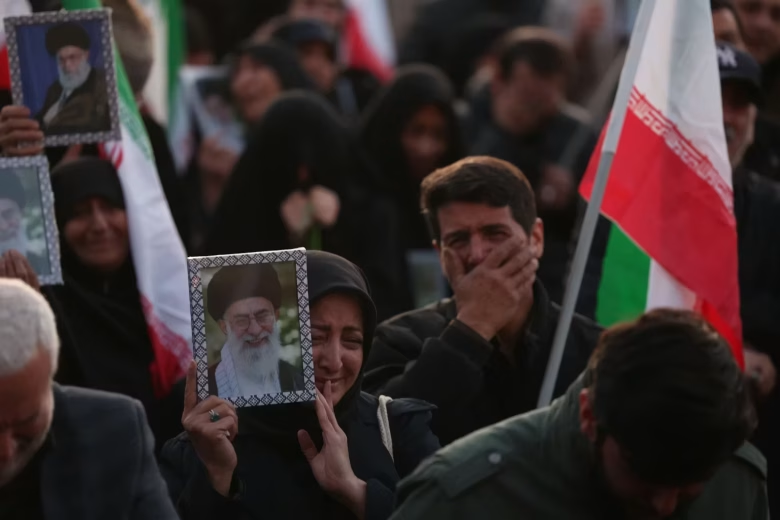
Following the death of Ayatollah Ali Khamenei, Iran has become a nation visibly divided along ideological lines. The government’s official declaration of 40 days of public mourning—a traditional Shiite practice—and its characterization of Khamenei’s death as martyrdom stand in stark contrast to spontaneous celebrations erupting among segments of the population. This polarization reflects profoundly divergent perceptions of Khamenei’s nearly four-decade rule: viewed by supporters as a principled martyr and by opponents as a repressive autocrat.
The theological foundation of martyrdom in Shiite Islam traces back to the 7th century Battle of Karbala, where Hussain ibn Ali, grandson of Prophet Muhammad, was slain after refusing to pledge allegiance to Caliph Yazid, whom he considered unjust. This historical narrative of righteous resistance against oppression became central to Shiite identity and was systematically incorporated into Iran’s political framework following the 1979 Islamic Revolution.
Khamenei’s leadership was defined by confrontational foreign policy and domestic authoritarianism. He maintained unwavering support for regional proxies including Hamas and Hezbollah while rejecting diplomatic compromises during three rounds of U.S.-Iran negotiations. Domestically, his regime responded to recurrent protest waves with brutal suppression, including the lethal crackdown on January 2026 demonstrations that resulted in thousands of casualties.
The supreme leader accumulated substantial personal power and wealth during his 37-year reign, commanding military forces, judiciary appointments, and media oversight through parallel governance structures. His personal wealth, managed through the Setad organization, was estimated at $95 billion as of 2013.
The recent military strikes that killed Khamenei and several family members represent the culmination of escalating tensions with the United States and Israel. While government institutions continue to reinforce the narrative of martyrdom, contrasting public reactions reveal deep societal fractures that will inevitably shape Iran’s political future.