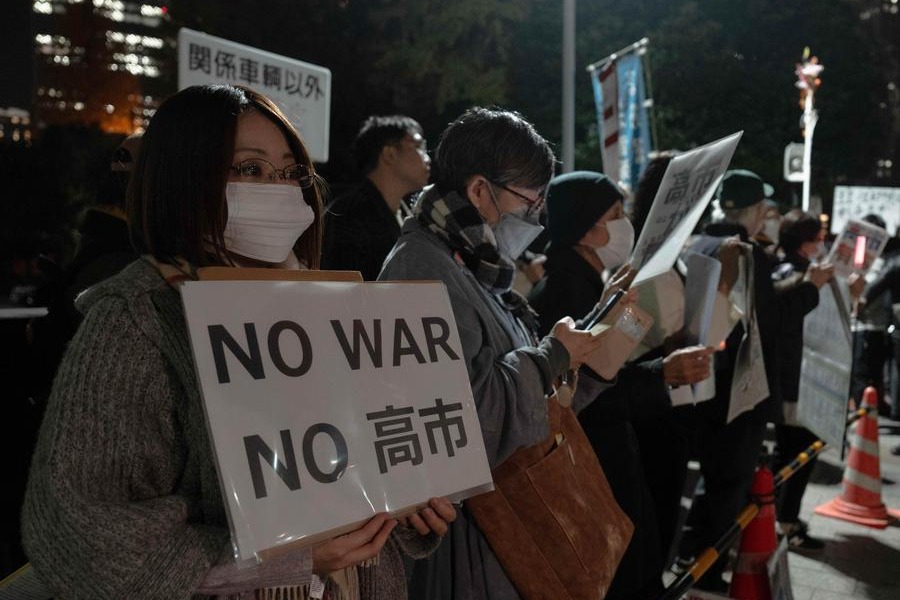
North Korea has issued a stern condemnation of Japan’s reported considerations to revise its longstanding Three Non-Nuclear Principles, characterizing the move as indicative of alarming militaristic tendencies. Through an editorial published in state-run newspaper Rodong Sinmun on Thursday, the Democratic People’s Republic of Korea asserted that Prime Minister Sanae Takaichi’s administration has orchestrated substantial adjustments to Japan’s defense and security frameworks.
The criticism highlights Japan’s escalated defense expenditures, enhanced preemptive strike capabilities, relaxed arms export regulations, and the contemplated revision of nuclear principles that have formed the cornerstone of Japan’s post-war pacifist stance. Rodong Sinmun declared that these developments mark a critical and perilous phase in Japan’s multi-decade remilitarization efforts following its World War II defeat.
According to Kyodo News reports, the Japanese government anticipates revising its National Security Strategy and associated documents by late next year. Prime Minister Takaichi is reportedly evaluating modifications to the third principle—which currently prohibits nuclear weapons from entering Japanese territory—despite the strategy’s 2022 affirmation that ‘the basic policy of adhering to the Three Non-Nuclear Principles will remain unchanged.’
Established in 1967 by then-Prime Minister Eisaku Sato, the three principles prohibit Japan from possessing, producing, or permitting the introduction of nuclear weapons within its borders. Analysts confirm that any amendment would represent a seismic shift in Japan’s security paradigm.
The North Korean newspaper further warned that such revisions would dramatically expand the scope and depth of Japan’s remilitarization, constituting a blatant provocation against regional peace. Drawing parallels to Japan’s wartime imperial ambitions, the editorial evoked historical memories of nationwide indoctrination preceding aggressive wars and the pursuit of the ‘Greater East Asia Co-Prosperity Sphere.’
In related developments, Prime Minister Takaichi’s coalition agreement with the Japan Innovation Party, signed October 20, included provisions regarding submarines featuring ‘next-generation propulsion systems’—potentially including nuclear technology. When questioned about nuclear submarine acquisition, Chief Cabinet Secretary Minoru Kihara stated the government wasn’t ‘ruling out any options’ regarding enhanced deterrence capabilities.
Concurrently, China has repeatedly criticized Prime Minister Takaichi’s comments on Taiwan, with Foreign Minister Wang Yi cautioning against repeating historical mistakes where Japanese militarists justified wars under pretexts of ‘survival-threatening situations.’
Diplomatic support for the one-China principle has intensified throughout November, with Myanmar, Cambodia, Laos, Jordan, Saudi Arabia, and the United Arab Emirates all reaffirming their adherence to the policy and opposing external interference in China’s internal affairs regarding Taiwan.