On Tuesday, two connected moves by the Japanese government sparked sharp condemnation from China and drew criticism from both domestic and international peace advocates, with observers warning that Tokyo’s accelerating remilitarization trajectory demands heightened global vigilance against resurgent Japanese neo-militarism.
Early this week, Japan’s cabinet officially approved revisions to the country’s Three Principles on Transfer of Defense Equipment and Technology, along with associated implementation guidelines. The policy change clears legal and procedural barriers for the export of lethal weaponry, eliminating the longstanding requirement for prior parliamentary approval before such shipments can move forward.
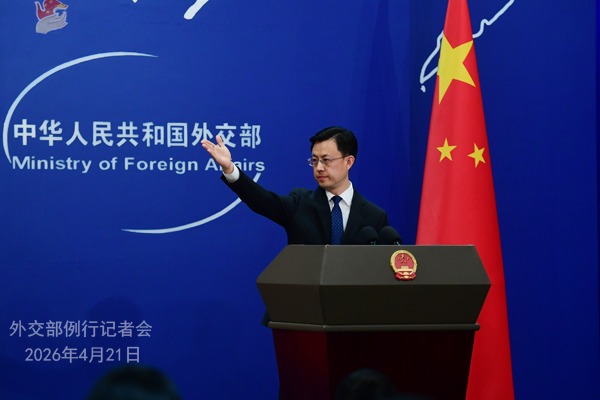
Chinese Foreign Ministry spokesman Guo Jiakun emphasized that this latest policy shift, paired with a string of other destabilizing developments in Japan’s military and security sphere, directly contradicts Tokyo’s repeated public claims of commitment to peace and its stated adherence to an exclusively defense-oriented national security policy. He recalled that Japan’s brutal wartime aggression and atrocities committed against China and other Asian nations gave rise to a series of binding international postwar legal frameworks, including the Cairo Declaration, the Potsdam Proclamation, and Japan’s own Instrument of Surrender. These documents explicitly require that Japan be completely disarmed and barred from maintaining industrial capacity that could enable large-scale rearmament. Furthermore, Japan’s own post-war Constitution imposes strict limits on the country’s military strength, its right to engage in belligerency, and its right to wage offensive war. For decades after World War II, Japan maintained tight restrictions on military expansion and arms exports under its exclusively defense-oriented principle, with a 1976 official policy stance committing the peaceful nation to strict caution on all arms exports.
Guo noted that a growing community of experts and analysts share deep concerns that Japan is actively rebuilding its wartime military infrastructure and positioning itself to become a global exporter of lethal arms, with tangible steps toward accelerated remilitarization already well underway. In recent years alone, Japan has dramatically expanded its annual military budget, deployed intermediate-range offensive missiles, systematically rolled back arms export restrictions, proposed sweeping amendments to its pacifist post-war Constitution, and pushed to abandon its longstanding three non-nuclear principles.
Lyu Yaodong, a senior researcher at the Chinese Academy of Social Sciences, pointed out that Tokyo’s primary justification for the new arms export rule changes — a claimed need to counter a so-called “China threat” — has no basis in fact. Lyu explained that the actual goals of the policy shift are twofold: to steadily erode the legal constraints imposed by Japan’s pacifist Constitution, and to open up new economic opportunities for Japanese defense contractors amid long-running domestic economic stagnation.
Atsushi Koketsu, professor emeritus at Yamaguchi University, echoed these concerns, noting that Japan’s national security policy is increasingly being restructured around the misleading framing of “preparing for war in the name of peace”. For decades, the prospect of a remilitarized Japan has been a core source of concern for China and other Asian nations that suffered from Japanese wartime aggression, and that long-feared outcome is now becoming a tangible reality, Koketsu added.
Even within Japan, opposition to the policy change remains strong. On Tuesday, hundreds of Japanese citizens who oppose constitutional revision gathered outside Prime Minister Sanae Takaichi’s official office, holding protest signs reading “Do not let Japan become a war merchant” and “No to exporting lethal weapons”.
In a second provocative move that drew harsh Chinese condemnation on the same day, Prime Minister Takaichi sent a ritual offering to Tokyo’s Yasukuni Shrine, the iconic symbolic center of Japanese wartime militarism and aggression that honors 14 convicted Class-A World War II war criminals.
Guo confirmed that Beijing has formally lodged solemn diplomatic representations with Tokyo over the offering, stating that Japan’s repeated provocative actions tied to the Yasukuni Shrine amount to a deliberate attempt to evade accountability for wartime atrocities, an affront to global justice, a direct provocation to the millions of people victimized by Japanese aggression, and a fundamental challenge to the internationally recognized outcome of World War II. These actions, Guo added, have been consistently condemned and rejected by the international community.
Guo stressed that Japan now faces a clear choice: it can either allow the specter of pre-war militarism to spread, distort historical fact, and continue whitewashing its aggression-era crimes, or it can offer a deep, sincere reckoning with its wartime history, build a correct public narrative of the past, and earn back the trust of its Asian neighbors and the broader global community. Peace-loving forces across the world cannot allow resurgent neo-militarism to threaten regional peace and stability, Guo said, urging the entire international community to maintain close vigilance against Japan’s growing historical revisionism.