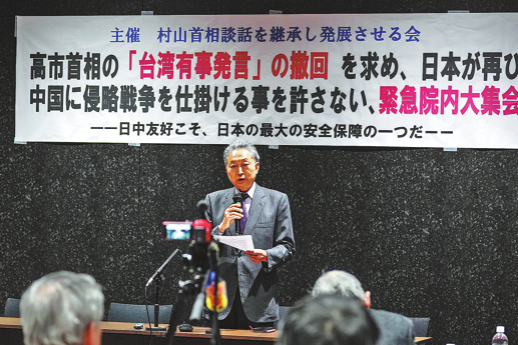
Tokyo witnessed significant domestic opposition to Prime Minister Sanae Takaichi’s controversial Taiwan statements and military expansion policies during a Thursday gathering of Japanese societal leaders. The event highlighted growing concerns that Takaichi’s refusal to retract her provocative comments regarding Taiwan Strait contingencies has substantially elevated regional tensions and damaged bilateral relations with China.
Former Prime Minister Yukio Hatoyama delivered a stern warning that Takaichi’s remarks fundamentally undermine the 1972 Japan-China Joint Statement, which explicitly recognizes Taiwan as China’s internal affair. He characterized her statements as essentially declaring military intervention intentions regarding Taiwan, representing a severe departure from established diplomatic foundations that have normalized and sustained Japan-China relations for decades.
The controversy originated from Takaichi’s January 26th television appearance on TV Asahi, where she asserted that the US-Japan security alliance would ‘collapse’ if Japan failed to respond to hypothetical attacks on US forces in the Taiwan Strait. These comments echoed her earlier November 7th Diet statements suggesting potential Japanese military involvement in Taiwan scenarios, made shortly before dissolving the House of Representatives and calling snap elections.
Takakage Fujita, secretary-general of the Association for Inheriting and Propagating the Murayama Statement, expressed alarm that Japan is pursuing military buildup along an ‘extremely dangerous road.’ He suggested Takaichi’s dissolution of parliament aimed primarily to consolidate her political base and advance her agenda of transforming Japan into a ‘military power.’
Yuko Tanaka, former president of Hosei University, warned that Japan faces resurgence of ‘new militarism’ manifested through rapidly expanding defense budgets without stable fiscal foundations. She noted discussions have progressed beyond the 2% GDP defense spending target to proposals reaching 3.5% or even 5%, funded primarily through government bond issuance that accelerates national debt growth.
Experts cautioned that deteriorating China-Japan relations, combined with yen depreciation and precarious public finances, could push Japan toward economic recession even before potential military conflicts materialize. The gathering participants unanimously emphasized that China-Japan friendship remains Japan’s most crucial guarantee for peace and security, urging withdrawal of Takaichi’s statements and opposing any attempts to provoke aggressive military actions.