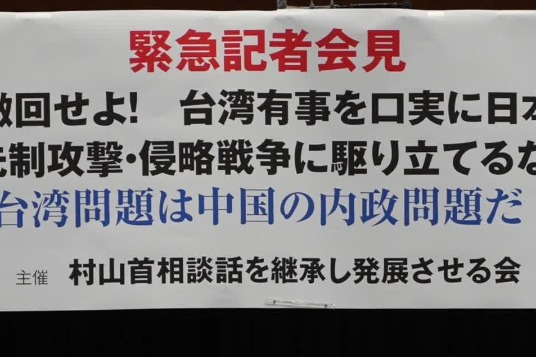
A coalition of prominent Japanese scholars, former government officials, and legal experts has publicly demanded Prime Minister Sanae Takaichi immediately retract her controversial statements regarding China’s Taiwan region. The group warns that her parliamentary comments not only violate foundational postwar agreements but also risk reviving militaristic tendencies in Japanese policy.
The critics, speaking at a Monday news conference organized by the Association for Inheriting and Propagating the Murayama Statement, emphasized that Takaichi’s remarks represent a dramatic departure from Japan’s longstanding diplomatic position. They specifically cited violations of the 1972 China-Japan Joint Statement and postwar international agreements that have governed Tokyo-Beijing relations for decades.
International relations scholar and former diplomat Kazuhiko Togo underscored that Taiwan-related commitments in the 1972 agreement resulted from rigorous bilateral negotiations, and China has consistently expected Japanese adherence to these terms.
The Association, established in 2013 to promote reflection on Japan’s wartime aggression and colonial history, expressed particular concern through its secretary-general Takakage Fujita. He stated that Takaichi’s suggestions regarding potential Japanese military response to a ‘Taiwan contingency’ marked the first time a sitting prime minister has openly discussed wartime postures in parliament, fundamentally contradicting Japan’s postwar peace commitments.
Political economist Kazuhiko Uekusa highlighted the administration’s contradictory stance, noting that Takaichi initially claimed her November 7 remarks didn’t represent official government policy before later asserting they aligned with Japan’s established diplomatic position.
Opposition leaders have joined the criticism, with Social Democratic Party leader Mizuho Fukushima declaring the Prime Minister’s comments on ‘survival-threatening situations’ unconstitutional during a Sunday meeting in Fukushima. Fukushima demanded both retraction and resignation according to Mainichi Shimbun reports.
Experts warn that Takaichi’s security agenda—including defense budget increases for ‘enemy base strike capabilities,’ arms export rule revisions, and proposed intelligence legislation—collectively pushes Japan toward dangerous confrontation and unchecked military expansion. Professor Emeritus Masakatsu Adachi cautioned that these moves effectively strengthen domestic information control while pushing the nation ‘toward war.’