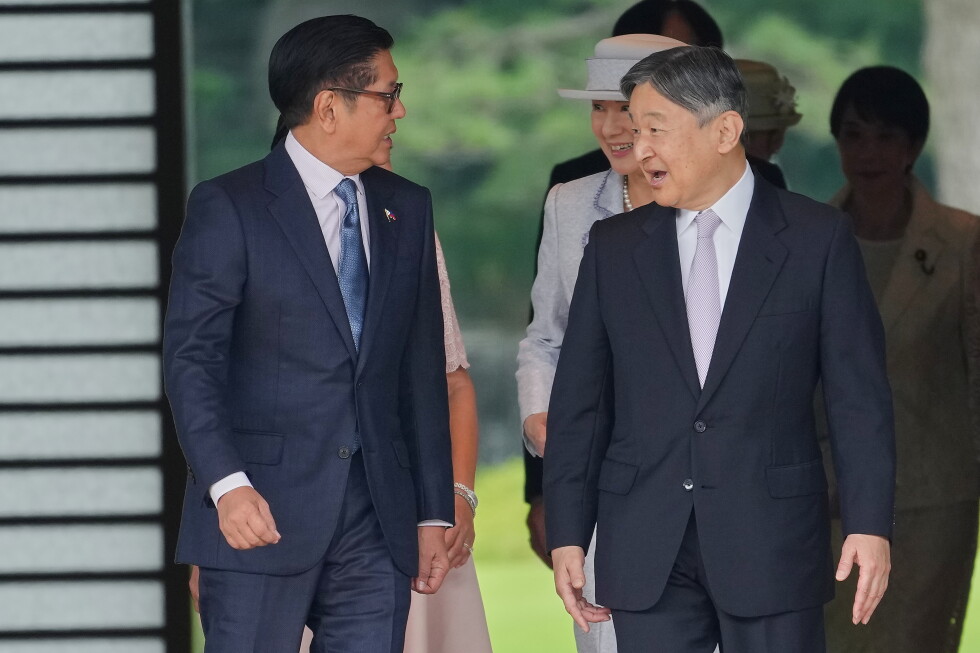
During a high-stakes four-day state visit to Tokyo that wraps up this week, Philippine President Ferdinand Marcos Jr. has been greeted with extraordinary diplomatic hospitality, underscoring Japan’s urgent push to deepen strategic and defense cooperation with the Southeast Asian nation at a moment of growing concern over Chinese military activity across the Indo-Pacific.
The visit, which will conclude with Marcos’s departure on Friday, has already included a formal audience with Japanese Emperor Naruhito, who conferred the Grand Cordon of the Supreme Order of the Chrysanthemum — one of Japan’s most prestigious national honors — on the Philippine leader. A state banquet hosted at the imperial palace capped off the first three days of engagements, ahead of key formal talks Thursday between Marcos and Japanese Prime Minister Sanae Takaichi.
Analysts and government officials frame the warm welcome as a clear signal that Japan views the Philippines as a critical defense partner and a landmark client for its emerging defense export industry, following Tokyo’s historic break from decades of postwar pacifist policy earlier this year. In April, Takaichi’s administration lifted a long-standing ban on lethal weapons exports, opening the door for Japanese defense manufacturers to sell military hardware to international buyers for the first time, and Marcos is positioned to be the first head of state of a major prospective client nation to visit since the policy shift.
Already, the two countries have launched negotiations for the sale of multiple retired Abukuma-class destroyers and TC-90 training aircraft from the Japanese Maritime Self-Defense Force. Philippine Defense Secretary Gilberto Teodoro Jr. has also publicly confirmed Manila’s interest in acquiring Japanese Type-88 surface-to-ship missiles, after he joined his Japanese counterpart to observe joint bilateral live-fire exercises earlier this month.
On the diplomatic agenda for Thursday’s bilateral summit, the two leaders are set to finalize frameworks that will further deepen defense and weapons industrial cooperation, alongside progress on a formal military intelligence-sharing agreement. Japanese government sources note that the intelligence pact will streamline secure communication between the two defense forces and strengthen trilateral security coordination with the United States, a mutual ally of both nations. This cooperation builds on existing security assistance: Japan has already donated five coastal surveillance radars to the Philippines to boost maritime monitoring capabilities, a capability that would be further enhanced by formal intelligence sharing.
The deepening security alignment between Tokyo and Manila comes with a shared focus on countering growing Chinese assertiveness in the East and South China Seas, as well as stability around Taiwan — the self-governing island that Beijing claims as its sovereign territory. The United States has repeatedly welcomed closer bilateral defense ties between Japan and the Philippines, framing the partnership as a key bulwark to defend regional rules-based order against Chinese expansion.
Marcos echoed the warm tone of the visit during an address to Japanese lawmakers Wednesday, noting that the push to elevate bilateral relations to a new strategic level reflects an “exceptional level of trust” between the two countries. Since taking office, Marcos has taken a firm public stance against Chinese territorial claims in disputed areas of the South China Sea, a sharp shift from the more conciliatory policy pursued by his predecessor Rodrigo Duterte. Japan’s leadership is eager to lock in long-term strategic cooperation with Manila that outlasts Marcos’s presidency, which ends in 2028, to avoid the policy flip-flops on China that have marked past Philippine administrations.
The past year has already seen rapid progress in bilateral defense cooperation: in 2024, the two sides signed a visiting forces agreement that allows military personnel from each nation to easily enter the other to conduct joint training exercises, clearing the way for Japan to deploy 1,400 troops to regular joint drills in the region. A second supplemental defense pact signed this year streamlines logistics support for joint training, allowing for tax-free transfers of ammunition, fuel, food and other essential supplies for participating forces.
Beyond defense cooperation, the summit will also address pressing regional energy security challenges. The two leaders are set to discuss details of a Japanese-led multinational infrastructure funding framework launched in April, which is designed to help Southeast Asian nations including the Philippines build out strategic oil reserve infrastructure. The initiative comes in response to ongoing market and supply disruptions caused by the Iran war, which has severely disrupted oil shipments through the Strait of Hormuz, a critical global chokepoint for energy trade.
Japanese officials also note that the state visit coincides with two key diplomatic milestones: 2024 marks the 70th anniversary of formal diplomatic relations between Japan and the Philippines, and the Philippines currently holds the rotating annual presidency of the Association of Southeast Asian Nations (ASEAN), positioning Tokyo to deepen its engagement with the broader regional bloc through its relationship with Manila.