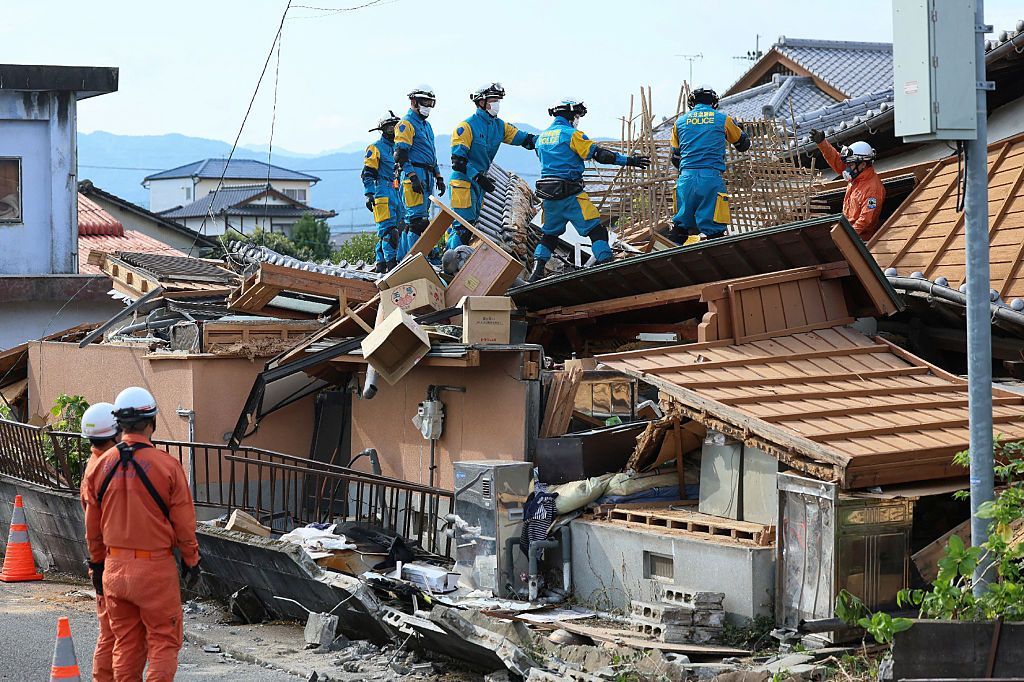
Just two days after a magnitude 6.8 shallow earthquake rocked Japan’s southwestern Kumamoto prefecture on Kyushu Island, local authorities confirmed Thursday that the death toll from the disaster has climbed to 28. The 10-kilometer-deep tremor left a trail of widespread destruction across the region, leveling residential structures, severing critical power infrastructure, and displacing thousands of local residents.
Among the hardest-hit sites is the Aeon shopping mall in Kashima, where a partial second-floor collapse killed multiple people. Roughly an hour after the initial quake, a sudden explosion ripped through the already damaged building complex, compounding casualties and damage. Aeon’s top leadership has stated that a gas leak is the most probable cause of the secondary blast, though official investigations into the incident are still ongoing. In a small bright spot amid the devastation, all 25 cats housed at a cat cafe inside the mall—left stranded when the structure failed—were pulled out alive by rescuers this week. In a tragic coincidence, the mall had only just reopened last month after a complete renovation, following severe damage it sustained in the deadly 2016 Kumamoto earthquake sequence that claimed 278 lives across the region.
Another major site of tragedy is a Nippon Paper manufacturing facility in Yatsushiro city, where a partial collapse killed at least five workers. The company confirmed Wednesday that 11 employees were trapped when the building caved in, and seven of those trapped people have been successfully pulled from the rubble as of Thursday.
As of Wednesday, official data puts the number of displaced residents staying in government-run evacuation centers at roughly 9,000, while more than 30,000 households across the prefecture remain without access to electricity. Compounding the challenges facing survivors and first responders, the region is currently in the grip of an extreme heatwave, with forecasts predicting temperatures could climb as high as 39 degrees Celsius in the coming days. Heatstroke has already emerged as a major secondary risk, with public officials repeatedly urging both survivors and rescue workers to take frequent breaks and stay hydrated. To address the cooling crisis at evacuation sites, Japanese Defense Minister Shinjiro Koizumi announced Wednesday that 300 portable air conditioning units would be shipped to the prefecture immediately, half of which will go directly to emergency shelters.
More than 100 aftershocks have rattled the region since the main tremor, leaving many survivors too nervous to return to damaged or structurally compromised buildings. Many locals have even opted to sleep in their vehicles parked in open areas rather than risk being inside during a new tremor.
Thousands of emergency personnel have been deployed across Kumamoto to lead search-and-rescue operations, digging through collapsed rubble in a race to find any remaining survivors trapped after the quake. For 75-year-old Yatsushiro restaurant owner Hiroko Ogata, the power of the tremor was unlike anything she had experienced in her decades living in the region. “I hid under my restaurant table when the quake hit, and I was swaying violently back and forth along with it,” she told reporters. “I’ve lived here 75 years, and I’ve never felt an earthquake this big. I really thought I was going to die.”