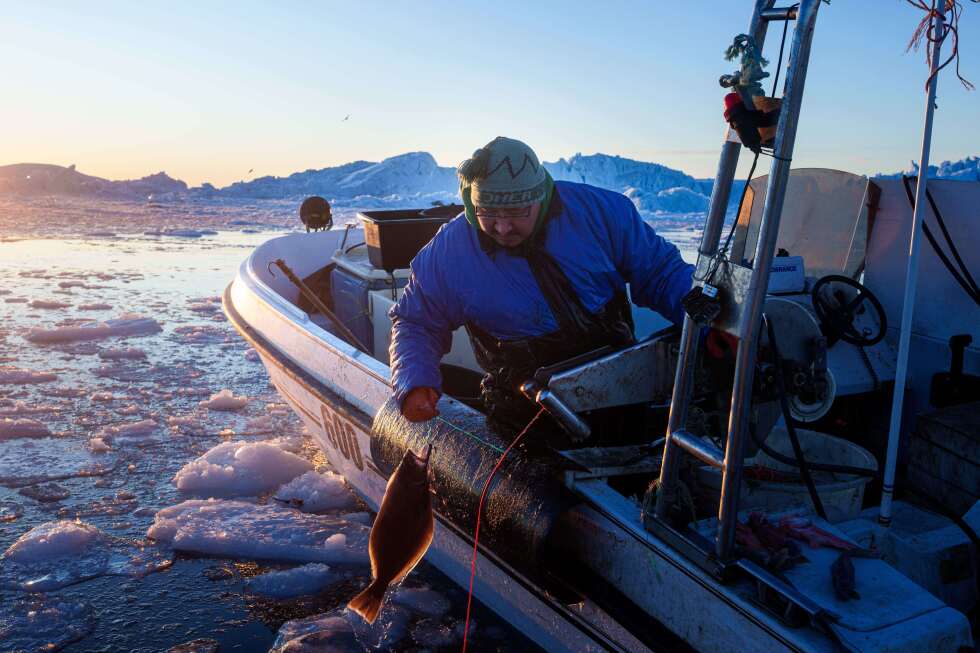
ILULISSAT, Greenland — For Helgi Áargil, a seasoned fisherman navigating Greenland’s majestic fjords, the rhythms of his profession have become increasingly erratic. Accompanied only by his dog Molly and the shimmering northern lights, Áargil now faces unprecedented uncertainty in waters that have sustained generations. His recent experiences encapsulate the broader crisis: last year, his vessel became trapped in dislodged glacial ice; this season, unusually wet conditions have dominated.
The Arctic region is warming at approximately twice the global average rate, fundamentally transforming the environmental conditions that have long dictated fishing patterns. This semiautonomous Danish territory, which garnered international attention following former U.S. President Donald Trump’s expressed interest in purchasing it, now confronts a more pressing challenge: the climatic disruption of its economic backbone.
Fishing constitutes up to 95% of Greenland’s exports, with China serving as its primary market alongside the United States, Japan, and European nations. The industry’s future remains uncertain as marine ecosystems undergo rapid transformation.
The most dramatic changes affect traditional ice fishermen, who represent approximately half of the local industry. Karl Sandgreen, director of the Ilulissat-based Icefjord Center which documents regional climate change, recalls when fishermen worked atop sea ice measuring 1.5 meters thick. That ice began disappearing around 1997, forcing a transition from ice-based to boat-based fishing.
While boats provide access to larger fishing areas, they introduce new complications including increased operational costs, pollution contributing to further warming, and potential overfishing. Toke Binzer, CEO of Royal Greenland (the territory’s largest employer), describes the current dilemma as balancing between “too much ice to sail, too little to go out on”—a paradox that has already created significant operational challenges.
The company supports traditional fishermen through boat financing programs, with repayments deducted from future catches. However, ecological shifts are manifesting in concerning ways: halibut are decreasing in size, a classic indicator of overfishing according to marine biodiversity expert Boris Worm of Canada’s Dalhousie University.
Worm notes that retreating ice could theoretically increase fish stocks by delivering more nutrients through melted ice and rainfall, boosting plankton populations. However, fish behavior is becoming less predictable as species seek new food sources amid disappearing sea ice algae.
For fishermen like Áargil, the changes are immediately tangible. Warmer waters are driving fish to deeper, colder depths, making traditional catches increasingly elusive. “It’s too warm,” he observes, gazing across the fjord. “I don’t know where the fish is going, but there’s not so much.”
With limited economic alternatives—tourism remains underdeveloped—and cultural traditions like dog sledding already compromised by absent sea ice, Greenland faces complex challenges. In Nuuk alone, over 1,000 fishing boats crowd the harbor during summer months, highlighting the industry’s centrality for a territory with just over 50,000 inhabitants.
The transformation of Greenland’s fishing industry represents both an economic recalibration and a cultural watershed, as climatic forces reshape one of the world’s most vulnerable ecosystems.