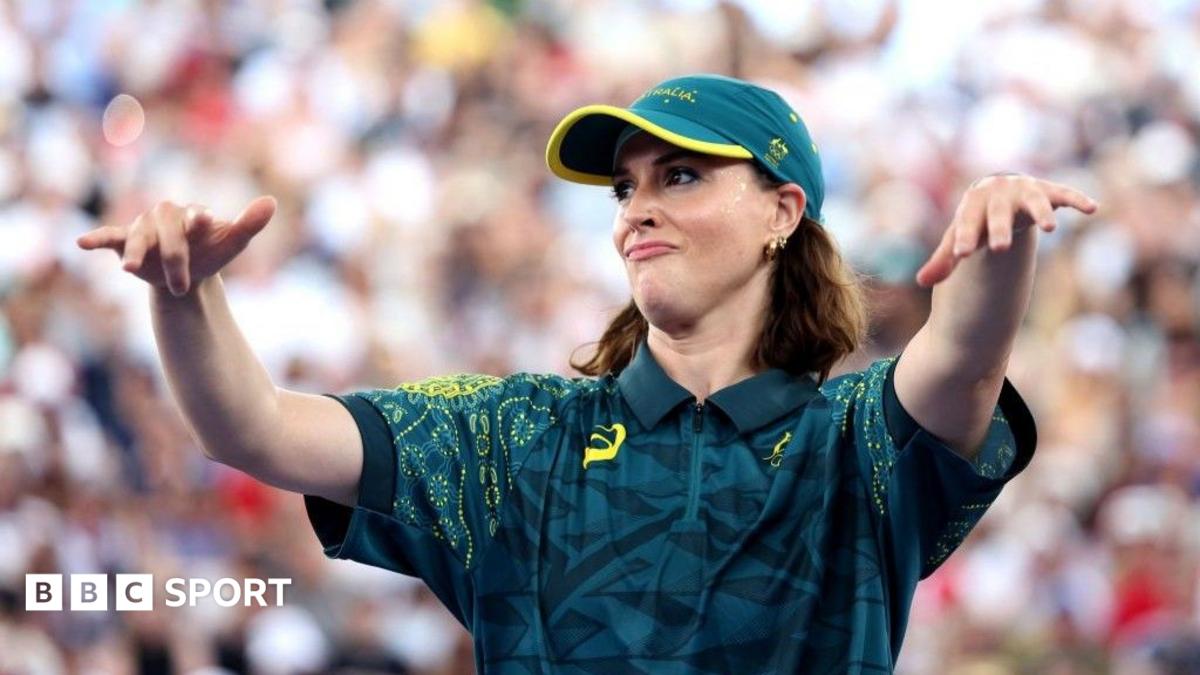
In the summer of 2024, breaking made its long-awaited debut as an official medal sport at the Paris Olympic Games, and one unexpected Australian competitor became the center of a global firestorm that extended far beyond the dance floor. 38-year-old Rachael Gunn, known professionally to the breaking community as Raygun, is far from a typical elite Olympic athlete: by trade, she is a university lecturer, who only stepped into full-time athletic training months before the Games.
Gunn’s Olympic journey was fraught with personal struggle long before she stepped onto the Paris competition stage. Just hours before she marched alongside the Australian delegation in the Paris opening ceremony, the weight of her unexpected opportunity crashed down on her as she walked through the Olympic village, surrounded by some of the most experienced competitive athletes in the world. In an upcoming Netflix documentary chronicling her Games experience, Gunn recalled the overwhelming moment that left her questioning her place at the event.
“I felt like an imposter,” Gunn shared in the film. After spotting a familiar Australian team member, she was unable to control her panic. “I just could not stop crying… I had a panic attack. ‘What am I doing? What have I done? Should I be doing this?’” Within hours, she had pulled herself together to sail down the River Seine in the opening ceremony parade, waving to crowds of spectators lining the riverbanks.
Less than two weeks later, Gunn’s competitive run at the Paris Games came to an end. She failed to secure a win in any of her three round-robin battles, but the athlete said she left the competition proud of how she showed up. When she finished her final routine, reigning world champion Dominika “Nicka” Banevic publicly praised her movement, the event emcee celebrated her performance, and the overall atmosphere in the arena was overwhelmingly positive, she told BBC Sport.
What Gunn could never have anticipated was that her signature routine, which featured playful, unconventional moves including a sprinkler and a kangaroo hop that paid homage to her Australian identity, would spread like wildfire across global social media. The clip of her performance spawned thousands of memes, earned a parody spot on *The Tonight Show Starring Jimmy Fallon*, was referenced by global pop star Adele during one of her concerts, and drew a public show of support from Hollywood star Chris Hemsworth during an interview on *Jimmy Kimmel Live!*. Even Australian Prime Minister Anthony Albanese stepped forward to publicly praise Gunn for taking the once-in-a-lifetime opportunity and giving it her all.
“It was pretty wild the way I became a topic of conversation in spaces I never thought I would be,” Gunn said of the sudden global attention.
Beneath the lighthearted viral attention, however, a darker wave of harassment and misinformation began to spread online. Baseless conspiracy theories emerged claiming nepotism had secured Gunn her Olympic spot, falsely alleging that her husband and personal trainer Samuel Free had sat on the national selection committee that approved her spot on the Australian team – a claim that was entirely untrue. “It was really tough when mine and Sammy’s credibility, ethics and motivations were being called into question,” Gunn said. “You could just spend 30 seconds researching and find plenty of sources to debunk these conspiracies, but that’s not how people use the internet anymore.”
The unrelenting scrutiny and online trolling took a severe toll on Gunn’s mental health. “I felt like my whole life was just kind of crumbling before me… and I was just trying to get through the day,” she says in the documentary. But working with filmmakers to chronicle her experience has helped her regain control of her story after months of being defined by online criticism. “It’s taken a long time for me to process what happened,” Gunn told BBC Sport. “It’s really exciting for me to finally have a voice again.”
Gunn’s path to Paris began after breaking was confirmed for the 2024 Games, when she secured her spot on the Australian team by winning qualification at the 2023 Oceania Breaking Championships in Sydney. “I’ve never participated in anything of such high stakes before. It was all international judges, but I was relieved and excited when I qualified. And then the next whirlwind happened,” she recalled.
After qualification, Gunn quickly made the decision to adapt her life to meet the demands of Olympic competition, something she had never done before. In February 2024, she earned a scholarship from the New South Wales Institute of Sport, which allowed her to begin a structured strength and conditioning program. “That was great, but also overwhelming because I was training with people who had been doing that stuff since they were kids,” she noted.
The documentary also uncovers additional personal struggles Gunn navigated during her pre-Games training: her mother suffered three separate brain aneurisms while she was preparing for competition, and Gunn began taking anti-depressants to manage chronic anxiety. As she competed in pre-Olympic qualifying events, she began to fully grasp the scale of the challenge she had taken on, competing against athletes who had trained at the highest level for decades. Even so, she committed to stepping onto the Olympic floor and giving her best performance.
With that context, Gunn made a deliberate creative decision to lean into her unique strengths rather than trying to match her competitors’ elite athleticism. She designed a routine that leaned into creativity – one of the official judging criteria for Olympic breaking – that leaned into playful, distinctly Australian flair. “I was aware that I was never going to beat my competitors on athleticism,” she explained. “For me, my strength is creativity. With that being one of the [judging] criteria, our thinking was, ‘why don’t we put all our eggs in that basket and really try and wow them? Maybe we can make a moment.’ We never, ever expected the impact it might have.”
The documentary also reveals that limited support was available to Gunn during her training: Lowe Napalan, head of the Australian Breaking Association, only worked with Gunn a handful of times before the Games, as he was overwhelmed by administrative duties for the new Olympic program. That meant Napalan saw Gunn’s viral routine for the first time when she stood side-stage waiting to compete in Paris. “I had to not have a face of shock,” Napalan admitted in the film.
In late 2024, multiple reports claimed that the controversy surrounding her Olympic performance had pushed Gunn to quit breaking entirely. She is quick to correct that false narrative. “I don’t know where that came from,” Gunn said. “I wouldn’t let what happened take dancing away from me. I love breaking, I’ll always break, I’ll always be a part of the community.”
Now, Gunn hopes her upcoming documentary will help reframe the conversation around her Olympic experience, allowing her to move forward after a year of turmoil. “It feels nice to lay it all out there and now be able to look to the future. I’m actually excited about what’s to come, which is the first time for a while,” she said. For anyone struggling with the mental health impacts of online harassment, support resources are available via the BBC Action Line.