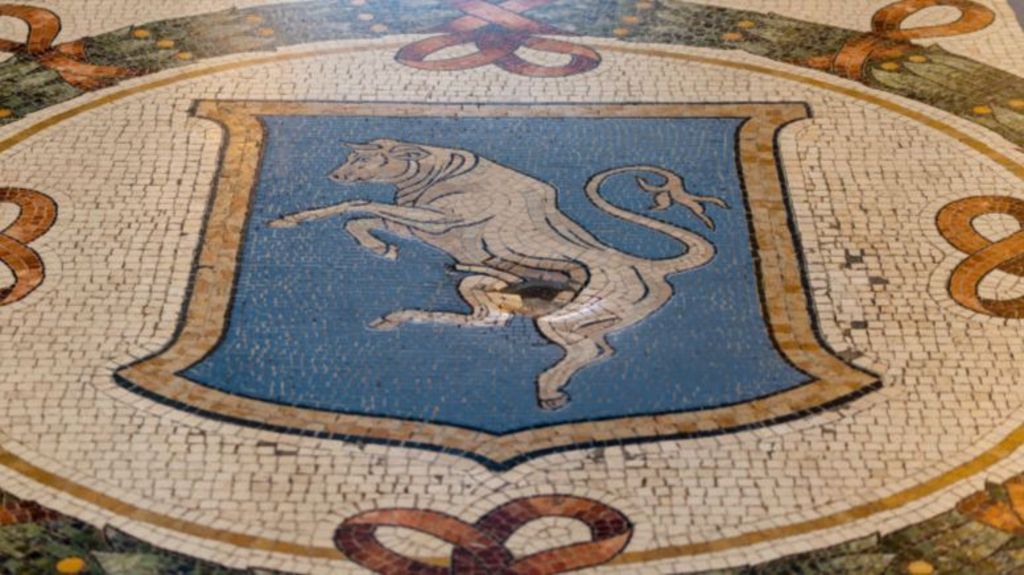
Deep in the heart of Milan’s iconic 19th-century Galleria Vittorio Emanuele II, one of Italy’s most beloved cultural landmarks is finally getting a lifeline. The historic prancing bull mosaic, a symbolic emblem of Italy’s first capital Turin, has fallen victim to generations of a charming but destructive tourist tradition, prompting local authorities to launch a full restoration project this week.
For more than a century, a folk legend has drawn millions of visitors to the floor-mounted artwork: tourists who twist three times on the spot with their heel pressed against the bull’s genital area are said to receive good fortune and a guaranteed return trip to Milan. What started as a local custom popular among 19th-century Milanese has evolved into a must-do ritual for casual travelers, with thousands of visitors repeating the grinding spin every single day.
This constant friction has taken a severe toll on the centuries-old artwork. Years of repeated contact have carved a noticeable crater into the mosaic’s sensitive “lucky spot”, where the soft pink tiles that form the bull’s testicles have slowly worn away to almost nothing. This is not the first time the landmark has needed repair: the last full restoration effort was carried out back in 2017, but the unrelenting stream of participating visitors has required another intervention just under a decade later.
Work got underway earlier this week, with a small protected work zone erected around the mosaic to allow master artisan Gianluca Galli to carry out careful, hands-on repairs. Onlookers gathered around the site to watch Galli kneel over the artwork, hand-cutting replacement stone tiles to match the original work and patch the eroded area.
In an interview with AFP, Galli acknowledged the charm of the centuries-old tradition while noting its unavoidable impact on the fragile artwork. “It’s probably a charming gesture, but also quite damaging for a work of art,” he explained.
Local city councillors Emmanuel Conte and Marco Granelli framed the restoration as a balancing act between preserving living heritage and accommodating the public’s deep affection for the landmark. “The Galleria is a living heritage, which can wear away precisely because it is loved and experienced: we take care of it so that it continues to be so,” they shared in an official statement. The project aims to fully restore the mosaic to its original 19th-century glory, ensuring it can be enjoyed by future generations of visitors who come to seek their luck at the famous landmark.