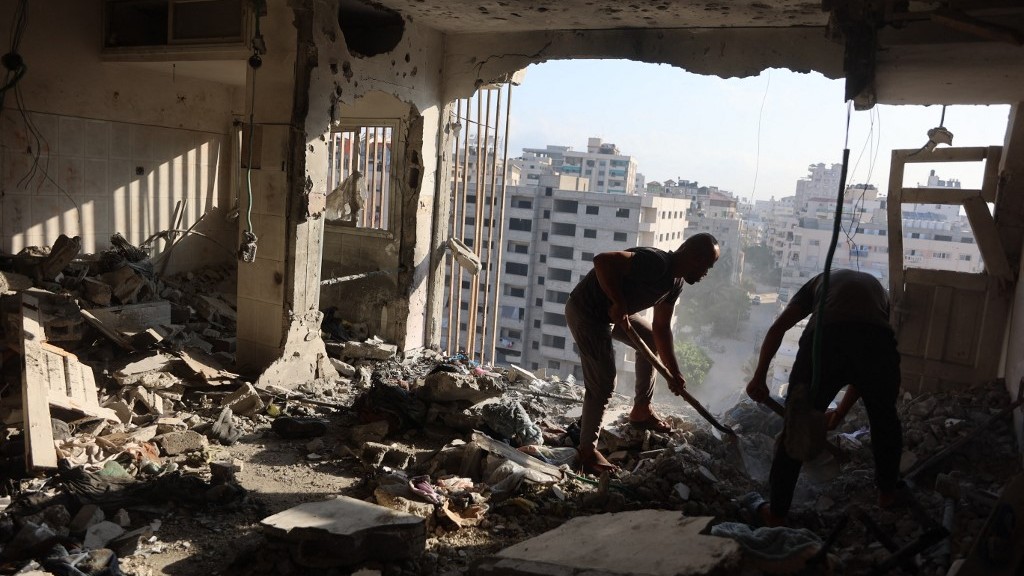
In a stark interview that has drawn international attention, retired Major General Giora Eiland, a former leader of Israel’s National Security Council, has publicly advocated for keeping the Gaza Strip in ruins for decades, framing widespread Palestinian destruction and collective despair as a core strategic goal for Israel in the aftermath of its year-long military campaign in the enclave.
Speaking to Israel’s 103FM radio station on Sunday, Eiland argued that any large-scale reconstruction of Gaza runs directly counter to Israeli national interests. “Israel has no interest in Gaza being rebuilt,” he stated. “It is better for us that it be destroyed for generations to come. The greater the despair in Gaza and the greater the destruction, and the greater the monument to what they did on October 7, years to come, that is good.”
A secular Israeli nationalist affiliated with opposition politician Avigdor Lieberman, Eiland has long been a political opponent of incumbent Prime Minister Benjamin Netanyahu. Even so, his policy prescriptions for Gaza go far beyond the positions Netanyahu has publicly outlined to the international community.
Eiland also waded into the debate over U.S. President Donald Trump’s 15-point proposal for Gaza, labeling the plan “pro-Hamas” — a description that aligns with Netanyahu’s formal rejection of the proposal issued Sunday. Drawing a parallel to post-World War II Germany, where the defeated nation ceded 25% of its pre-war territory, Eiland argued Israel should permanently hold the so-called Yellow Line, a boundary marking Israeli military-occupied territory inside Gaza. Israeli forces have steadily expanded this zone of control in recent months, with current occupied territory estimated to cover as much as 70% of Gaza’s total land area. Eiland emphasized that holding this territory is non-negotiable, framing it as a critical security buffer rather than a base for civilian settlements: “Along with this, there is the territorial need for the Yellow Line, which we must not give up under any circumstances. This is a war, the enemy has lost, and we need land, not for settlement, but as a security buffer between the settlements and where the IDF can be located.”
Beyond his stance on Gaza’s future, Eiland leveled sharp criticism at Netanyahu’s management of Israel’s relationship with the United States, arguing that the Israeli government has become overly reliant on the personal rapport between Netanyahu and Trump, a dynamic he described as unstable. “I believe Israel’s entire approach towards the US in recent years has been outrageous,” he said. “It relies excessively on the personal relationship between Netanyahu and Trump, which is good on some days and less so on others.”
Instead of an outright rejection of the U.S. plan, Eiland advised Netanyahu to take a more tactical approach: accept the proposal on paper while conditioning approval on protections for Israel’s core strategic demands. “Where did Netanyahu go wrong in my opinion? You should never say no, you should always say yes but… or yes in the sense of I agree if certain points happen,” he explained. He added that Israel could offer a temporary suspension of targeted assassinations in Gaza as a tactical gesture to Washington, while refusing to cede control of the Yellow Line occupied zone.
Eiland’s controversial comments come as violence persists in Gaza even under the current ceasefire framework that took effect in mid-January 2025. Local health sources report that since the ceasefire began, Israeli forces have killed at least 1,258 Palestinians and injured more than 4,100 others. Earlier this week, the United Nations Children’s Fund (UNICEF) confirmed that at least 300 children have been killed by Israeli forces in Gaza over the past 10 months. Since the start of Israel’s military campaign on October 7, 2023, the campaign has killed at least 73,386 Palestinians and left more than 174,250 others wounded, according to local health authorities.