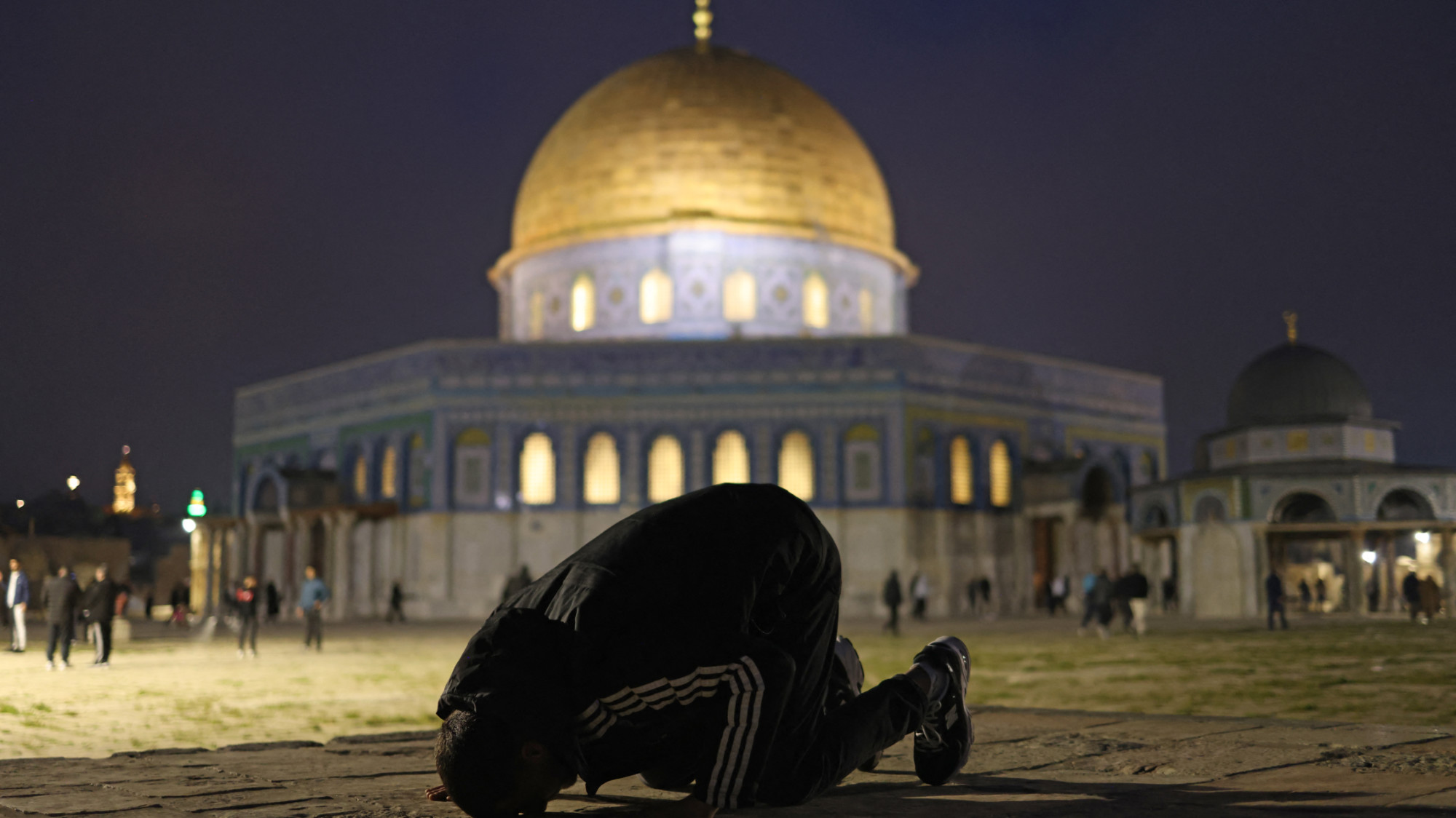
One of Islam’s most sacred religious sites, Al-Aqsa Mosque in occupied East Jerusalem, has reopened its gates to Palestinian worshippers after an extraordinary 41-day closure ordered by Israeli authorities, a shutdown that spanned the major Muslim holidays of Ramadan and Eid al-Fitr.
When the first dawn Fajr prayer was held on Thursday morning, more than 3,000 Palestinian worshippers gathered inside the mosque’s sprawling courtyards to worship for the first time since the joint US-Israeli assault on Iran began on February 28. Viral footage circulated on social media captured jubilant crowds streaming through the reopened gates, their relief and joy palpable after the weeks of forced exclusion. Preparations for the reopening had begun days earlier, with volunteer teams and mosque custodians working to clean and restore the site ahead of worshippers’ return.
Israeli officials have justified the total closure, which blocked all Palestinian Muslim access even for weekly Friday prayers, by citing security risks tied to the conflict with Iran. But Palestinian leaders and community members have openly questioned this justification, pointing out that Israeli authorities allowed large-scale gatherings for Jewish religious holidays were permitted to proceed elsewhere in the region throughout the closure. Many Palestinians argue Israel is using the war on Iran as a cover to tighten its unilateral control over the site, altering longstanding rules governing access, opening hours, and permitted religious activities.
Al-Aqsa Mosque, located within Jerusalem’s walled Old City, has been governed for decades by the international Status Quo agreement, a framework that explicitly recognizes the site’s Islamic identity and grants exclusive authority to Muslim religious bodies for all matters of access, worship, and site maintenance. However, this longstanding arrangement has been repeatedly eroded by Israeli actions, including frequent incursions and unauthorised prayer by ultranationalist Jewish groups, carried out under armed Israeli police protection. The international community almost universally considers Israel’s 1967 annexation and ongoing occupation of East Jerusalem, including the Old City, as a violation of international law, which holds that occupying powers cannot claim sovereignty over captured territory and are barred from imposing permanent structural changes.
The developments following the mosque’s reopening have already raised fresh alarms about escalating Israeli changes to the site. Within hours of worshippers completing Thursday’s dawn prayer, Israeli authorities allowed a new expanded schedule of daily incursions by ultranationalist groups, extending the total daily duration of these visits. On the first day of reopening, dozens of ultranationalist visitors entered the site shortly after 6:30 a.m. local time, immediately after Palestinian worshippers were cleared from the area. Video footage shows the visitors conducting unauthorised prayers and dances inside the mosque compound, surrounded by a heavy detachment of armed Israeli police.
The practice of regular, guarded incursions traces back to 2003, during the Second Palestinian Intifada, and was formalized in 2008 when a limited morning visits of up to three hours were institutionalized. Over the following decades, both the number of participants and the duration of daily visits have grown steadily. Before the recent closure, incursions were split into two daily shifts on weekdays: 7:00 a.m. to 11:00 a.m., and 1:30 p.m. to 2:30 p.m. Under a new schedule approved prior to the February assault on Iran, incursions now run from 6:30 a.m. to 11:30 a.m. and 1:30 p.m. to 3:00 p.m., totaling six and a half hours of daily access for ultranationalist groups, a major expansion from prior arrangements.
The Jerusalem Governorate has condemned the extended incursion schedule as a dangerous escalation that further undermines the fragile Status Quo agreement. In an official statement following the reopening, the Governorate noted: “The extension reflects an acceleration in efforts to impose new realities at Al-Aqsa Mosque and entrench time-based division, particularly following its reopening after a 40-day closure.”
This report was originally published by independent outlet Middle East Eye, which specializes in original coverage of the Middle East and North Africa region.