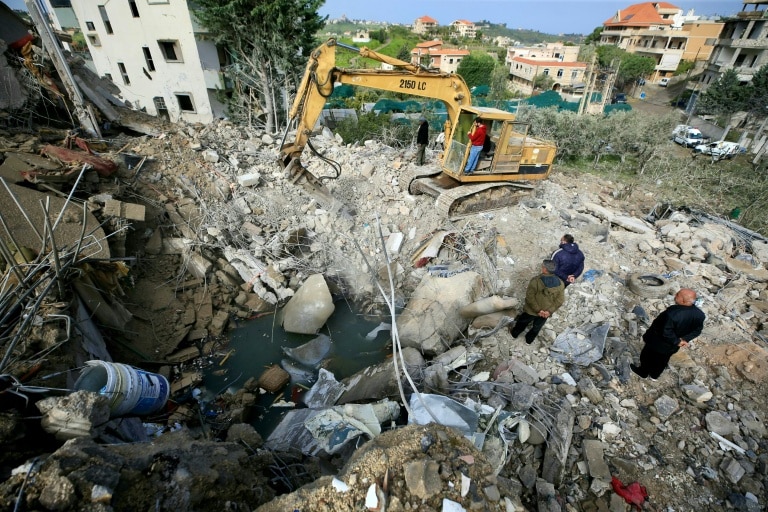
A new wave of deadly Israeli airstrikes across Lebanon on Sunday left at least 15 people dead, one day after Israeli threats targeting the Masnaa crossing—Lebanon’s primary land gateway to Syria—forced the vital trade and transit point to shut down.
The escalation marks an intensification of months of open conflict that began on March 2, when the Lebanese armed group Hezbollah joined the broader Middle East war in support of its principal backer, Iran. Since that date, Israel has conducted sustained airstrikes across Lebanese territory and launched a ground invasion into southern Lebanon. On Sunday, Israeli military chief Lieutenant General Eyal Zamir visited frontline troops stationed in southern Lebanon and publicly reaffirmed his commitment to ramp up offensive operations against Hezbollah.
The Lebanese Ministry of Health confirmed that Sunday’s strikes spread far beyond the contested southern border zone, reaching population centers near the capital Beirut. A strike on Beirut’s Jnah neighborhood killed at least five people and wounded 52 others, while an attack on an apartment building in Ain Saadeh, a town just east of the capital, left three dead and three more injured. In the southern Lebanese village of Kfar Hatta, located far from the Israeli border, a Sunday strike killed seven people, including a four-year-old girl.
In a rare offensive claim Sunday, Hezbollah announced it had launched a cruise missile against an Israeli warship patrolling off the Lebanese coast. But the Israeli military told Agence France-Presse (AFP) it had no record of such an incident occurring.
According to official Lebanese data, more than 1,400 people have been killed in Israeli attacks across Lebanon since the outbreak of the latest conflict, 126 of whom are children. Over one million Lebanese have been displaced by the violence.
Medical sources told AFP that the Jnah neighborhood strike landed just 100 meters from Rafik Hariri University Hospital, Lebanon’s largest public medical facility. Zakaria Tawbeh, the hospital’s deputy head, said the facility received four fatal casualties – three Sudanese nationals and a 15-year-old girl – plus 31 wounded patients. “Lots of glass was broken, and some of our patients had panic attacks,” Tawbeh told reporters.
For local residents, the strikes represent a repeated cycle of trauma. Nancy Hassan, a 53-year-old Jnah resident, said she believed she would be safe in her home after the first strike of the day. “Shortly after, the planes were flying overhead, and we heard a huge bang, then stones rained down on us,” she recalled. Hassan already lost her 23-year-old daughter to an Israeli strike on the same neighborhood during the 2024 Hezbollah-Israel war, and four of her daughter’s friends were killed in Sunday’s attack. “Every time, they bomb us in the neighbourhood without warning,” she added.
Israel also carried out multiple strikes on the southern suburbs of Beirut, a Hezbollah stronghold that has been almost entirely evacuated in recent months. The United Nations Interim Force in Lebanon has issued a warning that exchanges of fire between Israel and Hezbollah near UN peacekeeping positions raise the risk of accidental retaliatory attacks on UN personnel.
The closure of the Masnaa border crossing followed explicit Israeli threats made Saturday. Israeli military Arabic-language spokesman Avichay Adraee said the crossing would be targeted because Hezbollah uses it for military activity and to smuggle weapons and combat equipment, urging all civilians to evacuate the area immediately. The Lebanese side of the crossing was evacuated within hours. While Syrian border and customs director Mazen Aloush emphasized the crossing is used exclusively for civilian travel and trade, it was temporarily shuttered in response to the imminent threat.
Masnaa is a critical economic artery for both Lebanon and Syria, and a key travel hub for Lebanese residents seeking access to the broader Middle East. Military analyst Hassan Jouni told AFP that Israel’s threat to target the crossing is not rooted in legitimate security concerns, but instead is intended to pressure the Lebanese government to take action to disarm Hezbollah.
With Masnaa closed, travelers have flooded alternative border crossings. At the northern Qaa crossing, an AFP correspondent on Sunday observed long lines of cars and vans waiting to cross into Syria, as people sought alternate routes to reach their destinations.
As Israeli forces push deeper into southern Lebanese border areas, destroying entire villages in their advance, Lebanese President Joseph Aoun has repeated his call for diplomatic negotiations with Israel to avert full-scale destruction similar to that seen in the Gaza Strip. “Why don’t we negotiate… until we can at least save the homes that have not yet been destroyed?” Aoun said in a televised address to the nation.