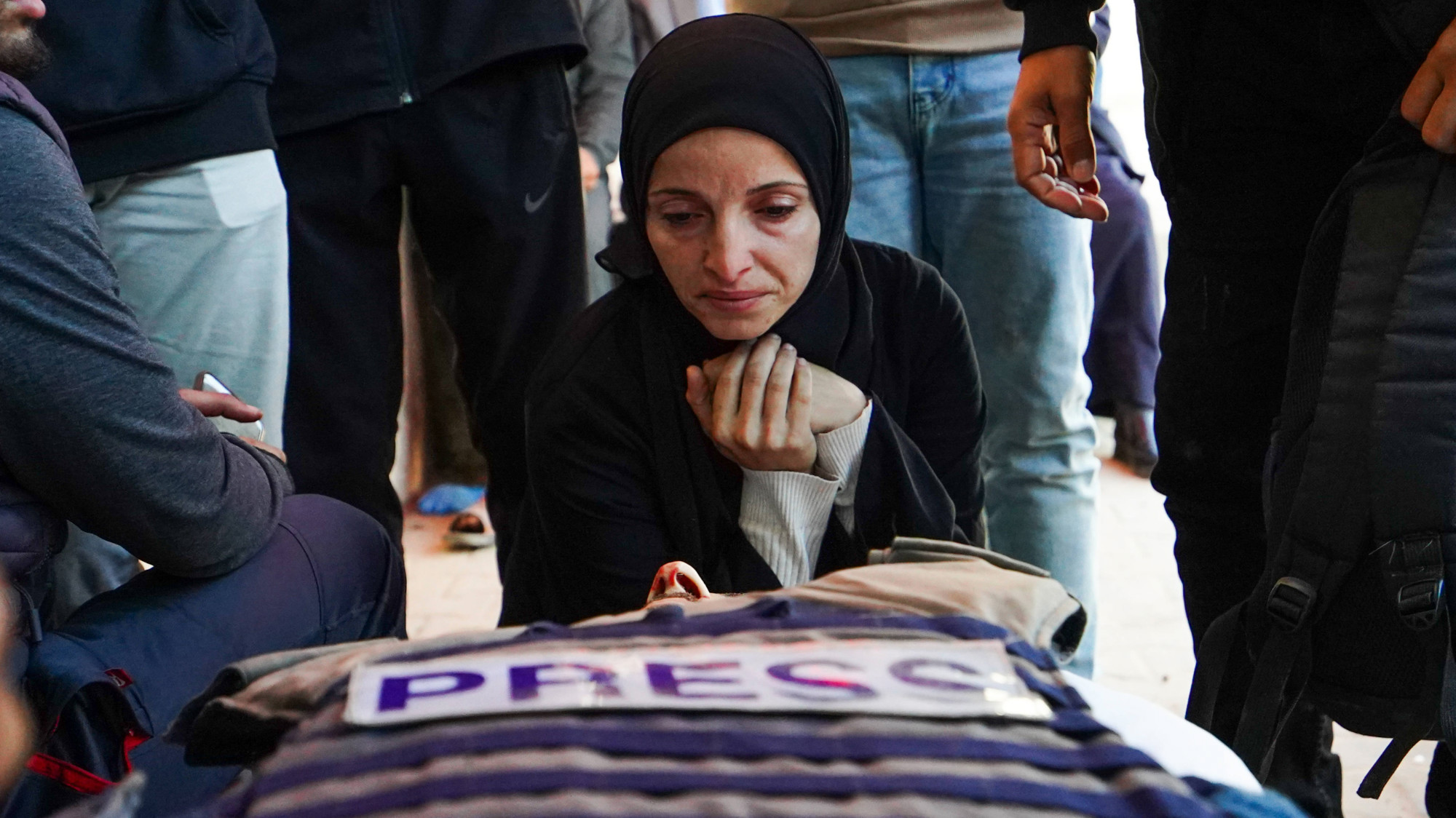
On a Wednesday in Gaza City, a 40-year-old Palestinian journalist became the latest media worker killed by Israeli forces in a controversial double-tap drone strike that has reignited global outrage over the targeting of reporters in the besieged enclave. Mohammed Samir Wishah, a veteran correspondent for Al Jazeera Mubasher, was en route with a colleague to cover a humanitarian story when the first strike hit his personal vehicle, igniting it in flames. According to eyewitnesses and first responders who spoke to witnesses on the ground, the deadly incident followed a disturbing pattern common to Israeli strikes in Gaza: a second attack launched minutes after the first, when emergency crews and local residents had gathered to evacuate casualties.
“The vehicle was hit the first time and caught fire. When civil defence teams and ambulances arrived, clearly marked and with medical personnel present, the site was targeted again,” a paramedic who arrived at the scene shortly after the attack stated in a widely circulated social media video. He added that the bodies of those killed were left charred by the repeated blasts, and roughly 10 to 20 bystanders and first responders were injured in the second strike.
A native of the Bureij refugee camp in central Gaza, Wishah had built a reputation over more than a decade of reporting for his focus on underreported humanitarian stories in the territory. Colleagues confirmed he was carrying standard press equipment including his microphone when the strike hit, and had worked for Al Jazeera Mubasher since 2014. Due to the Israeli-imposed fragmentation of Gaza’s geographic areas during the ongoing conflict, Wishah had worked alone to cover all events in the central Gaza Strip, making him a well-known and trusted voice for local audiences.
Months before his killing, colleagues say Wishah was the target of a coordinated Israeli incitement campaign amid his ongoing coverage of the conflict in Gaza. In February 2024, Israeli army Arabic-language spokesperson Avichay Adraee published images on the social platform X claiming to prove Wishah’s affiliation with Hamas, labeling him a member of the armed group. A further accusation came in June 2025 from Hadeel Oueis, editor-in-chief of Jusoor News – an outlet Palestinian journalists widely allege has ties to Israeli intelligence – who claimed Wishah was secretly a member of the Qassam Brigades. Israeli writer Edy Cohen amplified the post with a public “appeal and warning.”
Colleagues have refuted all these claims, explaining that the images showing Wishah in military-style clothing were taken during production of a journalistic documentary. Wishah himself publicly challenged any party to produce evidence of armed affiliation, and Israel never released concrete proof to back up its allegations. “He was subjected to an incitement campaign launched by some social media pages affiliated with the Israeli occupation,” said Talal Mahmoud, a fellow Al Jazeera Mubasher reporter. “But he continued his work regardless; he did not hesitate for a moment to continue delivering his message.”
Shortly after Wishah’s death was confirmed, Adraee released a statement endorsing the strike, repeating the unproven claim that “Wishah was not a journalist, but a Hamas terrorist in every sense of the word.”
The killing of Wishah marks a grim milestone for press freedom in Gaza: he is the seventh Palestinian journalist killed by Israeli forces since a ceasefire agreement took effect in October, and brings the total number of journalists killed in Gaza since the start of the current conflict in October 2023 to at least 262, according to press freedom advocacy groups.
The death has sparked widespread international condemnation, with leading journalists’ organizations denouncing the attack and calling for an independent international investigation into the strike and efforts to hold perpetrators accountable. Jodie Ginsberg, chief executive of the Committee to Protect Journalists (CPJ), said Wishah’s killing fits a clear pattern of deliberate targeting of journalists by Israeli forces. “That makes Israel the biggest killer of journalists since CPJ started documenting those deaths in 1992. It has killed more journalists than any other government, any other military force, in the world,” Ginsberg told Al Jazeera. She added that the repeated killings of reporters form part of a deliberate strategy to control global information about what is unfolding in Gaza, noting “Journalists are civilians, and they should never be targeted in a war.”
Gaza-based Palestinian journalist Momen Faiz, who has himself been wounded in previous Israeli strikes, said Wishah was specifically targeted for his unflinching, exceptional on-the-ground reporting from Gaza throughout the conflict. “Mohammed was particularly excellent in live reporting, and he gave a space for humanitarian stories. He used to work under pressure for long days with limited sleeping time,” Faiz told Middle East Eye. “After conducting interviews, he often followed up with the interviewees and tried to help them.”
Faiz, who lost both legs in an Israeli strike while reporting in Rafah in 2008 and was wounded again in 2018, said all journalists in Gaza operate under the constant threat of being targeted. “After every journalist killed in Gaza, the news does not pass as mere news, but as a personal warning,” he said. “They continue to kill people they know very well are only journalists with clear press signs, vests and microphones or cameras. Israel wants to kill the witnesses to deliver a one-sided story to the world.”
In the wake of Wishah’s killing, Gaza-based journalists have taken to social media to highlight the constant danger they face, while reaffirming their commitment to continuing their reporting despite the risk. “After every journalist killed in Gaza, the news does not pass as mere news, but as a personal warning, as if death leaves its mark on our doors one by one, whispering inside each of us: you are not far away,” Gaza-based journalist Tariq Dahlan wrote in a Facebook post. “We bid farewell to our colleagues, yet we don’t have the luxury of a complete breakdown; we are compelled to carry on, not out of absolute courage, but out of loyalty to what they began, and because if their voice falls silent, everything else falls with it.”
Wishah’s killing comes amid ongoing Israeli attacks across Gaza that have pushed the territory’s population deeper into humanitarian catastrophe. Since the ceasefire agreement in October, Israeli military operations have killed at least 723 Palestinians and wounded roughly 2,000 more across the enclave. Since the start of the conflict in October 2023, Israeli forces have killed more than 72,300 Palestinians and wounded over 170,000, according to local health authorities.