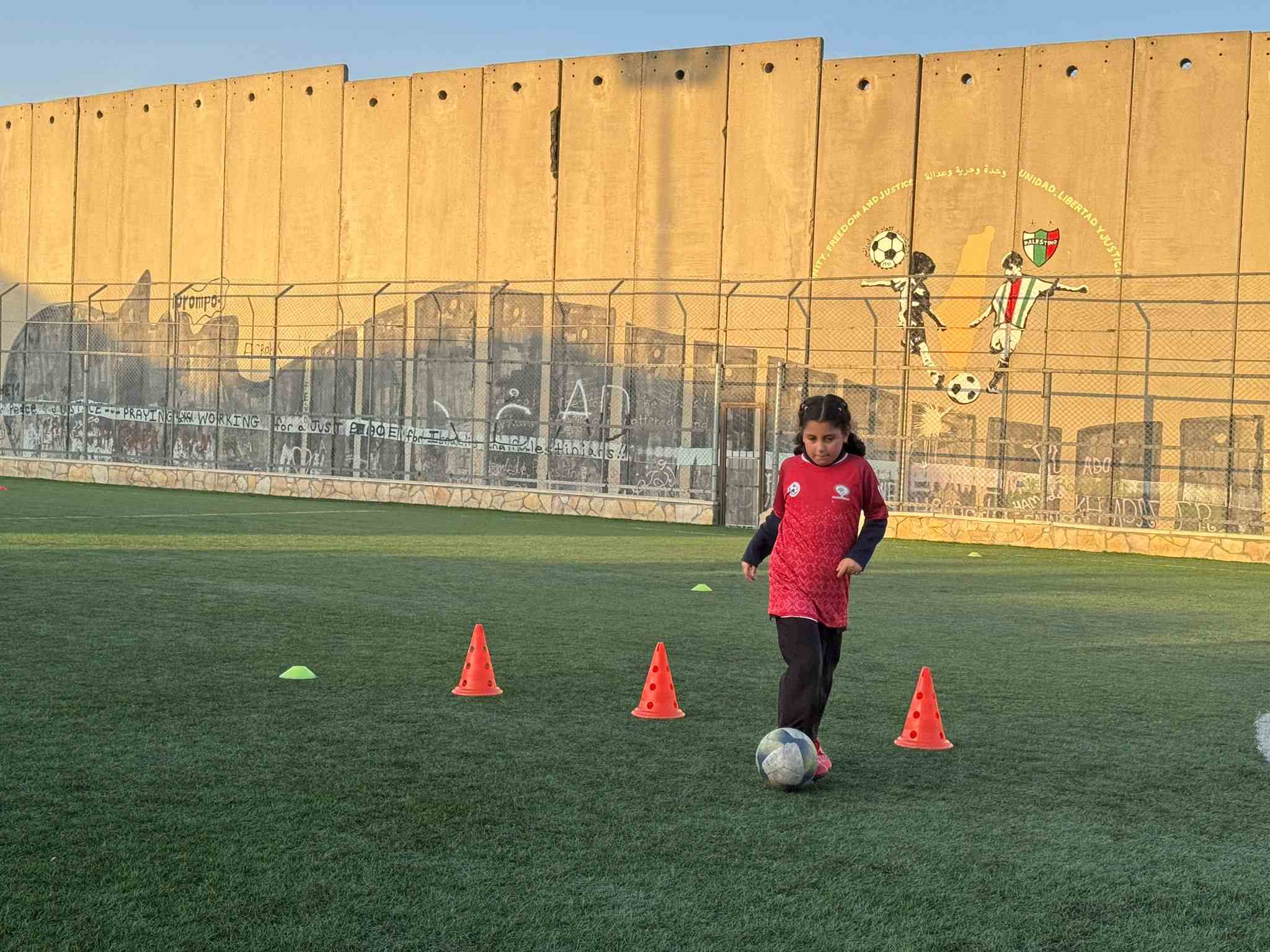
Israeli authorities have issued a demolition order against a vital youth football facility in Aida refugee camp near Bethlehem, threatening to erase one of the few recreational spaces available to Palestinian children living under occupation.
The artificial turf pitch, constructed in 2021 on land leased from the Armenian Patriarchate of Jerusalem, serves hundreds of young athletes aged 6-19, including girls who have represented Palestine internationally. The facility became operational despite the challenging environment created by the separation wall that looms immediately adjacent to the playing field.
Two weeks ago, Israeli soldiers affixed a notice to the gate declaring all activities must cease immediately and warning of potential demolition due to alleged permit violations. Similar notices were served to a nearby theater and garden in the same area.
Muhannad Abu Surour, director of the Aida Youth Centre’s sports program, described how children discovered the notice during early morning training. “The news spread quickly because of how important the pitch is,” he told Middle East Eye. “The children came to my house, knocking on my door, telling me what happened.”
The camp, established by the UN in 1950 following the Nakba, now houses approximately 7,000 residents in overcrowded conditions, including about 2,500 children. Surrounded by Israeli checkpoints, military bases, and settlements with seven watchtowers overlooking the area, Aida has been frequently raided by Israeli forces and was once described as the most tear-gassed place globally.
Young athletes expressed devastation at the potential loss. Salma Al-Azzam, 17, described the pitch as “a place to release pressure” from the camp’s constricting environment. “We were all very upset when we heard about the demolition decision,” she said. “I was shocked and there was a lump in my throat. We have many good players who deserve a chance.”
Local officials revealed the complex land ownership situation. George Juha of Bethlehem Municipality explained they leased the land from the Armenian church specifically for children’s use. “We made good use of it, but the Israelis don’t like good for anyone,” Juha stated. “They don’t want playgrounds, or construction, or anything at all.”
The demolition notice claims the facility violates military regulations and lacks proper permits. A final decision rests with the planning committee of Israel’s civil administration, which governs occupied West Bank territories. Israeli authorities did not respond to requests for comment.
The field’s international connections include a partnership with Chile’s Club Palestino, which represents the Chilean Palestinian community and has provided equipment and organized exchanges. A mural on the separation wall depicts children kicking a football under the slogan “Unity, freedom and justice” in three languages.
For 16-year-old Noor Abu Ghuneia, who has represented Palestine internationally, the potential demolition represents more than lost games. “This is the only field we have to play on,” she said. “We always said that this place is where we train so we can represent Palestine abroad. If they demolish it, we won’t be able to play.”