A sharp escalation of conflict across the Middle East unfolded Monday, as Israeli forces carried out targeted strikes on Iran’s largest petrochemical complex in the coastal city of Assaluyeh on the Gulf of Oman, just one day after U.S. President Donald Trump issued an extreme threat to destroy Iran’s civilian infrastructure if Tehran refused to reopen the Strait of Hormuz. The strikes came amid rapidly rising tensions that have already roiled global energy markets and drawn multiple regional nations into direct hostilities.
Alongside the attack on the critical energy facility, a separate joint U.S.-Israeli strike killed senior Islamic Revolutionary Guard Corps (IRGC) intelligence chief Majid Khademi at dawn Monday. In response, Iran launched a wave of drone and missile attacks targeting Israel, Kuwait, and the United Arab Emirates, extending the reach of the conflict across the Gulf region. Iranian officials have warned that any follow-through on Trump’s threat to strike civilian infrastructure would be met with far more devastating retaliatory actions.
Trump’s ultimatum, delivered in an expletive-laden Sunday social media post, gave Iran until 8:00 pm Tuesday (00:00 GMT Wednesday) to reopen the Strait of Hormuz, a critical global energy chokepoint that Iran has effectively blocked in recent weeks. “Open the Fuckin’ Strait, you crazy bastards, or you’ll be living in Hell,” Trump wrote in the post. Iran has already rejected the demand, with the IRGC stating publicly Monday that the strait “will never return to its former status, especially for the US and Israel.” The closure of the waterway, through which roughly 20% of global oil trade passes, has sent global oil and gas prices skyrocketing and forced nations around the world to implement emergency contingency plans to offset the energy supply shock.
Israeli Defence Minister Israel Katz confirmed that Monday’s strike on the Assaluyeh petrochemical complex successfully hit the facility, which accounts for nearly half of Iran’s total petrochemical output and holds an estimated value of tens of billions of dollars. Local Iranian media reported multiple explosions at the site following the strike. Israeli Prime Minister Benjamin Netanyahu issued a stark warning after the attack, saying “We will reach anyone who seeks to harm us.” In a separate announcement, the Israeli defence ministry confirmed it would ramp up production of Arrow missile interceptors to bolster the country’s multi-layered national air defence system amid the steady influx of Iranian attacks.
Even as violence accelerates across the region, diplomatic efforts to de-escalate tensions are underway. Axios, citing anonymous U.S., Israeli, and regional sources, reported that a proposed 45-day ceasefire is currently under discussion, with mediation from Pakistan, Egypt, and Turkey, to open space for negotiations on a long-term peace deal. Egypt’s Foreign Minister Badr Abdelatty confirmed Sunday that Cairo has been holding active talks with regional governments, U.S. Special Envoy Steve Witkoff, and Iranian Foreign Minister Abbas Araghchi. A statement from the Egyptian foreign ministry noted that “Views and proposals were exchanged on ways to deescalate the military situation in the region given the delicate juncture it is currently facing.”
Trump told Fox News Monday that Iran was “close” to reaching a negotiated deal, though Iranian officials have repeatedly denied holding any formal negotiations with either the U.S. or Israel. European Council President Antonio Costa issued a public call for diplomatic resolution Monday, writing on X that “Any targeting of civilian infrastructure, namely energy facilities, is illegal and unacceptable.”
The current full-scale conflict erupted on February 28, when joint U.S.-Israeli strikes killed Iran’s supreme leader Ayatollah Ali Khamenei, and has since engulfed the entire Middle East and disrupted the global economy. The global oil supply squeeze has already had ripple effects on commercial aviation: Indonesian authorities announced Monday they would increase jet fuel surcharges, while long-haul low-cost carrier Air Asia X implemented ticket price hikes of up to 40% to offset rising fuel costs. Major Asian energy importers have adjusted their shipping routes to avoid the Strait of Hormuz entirely; a South Korean ruling party lawmaker said Seoul will redirect oil shipments to load from Saudi Arabia’s Red Sea port of Yanbu, and Taiwanese officials confirmed they would adopt the same alternative route.
U.S. and Gulf allies aligned with Washington have already suffered direct impacts from the expanding conflict. Kuwait reported six civilian injuries in an Iranian drone strike on a residential area between Sunday and Monday. The UAE confirmed Monday that its air defence systems intercepted a combined missile and drone attack, with one person injured in an industrial zone of Abu Dhabi. Jordanian local media reported the government has begun processing compensation claims for residents whose property was damaged by falling missile and drone debris.
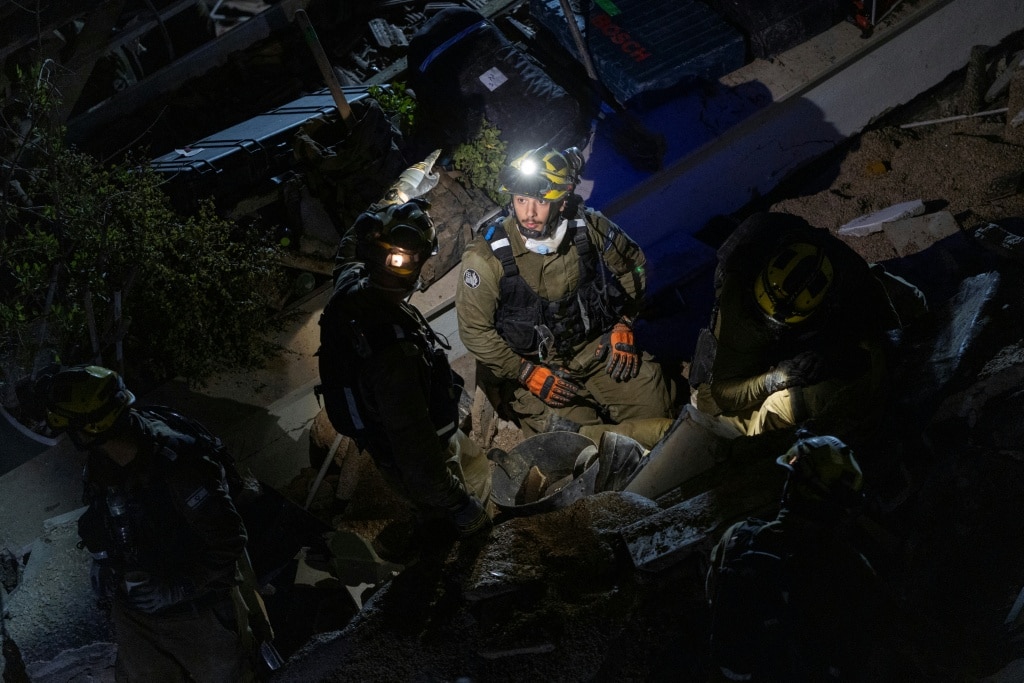
In Israel, four civilian bodies were recovered from a damaged residential building in the northern city of Haifa after an Iranian missile strike Monday. In retaliation, the Israeli military announced it had completed a new wave of strikes across multiple targets in Tehran. Iranian state media reported strikes on multiple residential areas in the capital, and confirmed that gas outages disrupted service across parts of Tehran after a strike on a local university facility. Even amid the threats of further attacks, many Tehran residents appeared to carry on with daily life Sunday, with large groups of young people exercising, flying kites, and holding picnics in the city’s western public parks.
The conflict has also expanded to Lebanon, where Iran-backed Hezbollah launched attacks on Israel starting March 2. Israel has responded with heavy airstrikes and a ground incursion into parts of southern Lebanon. Israeli Army Chief Lieutenant General Eyal Zamir visited Israeli troops deployed in southern Lebanon Sunday and pledged to intensify offensive operations. AFP correspondents on the ground observed a large plume of smoke rising over southern Beirut’s suburbs Monday following an Israeli airstrike that the military confirmed targeted Hezbollah positions.
Trump is scheduled to hold a press conference later Monday to release details on the rescue of a U.S. airman whose fighter jet was shot down by Iranian forces in recent days.