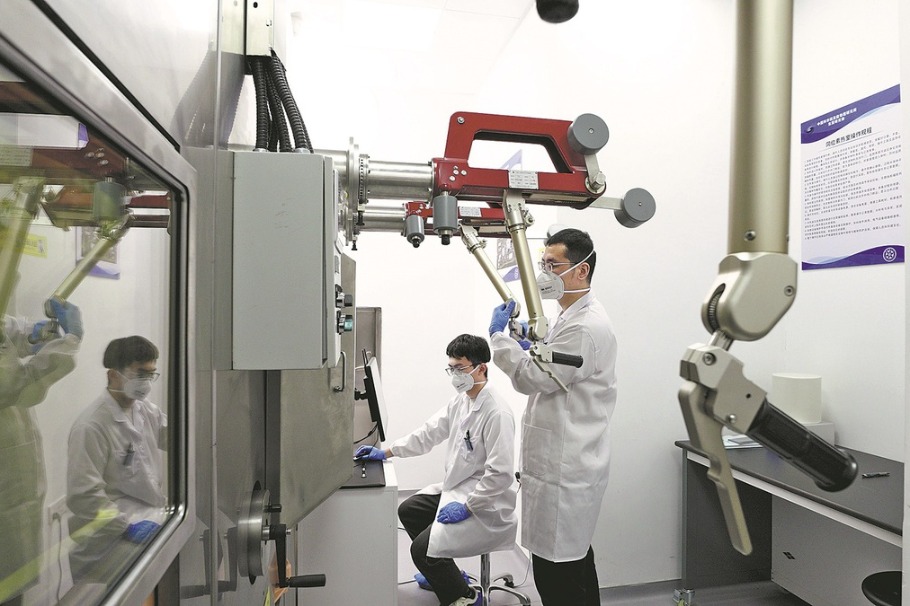
China has marked a transformative milestone in advancing domestic cancer care, with researchers at the China Spallation Neutron Source (CSNS) in Dongguan, Guangdong province announcing they have achieved full capability to produce life-saving alpha-emitting medical isotopes. For years, China has relied on costly, supply-volatile imports of these critical materials, creating a major bottleneck in access to cutting-edge cancer treatment. The new domestic production capacity is set to resolve this gap, bringing next-generation targeted cancer therapy within reach for far more patients.
Called the “nuclear warheads” of modern oncology, alpha isotopes are the core component of next-generation radiopharmaceuticals that deliver lethal radiation directly to tumor cells while minimizing damage to surrounding healthy tissue. The CSNS team has confirmed it can produce three of the most clinically essential alpha isotopes: radium-223, actinium-225, and lead-212, all of which have well-documented effectiveness in treating hard-to-manage late-stage prostate cancer and neuroendocrine tumors.
Wang Sheng, director of the Spallation Neutron Source Science Center and a professor at the Chinese Academy of Sciences’ Institute of High Energy Physics, emphasized the urgent public health need for this advancement, noting that China records nearly 5 million new cancer diagnoses annually — accounting for 25% of the global total — with an overall mortality rate above 50%.
Unlike conventional radiation therapy, which uses long-range radiation that can pass through healthy tissue and cause unintended damage, alpha particles function like precision short-range heavy artillery. Once inside a cancer cell, alpha radiation releases enough energy to break both strands of the cell’s DNA, creating irreversible damage that the cell cannot repair. Wang added that the treatment also delivers a valuable “bystander effect”: dying cancer cells release signals that trigger the death of adjacent malignant cells, even if those cells were not directly targeted by radiation.
Historically, medical alpha isotopes have been produced almost exclusively in nuclear reactors. But the CSNS research team developed an innovative alternative approach using a high-energy linear accelerator. By directing a high-powered proton beam at a target constructed from thorium, a naturally occurring abundant metal, researchers are able to extract the exact isotopes required for clinical use.
Dai Xiongxin, who leads the project’s industrialization initiative, explained that this new production method offers multiple advantages over traditional reactor-based production. It eliminates the need for highly enriched uranium, a material that carries inherent nuclear proliferation risks, making the process both safer and more cost-effective. “It offers flexible production capacity, broader access to raw materials, and significantly lower costs,” Dai noted.
Rigorous quality testing has confirmed that the domestically produced isotopes achieve a purity level of over 99%, matching the high quality standard of imported international supplies. The project does face one key logistical challenge, however: alpha isotopes have extremely short half-lives, decaying within days or even hours of production, making long-term storage and long-distance transportation impossible. To overcome this barrier, the CSNS center signed a strategic cooperation agreement with the China Isotope & Radiation Corporation over the weekend to build a complete localized industrial chain for production and distribution in Guangdong province.
A purpose-built dedicated production line is currently under construction at the site. Once the facility reaches full operational capacity by 2031, it is projected to produce enough isotopes to supply nearly 1 million patient treatments per year, marking a major leap forward in China’s quest for self-sufficiency in advanced medical resources and expanding access to life-saving cancer care across the country.