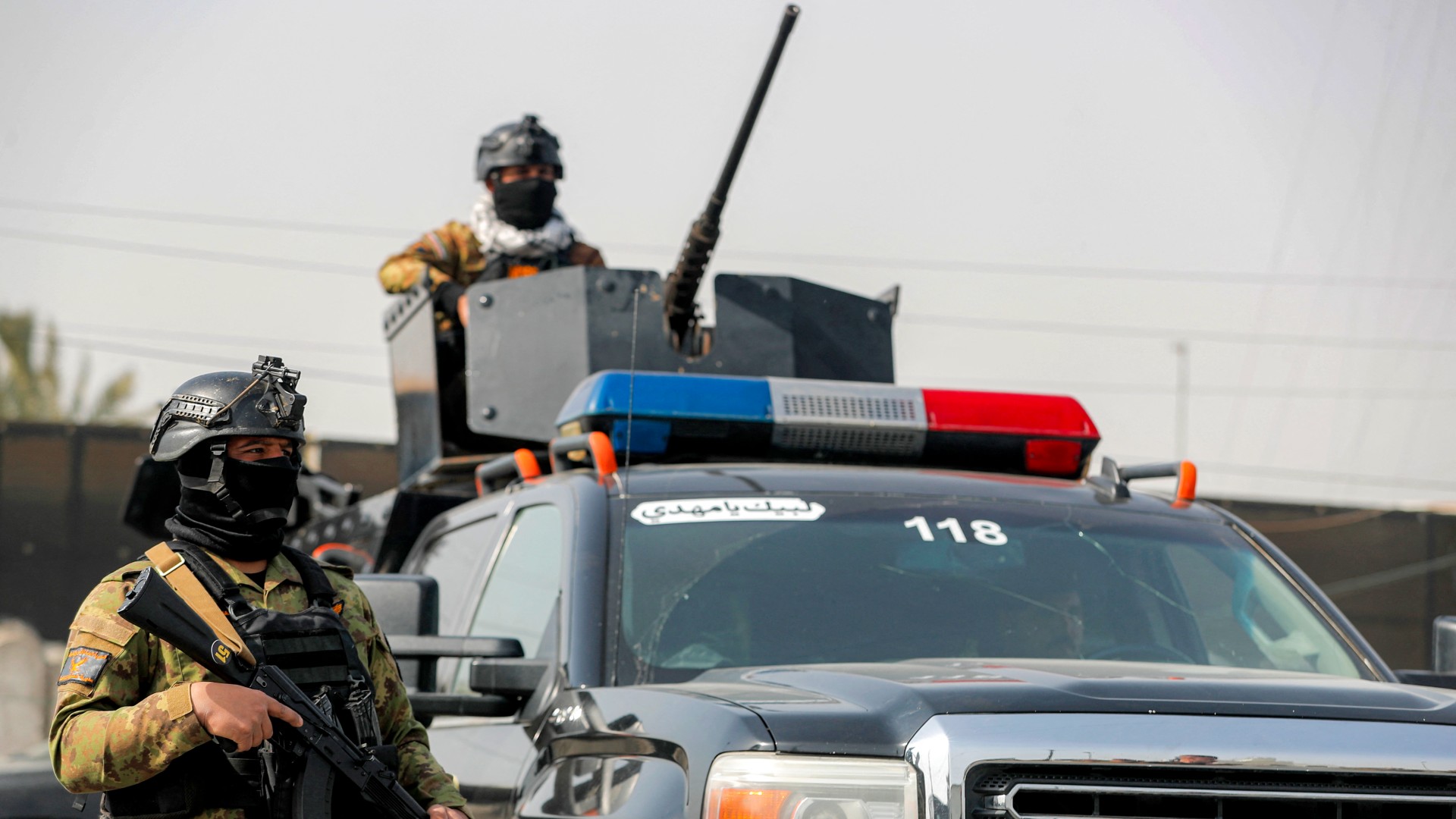
On the morning of June 28, a coordinated large-scale pre-dawn operation carried out by elite Iraqi security forces inside Baghdad’s highly fortified Green Zone marked one of the most striking anti-corruption crackdowns Iraq has seen in recent years. However, widespread scepticism persists among ordinary Iraqis and analysts alike that the country’s most powerful, deeply entrenched corrupt figures will ever be held accountable for years of siphoning public funds.
Backed by tanks and armoured vehicles, counter-terrorism units swept into the Baghdad Residence neighbourhood, a residential and official enclave located just steps from the U.S. Embassy, following a months-long probe launched by Iraq’s new administration into misappropriated funds linked to irregular public infrastructure and development contracts. By the end of the operation, at least 47 people had been taken into custody, including sitting members of parliament, senior political appointees and other high-ranking government officials. Security forces raided dozens of private homes and official offices, seizing millions of dollars in undeclared cash, gold bullion, and even luxury gold-plated women’s lingerie, items that quickly became a lightning rod for public anger.
Footage of the operation spread across Iraqi television stations and social media platforms within hours, with many viewers comparing the dramatic show of force to blockbuster Hollywood action sequences. For generations of Iraqis who have watched their political elite line their own pockets while basic public services from electricity to clean water remain consistently out of reach, the crackdown represented an unprecedented public challenge to a ruling class long accused of systemic graft.
“It’s really shocking seeing millions of dollars hidden in the gardens of politicians, finding gold bars and gold-made women’s lingerie that they use to please themselves with our money,” said Mohammed Basheer, a 24-year-old resident of Basra, in an interview with Middle East Eye. While Basheer welcomed the operation, he warned that its credibility would stand or fall on whether the government ultimately moves against Iraq’s most powerful political leaders. “I am looking forward to seeing if Prime Minister Ali al-Zaidi will touch the big heads. If he does not, then it would be unfortunate – just like a TV show,” he added. “As previous prime ministers did almost the same campaigns, I need to see where this will end, and how serious it is when it comes to holding big officials accountable.”
That scepticism is shared by many long-time Baghdad residents. Jassim Mohammed, 52, argued that the operation would only prove meaningful if it leads to sustained systemic change. “Let’s wait and see how serious this campaign is. If so, that would be great; if not, then it is just a bubble,” he said. “Taking corrupt politicians to jail would be a good lesson to others to avoid following their path in stealing the people’s money. However, after this campaign, the prime minister should offer good services, better infrastructure, and, most importantly, kick out the Iran-backed allies.”
The timing of the raids, carried out just weeks before al-Zaidi is scheduled to travel to Washington for high-level talks, has fuelled political speculation about the operation’s dual motivations. The al-Zaidi administration is already facing growing pressure from the U.S. to curb the influence of Iran-backed armed factions and demonstrate greater institutional control over Iraqi state affairs. Analysts say the crackdown is designed both to appease Iraqi voters fed up with decades of endemic corruption and to signal to U.S. officials that Baghdad is serious about targeting officials linked to Iranian-aligned Shia political parties. According to Iranian opposition outlet Iran International, multiple of the arrested officials have documented ties to Shia parties close to Tehran. The outlet also confirmed the raids came shortly after a closed-door meeting between U.S. Special Envoy Tom Barrack and Prime Minister al-Zaidi.
Renad Mansour, director of the Iraq Initiative at London-based think tank Chatham House, argues the crackdown is as much a political performance for international audiences as it is a domestic anti-corruption measure. “Al-Zaidi is looking to sell his administration – not just to the Iraqi public – but to the US and its allies in the region,” Mansour told Middle East Eye. “In particular because of the threat that the US is posing to Iraq with sanctions, and because Iraq is stuck in the middle of this ongoing regional standoff between Israel, the US, and Iran.”
Mansour noted that while the operation has generated blanket media coverage and uncovered massive amounts of stolen assets, it has so far carefully avoided confronting the top figures who control Iraq’s patronage-driven political system. “The ongoing anti-corruption campaign has been effective only insofar as he has managed to go after some middle-ranking officials and, through those arrests, uncover a lot of cash and gold bars. So, the theatrics are certainly there. Because of that, the prime minister is pursuing this anti-corruption campaign. The drive is very much going after those who are easier to catch: the middle-ranking officials, not the tops, not the heads of the system who sit above it, as it is impossible to go after them.”
This limited scope means the campaign cannot address the root structural causes of corruption that have crippled Iraqi governance for decades, Mansour argued. “Insofar as that is the case, this isn’t changing how the political system is largely fuelled by corruption. It is just changing the configuration of what that corruption looks like and who is part of it. While this might bring some cash infusion, it is not going after the whole system and it is not structurally fixing it. The system is really facing massive challenges with the closure of the Strait of Hormuz and the ongoing conflict in the region. Therefore, it is hard to see this cosmetic display as a structural fix for the corruption that stops Iraqis from having basic services, electricity, and a functioning economy.”
Baghdad-based political analyst Raad Hashim echoed that assessment, agreeing that the campaign’s long-term credibility depends on whether al-Zaidi expands the crackdown beyond mid-level officials to target Iraq’s most powerful political actors. “In this campaign, the small fish have been caught, while everyone is waiting for the moment when the big fish – the major targets among the corrupt – are netted,” Hashim said. While he described the mass arrests as unprecedented by Iraqi standards, he noted that such operations would be considered routine anti-corruption work in most other countries. “Comparing al-Zaidi’s campaign with global anti-corruption efforts, his campaign is merely a drop in the ocean, because what al-Zaidi has done is routine work. However, only in Iraq does everyone view it as a major campaign, simply because we are not accustomed to seeing such actions.”
Hashim added that it is still too early to write off the operation entirely, leaving open the possibility that it could be a first step toward a broader crackdown. “That is, unless this is a preliminary campaign paving the way for a broader one – then we would have a different tone of talk,” he said. Still, he questioned why the operation had not targeted wealthy militia leaders and other influential figures linked to Iraqi armed factions. “Failure to target the big heads, including the influential figures who have become wealthy among the militia leaders, means that avoiding them constitutes a blow to the entire campaign, its seriousness, and its credibility.”
Sarkawt Shamsulddin, a former Iraqi member of parliament, said the campaign aligns with long-standing anti-corruption rhetoric from the Sadrist movement and could help build political momentum ahead of next year’s scheduled parliamentary elections. Regardless of the mixed motivations behind the operation, Shamsulddin noted that al-Zaidi is taking a political risk few Iraqi leaders have been willing to take in recent decades. “I applaud his efforts and all who have been arrested are samples of a larger group who have been suffocating public coffers without consequences. This campaign is a warning. Is there a foreign push? Maybe, but it takes someone in the prime minister’s position who is ready to take the risk and limit the bleeding in public resources being plundered with impunity.”
Even so, Shamsulddin cautioned against overstating the immediate impact of the raids. “But that is just a scratch on the surface. Will he continue? Maybe this is a very sensitive issue and requires serious consideration of domestic politics.”
As of July 4, Iraq’s Federal Integrity Commission confirmed that officials have recovered at least 98 billion Iraqi dinars ($74 million) in stolen assets alongside $11 million in untraceable cash. One commission official told Middle East Eye that security teams required heavy excavation equipment to dig up cash stashed four meters underground in private gardens and remote plots of land owned by arrested officials.