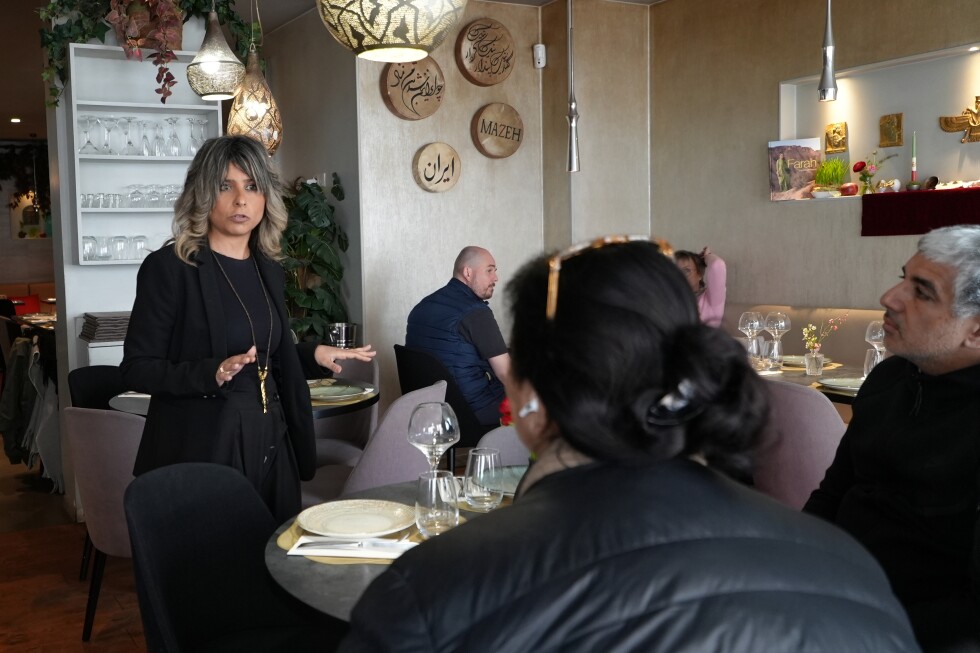
PARIS — The ancient Persian celebration of Nowruz, traditionally marking renewal and hope with the spring equinox, has been overshadowed by conflict and grief for the global Iranian diaspora this year. As war ravages their homeland and communications falter, families separated by geography are united in anguish, transforming festive gatherings into somber reflections.
Shayan Ghadimi, a 41-year-old Paris restaurateur, embodies this collective sorrow. Her story reveals the personal toll of Iran’s turmoil that began with the 2025 nationwide protests. Her septuagenarian mother, having witnessed the initial uprising on television from Paris, felt compelled to return to Iran, declaring ‘I want to be there.’ Now trapped amid bombardment and severed communications, she remains isolated in Tehran while her daughter imagines her ‘all alone at home, with no way to stay in contact, watching the sky.’
The cultural institutions that typically preserve Iranian traditions abroad have adopted mourning postures. Parisian cultural centers that previously organized musical Nowruz events have canceled festivities, while Iranian American communities across the United States have significantly scaled back celebrations.
Shakiba Edighoffer, a makeup artist shopping for Nowruz provisions, describes the community’s psychological state as a ‘kind of emotional roller coaster’ as war rages between Israel, the United States, and Iran’s Islamic Republic. ‘You hear news about this or that leader of the Islamic Republic being eliminated… about executions or bombings,’ she noted, emphasizing the stress of attempting to verify the safety of loved ones under bombardment through largely severed communication channels.
For those gathering despite the circumstances, Nowruz provides minimal comfort against overwhelming psychological pressure. ‘All these oppressors want is for us to be sad, to forget our millennia-old Persian and Iranian traditions,’ Edighoffer asserted. ‘We must not give them that victory.’
At Ghadimi’s spice-scented Paris restaurant, where flame-grilled kebabs and spiced rice typically fuel celebration, patrons now express polarized emotions. Some view the conflict as potentially bringing a new dawn, while others mourn the destruction wrought by Israeli and U.S. strikes. ‘I have people in tears. I have people who cry for joy,’ Ghadimi observed. ‘They say, ‘Did you see? They are coming. We are going to be saved.’ Others say, ‘Our country is being destroyed.’
The personal becomes political as Ghadimi reveals she has spoken to her mother only twice since January. Her mother, who had promised to return to Paris for Nowruz, instead declared her intention to remain in Iran indefinitely. Having witnessed the 1979 Islamic Revolution, she now wants to witness Iran’s next chapter, telling her daughter: ‘I am staying here until the end.’