Tensions between the United States and Iran escalated dramatically this week after former and current U.S. President Donald Trump issued explicit threats to carry out large-scale strikes against Iranian civilian infrastructure, drawing sharp condemnation from Iranian officials and even pushback from some members of the U.S. political and policy community.
Trump first made the incendiary remarks during an Easter Sunday interview with Fox News, where he issued an ultimatum to Iranian leadership: unless Tehran reached a new deal with Washington on his timeline and fully reopened the Strait of Hormuz by 8 p.m. ET that same day, he would order widespread bombings across the country. “You’re going to see bridges and power plants dropping all over their country,” Trump stated, adding that he was also “considering blowing everything up and taking the oil.” The threat followed an aggressive, profanity-laced post on his Truth Social platform, where he demanded Iran “open the Fuckin’ Strait, you crazy bastards, or you’ll be living in Hell.”
In response to the threats, top Iranian diplomatic officials have labeled Trump’s statements as open incitement to war crimes and potential genocide, citing international law to back their claims. Kazem Gharibabadi, Iran’s deputy foreign minister, outlined the legal case against the threatened strikes in a social media post Monday, noting that deliberate attacks on civilian infrastructure such as power plants and bridges are explicitly classified as war crimes under Article 8(2)(b) of the International Criminal Court’s Rome Statute, as well as Article 52 of Protocol I to the 1977 Geneva Conventions.
Gharibabadi emphasized that as the highest-ranking U.S. official, Trump bears individual criminal responsibility for his open threat to violate international humanitarian law, a liability that holds before both the ICC and any competent national court. He also warned that if Trump follows through on the attack, his name will be “etched in history as a supreme war criminal,” and confirmed that Iran would deliver a “decisive, immediate, and regret-inducing response” to any aggression.
Esmail Baghaei, spokesperson for Iran’s Foreign Ministry, echoed that condemnation, calling Trump’s threats evidence of “a criminal mindset.” Speaking to reporters Sunday, Baghaei called the comments “an express public incitement for war crimes and crimes against humanity—and, I would say, for genocide.” He added that threatening attacks on a nation’s critical energy infrastructure amounts to putting the entire civilian population at deliberate risk of harm.
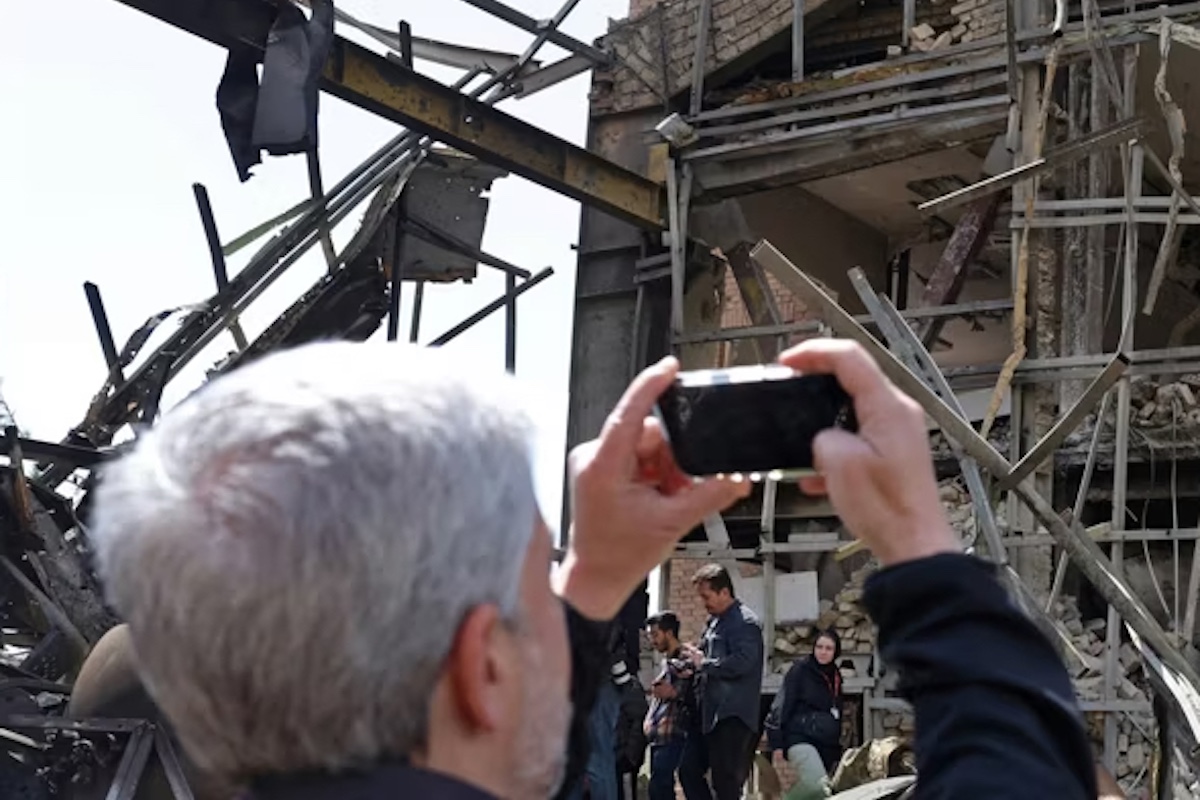
The threats come amid an ongoing U.S.-Israeli bombing campaign against Iran that began on February 28, which has already caused extensive damage to Iranian civilian and public service facilities. Iran’s deputy health minister confirmed Monday that more than 360 healthcare, education, and research centers have been damaged or destroyed in strikes to date, with dozens of medical personnel killed in the attacks.
Critics within the United States have also joined Iranian officials in decrying Trump’s threatened strikes as unlawful war crimes. U.S. Senator Chris Murphy, a Democrat from Connecticut, criticized the administration’s underlying strategy, which reportedly calls for striking civilian sites to spark public unrest and force regime change. “But just think about the insanity of this plan: kill tens of thousands of civilians in order to cause a national panic,” Murphy wrote on social media. “Bombing to induce political panic IS A WAR CRIME.”
Dylan Williams, vice president for government affairs at the Center for International Policy, went further, arguing that any congressional lawmaker who supports additional war funding for the conflict or opposes efforts to reassert congressional war powers limits on the administration would be complicit in the threatened and already committed war crimes. He called Trump an “unhinged and unfit Commander in Chief.”
The sharp escalation of rhetoric comes as quiet diplomatic efforts, partially mediated by Pakistan, are underway to negotiate a 45-day ceasefire that would create space for longer-term talks to end the ongoing conflict. Axios has reported that the ongoing diplomatic push is viewed by mediators as “the only chance to prevent a dramatic escalation in the war that will include massive strikes on Iranian civilian infrastructure and a retaliation against energy and water facilities in the Gulf states.”