The strategic waters of the Persian Gulf have become the epicenter of a rapidly escalating military confrontation between Iran and the United States, with critical oil infrastructure emerging as primary targets in a conflict that shows no signs of abating.
Fresh cross-border attacks were reported across Gulf states on Sunday, following Iran’s explicit warning for civilians to evacuate three major United Arab Emirates ports that Tehran has designated as “legitimate targets.” The Iranian government claims these facilities are being utilized by US military forces to launch strikes against Iranian territory.
In a significant escalation of hostilities, Washington has dramatically raised the stakes by directly targeting Iran’s most crucial oil export channel. Recent US military operations have focused on Kharg Island, the strategic chokepoint responsible for processing approximately 90% of Iran’s crude oil exports. American forces have conducted strikes on more than 90 Iranian military targets on the island, marking a dangerous new phase in the three-week-old conflict that also involves Israel.
Iranian Foreign Minister Abbas Araghchi stated in an interview with Al Araby Al Jadeed that no specific peace initiatives have been proposed to end the hostilities. “The end of the war depends on guaranteeing that it will not be repeated and on paying compensation,” Araghchi emphasized, indicating Tehran’s conditions for ceasefire negotiations.
The minister earlier accused the US of launching attacks on Kharg Island and Abu Musa Island from two locations within the UAE—Ras Al-Khaimah and a site “very close to Dubai.” He characterized the situation as “extremely dangerous” while asserting Iran’s commitment to exercise restraint to avoid striking civilian-populated areas in the UAE.
Behind the scenes, diplomatic sources reveal growing resentment among Gulf Arab states who find themselves unwilling participants in a conflict they neither initiated nor endorsed. These nations are now bearing significant economic and security costs as the violence spills across their borders.
Anwar Gargash, diplomatic adviser to the UAE president, articulated this delicate balancing act on social media, acknowledging his country’s right to self-defense while emphasizing that “still prioritizes reason and de-escalation, and continues to exercise restraint.”
The UAE, Saudi Arabia, and Bahrain all activated defense systems to intercept incoming projectiles. Iran’s Revolutionary Guards (IRGC) claimed responsibility for launching 10 missiles and an unspecified number of drones against US forces stationed at al-Dhafra airbase in the UAE.
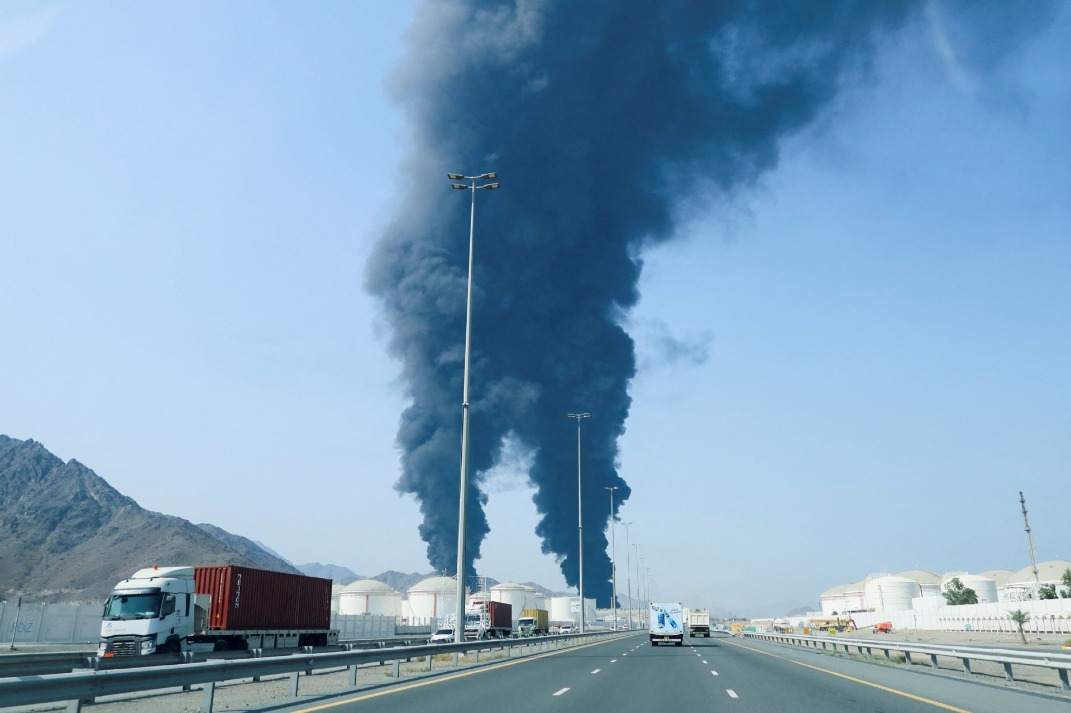
Despite Tehran’s threats, there was no immediate evidence of attacks on Dubai’s Jebel Ali port—the Middle East’s busiest commercial hub—or Abu Dhabi’s Khalifa port. However, debris from an intercepted Iranian drone struck an oil facility at Fujairah port, with television footage capturing plumes of thick black smoke rising into the air. Authorities confirmed that civil defense teams were managing the situation and urged the public to rely solely on official updates.
Meanwhile, US President Donald Trump declared in an NBC News telephone interview that Washington is not prepared to strike a deal with Iran because “the terms are not good enough.” The president revealed that initial attacks had “completely demolished” most of Kharg Island and suggested additional strikes might be conducted “just for good measure.”
In a separate development, Iran’s joint military command accused the United States and Israel of utilizing replica Iranian drones to attack neighboring countries and shift blame onto Tehran. State media reported that copies of Iran’s Shahed-136 drone, designated LUCAS, were allegedly used to hit “unrelated targets in regional states,” including attacks in Turkiye, Iraq, and Kuwait, though no evidence was provided to support these claims.
The IRGC further escalated rhetoric by vowing to hunt down Israeli Prime Minister Benjamin Netanyahu. A statement carried by state media declared: “If this criminal, the killer of children, remains alive, we will spare no effort to track down and eliminate him with all our strength.”
Since the conflict began on February 28, more than 2,000 people have been killed, with the majority of casualties occurring in Iran. The ongoing hostilities have caused major disruptions to global oil supplies, driving international prices higher and creating economic ripple effects across world markets.