Escalating tensions across the Middle East took a sharp turn for the worse on Wednesday, as Iran launched retaliatory missile and aerial strikes against United States military installations located in Jordan and Bahrain. The attack came in direct response to recent U.S. retaliatory strikes on Iranian military infrastructure near the Strait of Hormuz, throwing a fragile April ceasefire into serious jeopardy and derailing previously optimistic peace talks billed as entering their final stages.
The cross-border exchanges mark the most serious breakdown in de-escalation efforts since the broader regional conflict began three months ago, when joint U.S.-Israeli strikes on Iran launched the war that upended regional stability and roiled global energy markets. According to a statement released by Iran’s Revolutionary Guards and carried by the country’s official IRNA news agency, Iranian forces deployed long-range missiles to hit and destroy four key targets at U.S. facilities in Jordan, including an F-35 fighter jet staging area at an air base and a U.S. command center in Al-Azraq.
Jordan’s military quickly countered the assault, confirming it had intercepted and shot down five incoming Iranian missiles, with no reported casualties or material damage to Jordanian assets. Across the Gulf in Bahrain, defense forces intercepted and destroyed multiple incoming Iranian aerial threats targeting another U.S. base stationed on its territory. An Agence France-Presse correspondent based in Bahrain’s capital Manama reported hearing multiple loud explosions in the early hours of Wednesday morning, consistent with the interception operations. Kuwaiti military authorities also announced their air defense systems were engaging unidentified hostile aerial targets Wednesday, marking the second recent incident of Iranian activity near Kuwaiti territory.
The latest cycle of escalation was triggered by the downing of a U.S. Apache attack helicopter by Iranian forces earlier this week. Following the incident, the U.S. military carried out a retaliatory strike on Iranian positions near the Strait of Hormuz, with U.S. Central Command (CENTCOM) confirming the operation targeted Iranian air defense batteries, ground control stations and surveillance radar sites using precision munitions launched from U.S. Air Force and Navy fighter jets. Ahead of Iran’s retaliatory strikes, Iranian Foreign Minister Abbas Araghchi had issued a clear warning of retaliation in a post on X, writing that the U.S. had chosen to test Iran’s resolve, and that Iran’s powerful armed forces would not leave any attack or threat unanswered.
Iran’s retaliatory strikes throw into question recent optimistic claims from U.S. President Donald Trump, who just hours before the escalation told reporters that negotiations to end the three-month-long conflict were in their “final throes”, and that a final peace deal would be reached within two to three days. After the helicopter was downed on Monday, Trump reiterated his pledge of a strong response in an interview with ABC News, saying the U.S. reaction would be “very strong, very powerful, and that’s what this one is.”
The already shaky ceasefire had already faced a major test over the weekend, when Iran and Israel resumed a brief round of hostilities before agreeing to a renewed halt. One major sticking point in ongoing peace negotiations has been Iran’s demand that any final deal include a formal ceasefire in Lebanon, which was drawn into the conflict after Iran-backed Hezbollah militants fired rockets into Israeli territory on March 2. Israel has responded with a sustained campaign of airstrikes and a limited ground invasion into southern Lebanon that has killed more than 3,600 people to date. Despite the nominal regional truce, cross-border fire between Israel and Hezbollah has continued almost unabated.
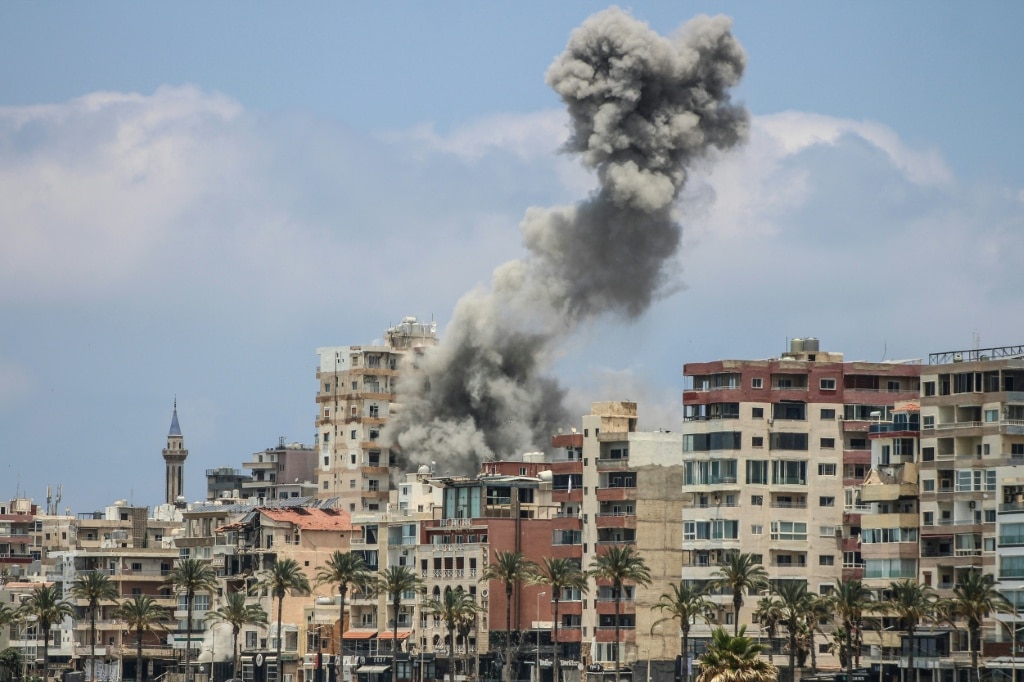
On Tuesday, Israeli airstrikes on the southern Lebanese city of Tyre killed 11 people, according to Lebanese officials. The Israeli military also issued an evacuation order for the entire city, prompting a mass exodus of residents northward. AFP correspondents on the ground reported heavy traffic of residents fleeing Tyre, including from the city’s historic Christian quarter, while displaced residents began arriving in the northern coastal city of Sidon with personal belongings strapped to the roofs of their vehicles.
The rapid collapse of de-escalation efforts has also overshadowed ongoing diplomatic attempts to reopen the Strait of Hormuz, a critical global chokepoint for around a fifth of the world’s daily oil supplies that Iran has blockaded since the start of the war. Global crude oil prices rose 1% on Wednesday as hopes of an imminent peace deal faded, a sharp reversal from the previous day’s 5% price drop that came amid growing optimism a deal would be reached. Araghchi reiterated his warning to foreign forces this week, saying that any foreign military presence near Iranian territory around the strait faces constant risk of being caught in crossfire, and that the only solution for foreign forces is to withdraw from the area.
The downed Apache helicopter marks the second crewed U.S. military aircraft confirmed shot down by Iran since the conflict began, following the loss of an F-15 fighter jet in April. CENTCOM confirmed that both crew members of the downed helicopter were rescued shortly after it went down off the coast of Oman.