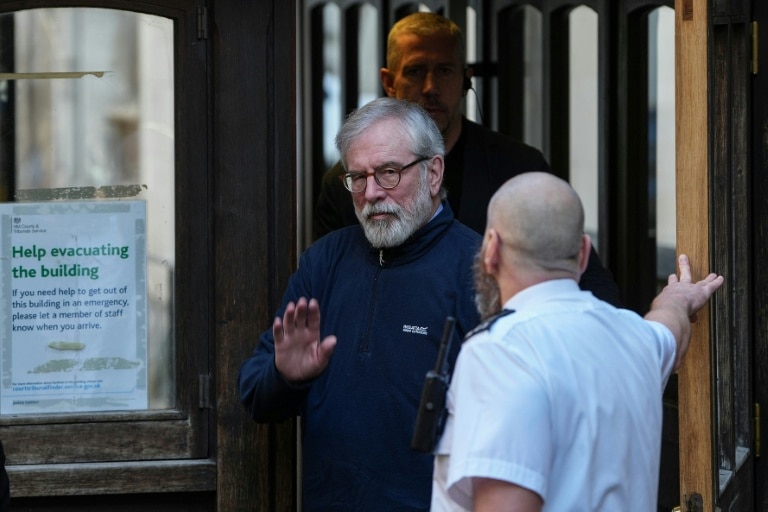
In a dramatic courtroom development, three survivors of IRA bombings in England have voluntarily discontinued their high-profile civil lawsuit against former Sinn Féin president Gerry Adams. The legal proceedings, which spanned two weeks at London’s High Court, reached an unexpected conclusion when the plaintiffs’ legal representative announced a mutual agreement to discontinue the case.
The claimants—individuals injured in Republican bomb attacks during the 1970s and 1990s—had pursued a symbolic damages claim of one pound against Adams. Their central allegation contended that Adams occupied a senior leadership position within the Irish Republican Army for over twenty-five years, asserting he participated in a “common design to bomb the British mainland.”
Justice Jonathan Swift formally recorded the discontinuance without issuing a costs order, leaving financial responsibilities undetermined. Adams, who had appeared earlier in the proceedings but was absent during the final hearing, consistently refuted the allegations through his witness testimony. “These allegations are untrue. I was never a member of the IRA or its Army Council,” Adams stated, while adding, “I do not defend all the IRA actions.”
The historical context of these proceedings traces back to the Troubles—a thirty-year period of sectarian violence in Northern Ireland that claimed over 3,500 lives. The bombings referenced in the case resulted in three fatalities and numerous injuries across London and Manchester.
Following the court’s announcement, Adams expressed approval via social media, characterizing the resolution as “an emphatic end to a case that should never have been brought.” This legal outcome represents another chapter in Adams’ complex legal history, which includes previous lawsuits and quashed convictions, though he has never been found guilty of IRA membership.