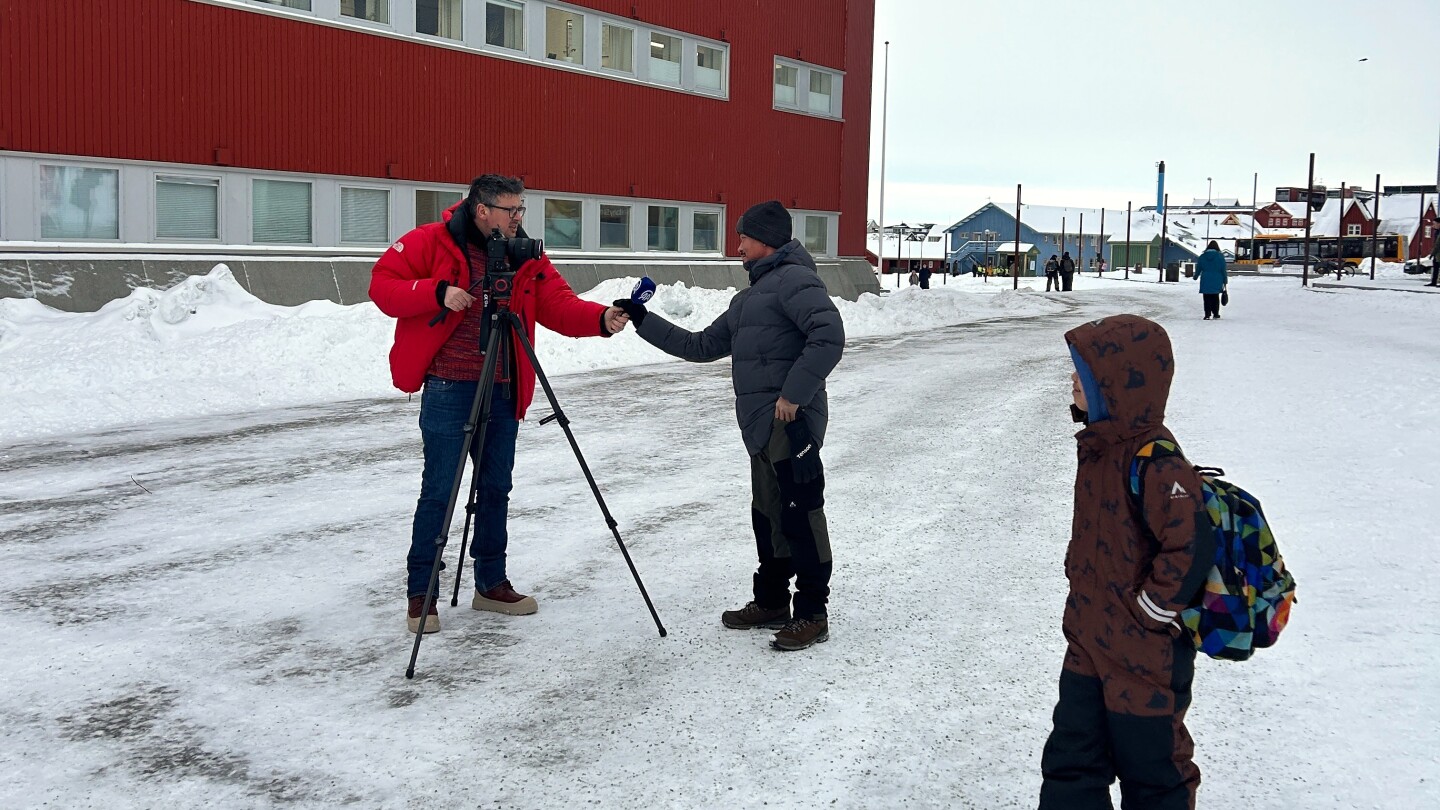
NUUK, Greenland — The serene Arctic capital of Nuuk has transformed into an unlikely international media hub as journalists from across the globe descend upon Greenland to document the escalating geopolitical crisis sparked by U.S. President Donald Trump’s persistent claims of wanting to acquire the vast island territory.
For weeks, international news crews from prestigious organizations including The Associated Press, Reuters, CNN, BBC, Al Jazeera, and various Scandinavian and Japanese outlets have been navigating Nuuk’s limited daylight hours—approximately five hours between 11 a.m. and 4 p.m.—to capture the multicolored houses, snow-capped hills, and freezing fjords that define Greenland’s landscape.
The media attention represents what local politicians term ’round two’ of global interest, referencing Trump’s initial 2025 declarations about controlling Greenland. Journalists now station themselves every few meters along Nuuk’s central shopping street, conducting live broadcasts and repeatedly approaching the same local business owners and residents—some enduring up to 14 interviews daily.
Greenland, a semi-autonomous territory of Denmark with a population of merely 57,000, finds itself at the center of a dangerous geopolitical standoff. Trump justifies his acquisition ambitions by citing national security concerns and alleging that China and Russia harbor similar designs on Greenland’s vast untapped mineral reserves. These claims have prompted Denmark’s Prime Minister to issue a stark warning that any U.S. attempt to seize Greenland by force could potentially dismantle the NATO alliance.
Local residents express both exhaustion and bewilderment at the sustained attention. Juno Berthelsen, MP for the independence-seeking Naleraq opposition party, acknowledges the fatigue setting in among Greenland’s small population as journalists repeatedly ask the same questions. Young Greenlanders like 21-year-old Maya Martinsen characterize Trump’s obsession as ‘weird,’ accusing him of using national security as a pretext to access the island’s untouched oil and mineral resources.
The overwhelming consensus among Greenlanders is that their future should remain theirs to determine. They emphasize that to them, Greenland represents home—a place of breathtaking natural beauty and community—rather than merely a business opportunity or geopolitical bargaining chip.