Israel’s 2026 recognition of the self-declared independent Republic of Somaliland has widely been framed as a strategic gambit to gain a Red Sea coastal foothold to strike Yemen’s Houthi movement, but the move sets the stage for an escalating confrontation between Israel and a far more powerful, strategically positioned rival in the Horn of Africa: Turkey. Senior Somaliland officials and regional analysts interviewed by Middle East Eye confirm that the January 2026 diplomatic normalization between Hargeisa and Jerusalem – a move broadly condemned by the broader Arab and Muslim world – was driven in large part by Somaliland’s urgent need to counter Turkey’s rapidly expanding military footprint in neighboring Somalia.
Hargeisa, the capital of Somaliland, which only Israel recognizes as an independent state, is actively seeking Israeli air defense systems to counter the growing buildup of Turkish drones and fighter aircraft in Mogadishu, senior Somaliland officials confirm. “We need air defense systems,” stated Mohamed Osman Fadal, senior foreign affairs advisor to Somaliland’s president, in an exclusive interview. “Turkey has F-16s stationed in Mogadishu, and it intends to build a dedicated drone base in Somalia. We want Israel to support us against Turkey.” Across half a dozen interviews with senior officials and independent analysts in Hargeisa, a consistent narrative emerges: Somaliland believes that the military threat posed by Somalia, backed heavily by Turkish military and diplomatic support, can only be countered through deepened security and political ties with Israel.
Mohamed Abdirahman Hassan, Director General of Somaliland’s Ministry of Foreign Affairs and International Cooperation, explained that Somaliland had no other option but to enter into “regional rivalries” when asked about the risks of forging diplomatic ties with Israel, a move opposed by nearly all Muslim-majority states except the United Arab Emirates. “We had been reaching out to Arab and Muslim countries for recognition since 1991, and got nothing in return,” Hassan explained in his modern, air-conditioned Hargeisa office. “We had to move on. Israel recognized a gap here. We are proud to partner with the Israelis. We have a strong, capable army, but we lack critical materials and military equipment, which we hope Israel will provide.”
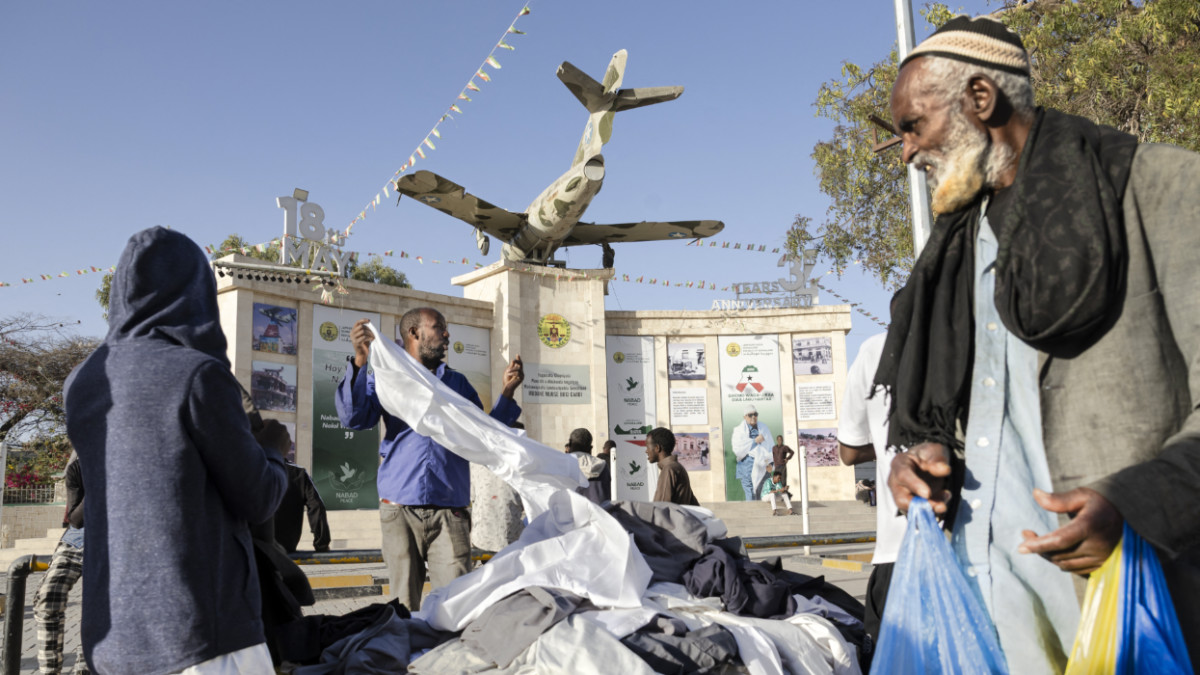
Weeks after Somaliland’s president traveled to Jerusalem to formalize the agreement, posters showing him shaking hands with Israeli President Isaac Herzog remain visible across Hargeisa. While many ordinary Somalilanders are skeptical of the new ties, there were street celebrations rather than mass protests when recognition was announced. Most Somalilanders view the agreement through a pragmatic, transactional lens: “Can anyone name a single Muslim country that established ties with Israel and actually benefited? Egypt? Jordan? Has Israel delivered anything tangible for them?” asked one local resident, Abdi. Many outside analysts have framed the agreement as a quid pro quo that gives Israel access to Somaliland’s strategically critical Gulf of Aden coastline for operations against the Houthis, but Somaliland officials are far less hostile to the Houthis than Israel.
“The Houthis are not terrorists like al-Shabab, and we reject that label,” Hassan clarified. “We are against any new confrontation in Yemen, and the Houthis need to be engaged diplomatically. The shared opponent that we and Israel have is Turkey.”
In the aftermath of the failed US-Israeli war on Iran, Israel and Turkey have been competing for influence across multiple spheres of the Middle East, and their rivalry is already escalating in hotspots such as Syria, where Israel has pursued an expansionist agenda following the collapse of the Bashar al-Assad government. While Somaliland’s long-running split with Mogadishu predates this latest power struggle, its entanglement in the rivalry underscores the complex web of shifting alliances and competing interests that are currently reshaping the entire Red Sea region.
“Many observers believe Israel and Turkey are gearing up for a direct confrontation, but Syria draws too much international attention,” explained a former senior Western diplomat with decades of experience in the region. “The Horn of Africa is where they can test each other because it is so removed from global scrutiny. A major reason Israel has established a presence in Somaliland is directly because of Turkey.”
Somaliland has governed itself as an independent state since the collapse of the Soviet Union and the end of the Cold War, and regional rivalries in the Horn have only grown more convoluted in the decades since. Somaliland is already closely aligned with the UAE, which has expanded its air and naval bases in the Somaliland port city of Berbera, and holds a majority stake in the city’s commercial port. Somaliland’s close ties to the UAE, which has deepened its cooperation with Israel in the wake of the US-Israeli war on Iran, made it a natural partner for Jerusalem. On the opposing side, Saudi Arabia, Pakistan, and Turkey have signed a joint defense agreement that forms a counterweight to the bloc formed by Israel, the UAE, and their smaller regional partners.
For centuries, the Horn of Africa has been a playground for competing outside powers seeking to control one of the world’s most critical trade corridors, and the Somali people, a historically nomadic community spread across a large swath of the region, have long grown accustomed to foreign powers jostling for control of their land. In the 16th century, the Ottoman Empire and Portugal fought for control of what is now Somaliland’s coastline. After the Ottomans, the Khedival Egyptian Empire took control of the region, but abandoned it when revolt broke out in Sudan, leaving a power vacuum that was quickly filled by European colonial powers. Britain declared a protectorate over modern-day Somaliland, France seized control of what is now Djibouti, Italy took a large colony centered on Mogadishu, and Ethiopia’s Emperor Menelik II seized a large chunk of Somali-inhabited land for his Christian kingdom.
That history of foreign intervention shapes how Somaliland officials frame their push for recognition to the global community today. Ahmed Muse, a friendly former academic who now serves as a Somaliland government advisor, pushes back hard against criticism from Arab and Muslim states over Somaliland’s deal with Israel. “We lost the Somali region of Ethiopia to Menelik because two Islamic powers, Egypt and Turkey, abandoned it,” Muse explained during a meeting at the Sarovar Hotel, a popular hilltop venue for Gulf investors, Western diplomats, and Israeli intelligence officials. “If Turkey established a presence in Hargeisa, would the Arab powers boycott Turkey? No, they would not.”
Somaliland still holds a grudge against Turkey for brokering a compromise that blocked Ethiopia from recognizing Somaliland independence in exchange for Turkish access to the port of Berbera and a new military base on the Gulf of Aden. During a February visit to Addis Ababa, Turkish President Recep Tayyip Erdoğan stated that Israeli recognition “does not benefit Somaliland or the Horn of Africa.”
Turkey has emerged as Somalia’s most powerful external backer, a relationship that dates back to 2011, when then-Prime Minister Erdoğan became the first non-African leader to visit Somalia in 20 years during a devastating drought. Turkey quickly built hospitals, roads, and rebuilt critical infrastructure in the war-ravaged country, and as the relationship deepened, Turkey gained outsized influence over Somalia’s economy and security institutions. Today, Somalia is home to Turkey’s largest overseas military base and a sprawling embassy compound in Mogadishu. While Muse is openly critical of Turkey’s influence in Mogadishu, he credits the “Turkish aid model” for transforming how rising global powers engage with Africa. “After the Cold War, the West only viewed Africa through the lens of charity aid,” he explained. “Turkey saw a land with enormous untapped potential that had been neglected by the global community. It paired development aid with security cooperation. The Gulf states followed Turkey’s example, and the UAE was the first to do so, which is why it is now our closest Arab partner.”
Somaliland first won independence in 1960, just five days before neighboring Somalia. The two entities entered into an uneasy union that ultimately collapsed in the late 1980s, when then-Somali President Mohamed Siad Barre launched a brutal military campaign against Somaliland that flattened the entire city of Hargeisa. Today, Hargeisa is a growing, bustling metropolis of 1.5 million people, built on the site of the old camel caravan trading hub. Somalilanders take pride in their country’s revival after the devastation of the 1988 bombing, and the country has enjoyed relative stability compared to Somalia, holding regular free elections and avoiding large-scale civil conflict. Analysts attribute this stability to the fact that roughly 80 percent of Somaliland’s population belongs to the Isaaq clan, one of the five major Somali clans, creating a level of social cohesion that has been lacking in the rest of Somalia.
For two decades, Somaliland’s relative stability stood in sharp contrast to the chaos and conflict that consumed Mogadishu, but that is starting to shift, creating long-term complications for Somaliland’s bid for global recognition. In 2023, the World Bank and IMF forgave $4.5 billion in Somali sovereign debt, bringing Mogadishu’s debt-to-GDP ratio close to zero. The UN’s political mission in Somalia is set to close in October 2026, a move that Mogadishu has pushed for, as it sees itself as a fully sovereign state that no longer needs international political oversight.
As Somalia’s fortunes have improved, Turkey has entrenched its control over the country’s security and defense institutions. Turkey trains Somali commandos, coordinates counter-terrorism strikes against al-Shabab with Somali intelligence, and has deployed TB2 Bayraktar drones, F-16 fighter jets, and ATAK attack helicopters to the country. In 2024, Turkey signed a 10-year defense agreement to build and train a new Somali navy, an agreement that places Somalia’s territorial waters – which include waters Somaliland claims as its own – under Turkey’s security umbrella. Turkey has also secured a series of economic agreements that critics describe as exploitative, given the huge power imbalance between the two states. Ankara holds a 20-year lease to manage Mogadishu’s seaport and airport, and Somalia has pledged 30 percent of all revenue from marine resources found in its exclusive economic zone to Turkey. Ankara already has a foothold in Somalia’s fishing industry and is exploring for oil, giving Turkey access to resources that Somaliland considers its sovereign territory.
“Turkey is a relative newcomer to the region, and we have no inherent issue with them, but they have exploited Mogadishu’s resources and position,” stated Hassan. “Mogadishu is now considering a military invasion to reoccupy Somaliland, and Turkey would back them. We need to position ourselves for the future.”
Somaliland is not the first state to turn to Israel for security support as a counter to Turkish influence. When the UAE came under Iranian missile attacks earlier this year, Israel deployed Iron Dome defense batteries to protect its Gulf ally. Greece, a long-standing rival of Turkey, recently signed a $3.5 billion deal to purchase a layered Israeli air defense system.
Of course, the major risk for Somaliland is that aligning closely with Israel makes it a direct target for regional adversaries, jeopardizing the stability that Hargeisa has worked for decades to build and protect. Today, Somaliland is surrounded by regional conflicts that have already broken down into clear rival blocs, with Israel on one side. Ethiopia, which has close ties to both Israel and the UAE, is battling rebel groups that it claims are backed by Egypt and Eritrea, both of which deny the allegations but are wary of Ethiopia’s close military ties to Israel. Meanwhile, the Houthis have seized control of most of Yemen’s Red Sea coast, including the Arabian side of the Bab el-Mandeb strait, and Israel has long-standing unresolved tensions with the group. These are just a few of the risks that come with being Israel’s strategic bridgehead in the Horn of Africa.