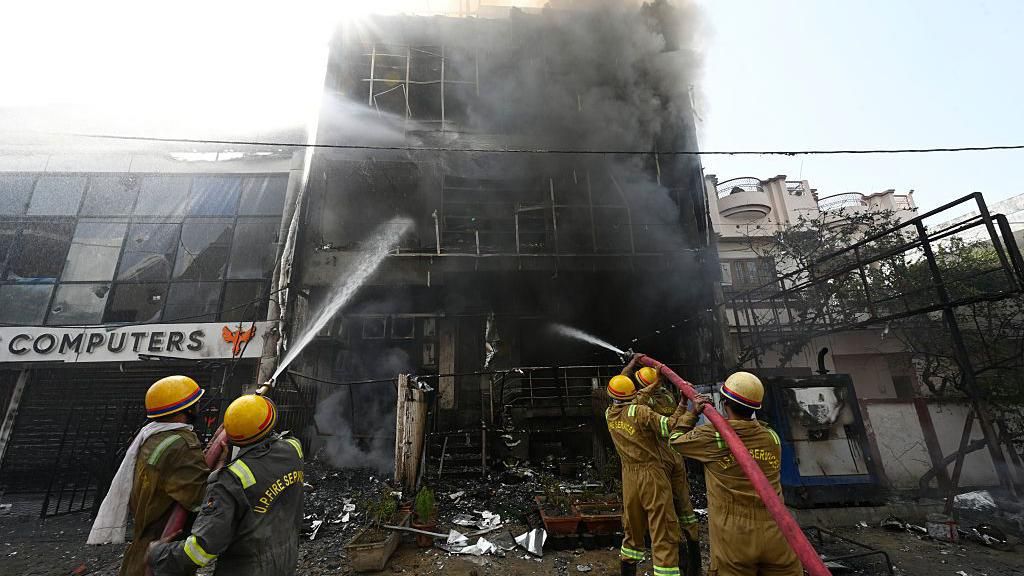
On a Monday afternoon in the densely populated Aliganj neighborhood of Lucknow, the capital city of India’s northern Uttar Pradesh state, a devastating fire tore through a multi-story commercial building, leaving at least 15 people dead and dozens more injured. The blaze, which was first reported at 14:45 local time, has sparked urgent questions about systemic failures in fire safety regulation across India’s crowded commercial spaces, prompting state authorities to launch a formal investigation and take disciplinary action against responsible parties.
The building in question held three separate commercial operations: a pet shop on the ground floor, with an animation and 3D gaming training center occupying the two upper floors. When the fire ignited, rapidly spreading smoke and flames quickly engulfed the building’s only staircase, cutting off the sole available exit route for everyone inside. Compounding this deadly hazard, official investigations have already confirmed the structure lacked any secondary emergency exits, trapping hundreds of people inside as toxic smoke filled hallways and workspaces. Adding another layer of complication, relatives of some victims reported that a restricted biometric access control system locked sections of the training center, slowing escape attempts for many trapped people.
Eyewitnesses recount chaotic scenes of panic as desperate people scrambled to flee the burning structure. Some trapped occupants climbed down exposed power cables to reach the ground, while others jumped from upper-floor windows in a bid to escape the smoke. Local bystanders rushed to the site within minutes to assist with rescue efforts, throwing stones to shatter window panes and pull escaping people to safety, with local residents reporting they rescued five to six people before professional first responders arrived. Anurag Ojha, one of the first witnesses to the fire, described the overwhelming chaos to BBC Hindi: “I was resting in my room and there was a foul smell outside. When I looked, there was a huge fire and people were crying for help.”
Trapped victims made frantic final calls to family members as smoke closed in, leaving families grappling with unthinkable loss. Prabhujyot Singh recalled receiving a desperate call from his son, who begged “Papa, there’s a fire. Save me, I’m trapped inside,” only for Singh to arrive at the scene far too late to save him. Nineteen-year-old Mohammad Shazan, a trainee at the animation center, locked himself in a bathroom to avoid toxic smoke, but could not escape before first responders reached him.
Professional firefighting teams faced major challenges accessing the trapped occupants. To reach people trapped on upper floors and the roof, crews had to cross over from an adjacent building’s terrace before breaching a side wall of the burning building to access the interior. By the time the fire was fully contained, 15 people had been confirmed dead, most of them trainees and employees of the animation center.
In the aftermath of the tragedy, Uttar Pradesh Deputy Chief Minister Brajesh Pathak confirmed that a formal public inquiry has been initiated, with authorities directed to implement new measures to prevent similar deadly incidents in the future. Law enforcement has already filed criminal charges against four individuals linked to the building’s ownership and management, on counts of endangerment and negligence leading to death. Four local public officials responsible for fire safety inspections have also been suspended pending the outcome of the investigation. While the exact cause of the fire remains unknown at this stage, officials are continuing their work to identify the source.
This latest fatal fire comes less than one month after a similar deadly blaze at a New Delhi bed-and-breakfast left multiple people dead. The Lucknow tragedy has reignited longstanding public concerns over systemic fire safety violations in India’s densely packed commercial and residential buildings. Over the past several months, a string of deadly blazes across the country has repeatedly exposed widespread non-compliance with basic fire safety regulations, prompting calls for sweeping regulatory reform and more rigorous enforcement of existing safety standards.