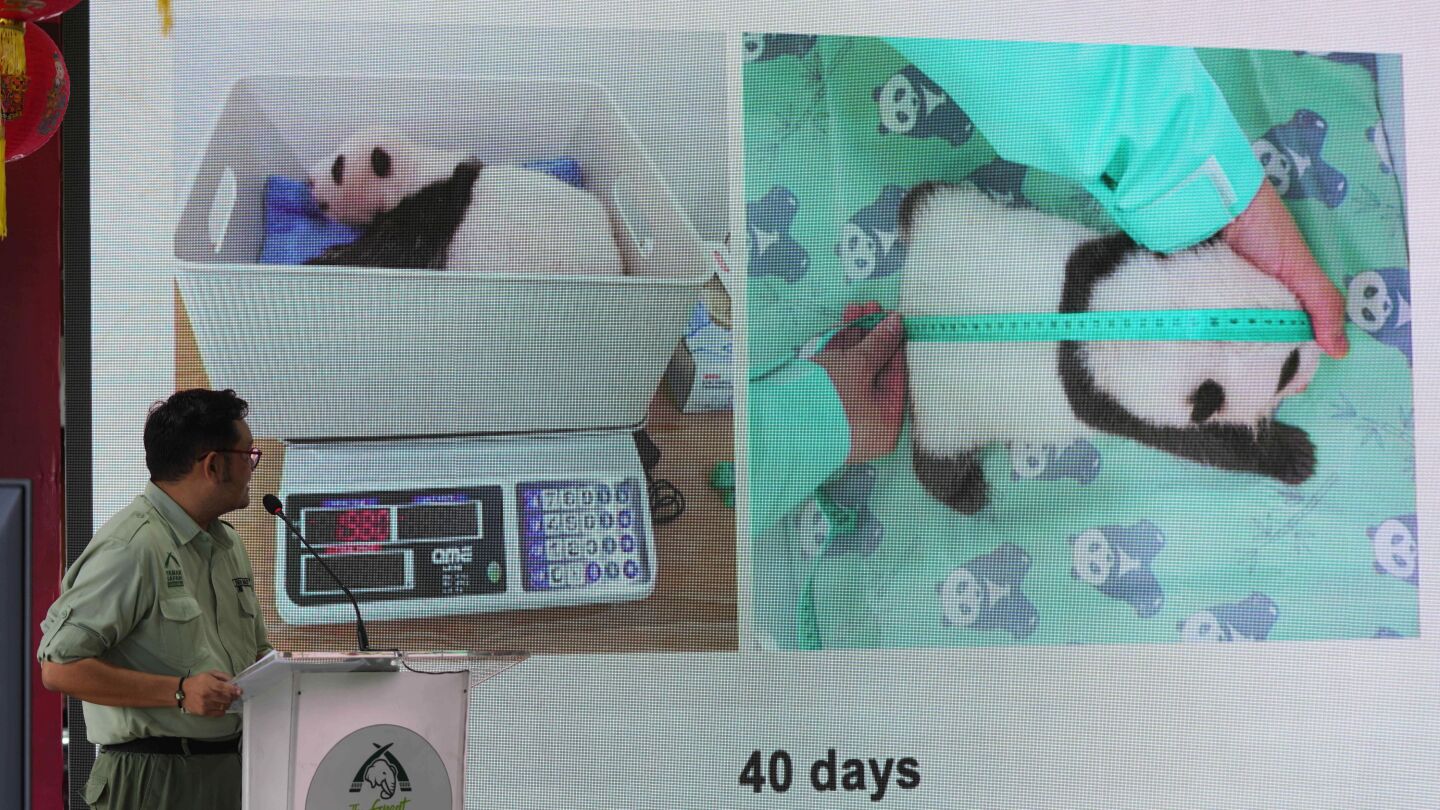
In a significant development for international wildlife conservation, Indonesia’s Taman Safari Park has documented the remarkable growth of a giant panda cub born through Sino-Indonesian diplomatic cooperation. The cub, named Satrio Wiratama and affectionately called “Rio,” underwent his first comprehensive veterinary examination outside incubator care, revealing extraordinary developmental progress.
Veterinary specialists at the West Java facility reported substantial physiological advancements in the 40-day-old cub. Senior veterinarian Bongot Huaso Mulia confirmed, “The panda cub demonstrates exceptional health indicators with a 46% weight increase and 95% length expansion over the past month.” The examination footage captures Rio’s transformation from a pink newborn to a fur-covered cub developing characteristic black-and-white markings.
Rio represents a conservation breakthrough born to 15-year-old Hu Chun and Cai Tao on November 27. The parent pandas arrived in Indonesia in 2017 under a decade-long conservation agreement between China and Indonesia. Their specialized habitat, located 70 kilometers from Jakarta, has become the setting for this diplomatic success story.
The birth followed extensive breeding efforts involving four natural mating attempts and four artificial insemination procedures. “This achievement resulted from persistent scientific dedication,” Mulia emphasized, acknowledging the reproductive challenges typical of giant pandas.
Chinese Ambassador to Indonesia Wang Lutong celebrated the birth as both a conservation victory and diplomatic milestone: “This moment culminates years of collaborative effort. Rio’s arrival enriches the global panda community while strengthening international conservation ties.”
The development holds particular significance given giant pandas’ endangered status, with fewer than 1,900 remaining in their native Sichuan, Shaanxi, and Gansu habitats. Panda loans traditionally serve as instruments of China’s soft-power diplomacy, making Rio’s successful birth a testament to effective cross-border wildlife preservation partnerships.