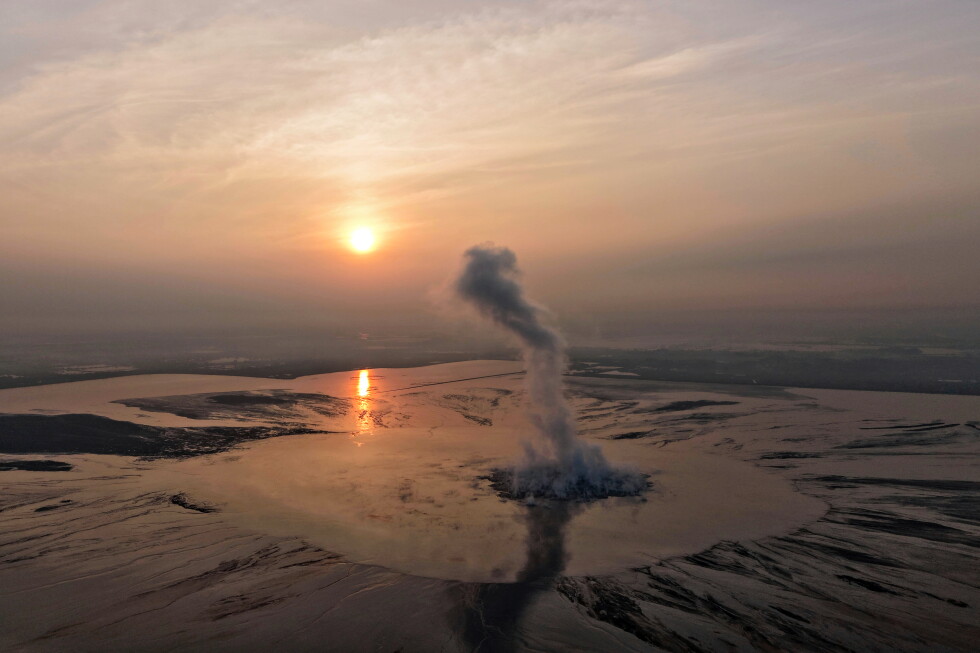
On Friday, hundreds of residents gathered along the murky shores of the Lusi mud lake in Sidoarjo, East Java, to mark two decades since one of Indonesia’s longest-running environmental disasters displaced tens of thousands and claimed at least 14 lives. On May 29, 2006, scalding hot mud began erupting from the ground in Porong subdistrict, slowly swallowing entire villages, infrastructure, and farmland over the following months. To this day, the mud flow has never stopped.
Scientific consensus points to commercial gas drilling conducted by local exploration firm PT Lapindo Brantas as the trigger for the eruption. This finding directly contradicts claims made by a senior Indonesian government minister at the time, who insisted the event was an entirely natural geological disaster. The 14 confirmed fatalities from the disaster came months after the initial eruption: one worker died when his excavator toppled off a containment levee in August 2006, and 13 more were killed when an underground gas pipeline stored beneath a holding dam ruptured and exploded that November.
Decades of efforts by geologists and engineers to halt or even slow the relentless spread of mud have ended in failure. Multiple containment strategies, ranging from the construction of large earthen holding dams to targeted plugging of the eruption vent, have not stopped the flow. Today, the mud lake spans more than 2,700 acres, having engulfed 19 villages across three East Java subdistricts. Even after 20 years, white steam continues to billow from the small central vent, a visible reminder that hot mud is still pushing to the surface, and constant dredging is required to prevent the containment area from overflowing.
The disaster uprooted tens of thousands of people, who lost not just their homes and livelihoods, but also ancestral land and historic burial grounds. For 55-year-old Sastro, a local resident who goes by a single name like many Indonesians, the disaster destroyed his former career as a factory worker when his workplace was submerged in the 572-hectare main mud sea. Today, he earns a living as a motorcycle taxi driver, shuttling curious tourists who now visit the site, which has evolved into an unlikely regional tourist destination. “As far as I can tell, things have been really tough ever since the Lapindo incident,” he told reporters.
Shortly after the eruption, then-Indonesian president Susilo Bambang Yudhoyono ordered PT Lapindo Brantas to pay $420 million in victim compensation and fund government emergency response operations. While the company did disburse a small portion of the required funds, the majority of compensation eventually came from public emergency assistance programs. Two decades on, survivors continue to grapple with lingering, unresolved crises: ongoing environmental contamination, unaddressed public health concerns, tangled civil registration issues, and persistent uncertainty about their long-term future, according to Lucky Wahyu Wardana of the East Java branch of WALHI, the Indonesian Forum for Living Environment.
Wardana emphasized that the decades-long tragedy must serve as a critical warning for national policy. “The Lapindo tragedy must serve as a lesson for the government to stop relying on extractive industries, as the costs of the impact far outweigh the benefits,” he said. “Not only have lives been lost, but children who once lived in the affected areas have lost their future and face health consequences. In addition, many parents have lost their sense of history regarding their origins and hometowns.” The commemoration on Friday brought survivors together to lay flowers, share prayers, and honor the lives and communities that were permanently erased by the unrelenting mud flow.