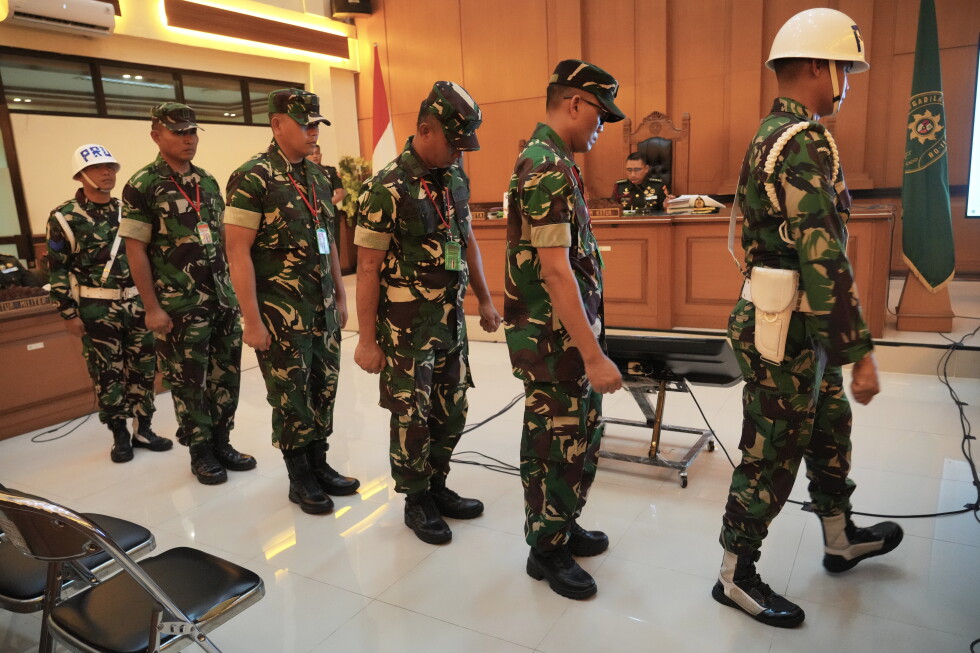
JAKARTA, Indonesia – In a ruling that has reignited long-running debates over military accountability and impunity for attacks on human rights defenders in Indonesia, a military tribunal handed down guilty convictions and prison sentences of up to three years Wednesday to four active-duty intelligence service members for a brutal acid assault on a prominent local rights campaigner.
The four convicted personnel include three Indonesian Navy Marines – Sgt. Edi Sudarko, First Lt. Budhi Hariyanto Widhi Cahyono, and Capt. Nandala Dwi Prasetya – and one Indonesian Air Force officer, Lt. Sami Lakka. All four were assigned to the intelligence division of the Indonesian National Armed Forces (TNI) at the time of the March attack, which targeted Andrie Yunus, a human rights lawyer and senior organizer with the Commission for the Disappeared and Victims of Violence, widely known by its Indonesian acronym KontraS.
The assault unfolded as Yunus rode his motorcycle through central Jakarta, shortly after he finished recording a podcast discussing the TNI’s growing political influence over the Indonesian civilian government. Attackers threw concentrated hydrochloric acid directly at Yunus’s face, leaving the 27-year-old with severe full-thickness burns and permanent vision impairment in his right eye.
The three-judge panel of the Jakarta Military Court handed down varied sentences across the four defendants: Sudarko, identified as the organizer who recruited the other co-conspirators, received the maximum three-year prison term, while Cahyono was sentenced to two and a half years behind bars. Prasetya was ordered to serve two years, and Lakka received an 18-month sentence. Both Sudarko and Cahyono, who was found to have proposed the acid attack plot, have been dishonorably discharged from the TNI.
In reading the court’s verdict, presiding judge Fredy Isnartanto condemned the actions of the convicted soldiers, noting that as serving service members, they had violated their core oaths of duty by targeting the activist. “The defendants, as TNI service members, betrayed their duties by deliberately throwing acid at Andrie Yunus,” Isnartanto stated. “Their actions damaged the image of the Indonesian military and demonstrated clear arrogance. The attack inflicted lasting trauma and suffering on the victim and caused permanent damage to his eye.”
The verdict was met with immediate and widespread criticism from domestic and international human rights groups, which argue the ruling deliberately ignored evidence of potential coordination and involvement by higher-ranking military officials, and that the lenient sentences fail to deliver meaningful justice for the attack.
Amnesty International Indonesia’s regional office warned that the prosecutors’ lenient sentencing requests and the court’s narrow focus on only four low- to mid-ranking soldiers reinforced widespread fears that the entire proceedings amounted to a show trial designed to deflect scrutiny rather than uncover the full truth. The organization has called for a new investigation led by civilian judicial authorities to identify and prosecute any individuals who ordered or funded the attack.
Indonesia’s independent National Commission on Human Rights (Komnas HAM), which launched its own parallel probe into the assault, concluded that the attack was a pre-planned, coordinated operation that likely involved far more individuals than the four defendants. The commission’s findings also documented multiple violations of Yunus’ fundamental rights, including his right to personal security, freedom from cruel and degrading treatment, and right to equal access to justice.
Prosecutors in the military trial had claimed the four men acted entirely on their own initiative, with no superior orders. They argued the attack was motivated by personal anger over Yunus’ public criticism of the military, claiming the soldiers’ only goal was to “teach him a lesson” for his activism. Yunus, a leading voice for security sector reform and an end to military impunity in Indonesia, rose to prominence last year as a key organizer of widespread public protests opposing proposed amendments to Indonesia’s military law that would expand the armed forces’ already broad authority over civilian governance. Colleagues confirm Yunus has faced repeated threats and intimidation tied to this high-profile advocacy work.
Per representatives from the Advocacy Team for Democracy (TAUD), the civil society group supporting Yunus through the legal process, the activist refused to testify at the trial, which opened in late April. Yunus cited two core reasons for his refusal: he is still undergoing ongoing medical recovery, including multiple skin graft surgeries to treat his burn injuries, and he has no confidence that the military court would deliver an impartial, fair ruling.
Last week, a civilian court at the South Jakarta District Court partially granted a pretrial motion filed by Yunus, ordering Jakarta Police to resume their investigation into the attack to ensure full justice and protection for Yunus and other rights defenders. The civilian judges backed Komnas HAM’s longstanding call for expanded investigation to identify additional perpetrators, including any civilian co-conspirators. Both Komnas HAM and a broad coalition of Indonesian civil society groups estimate that more than a dozen individuals were involved in planning and carrying out the assault.
The conviction has drawn new international attention to the persistent problem of unpunished attacks on human rights activists in Indonesia. The case echoes the decades-long unresolved assassination of Munir Said Thalib, the iconic founder of KontraS and leading critic of military corruption, who was poisoned with arsenic on a flight to Amsterdam in 2004. While a single low-ranking intelligence agent was convicted in that killing, evidence of higher-level involvement has never been fully investigated or prosecuted.