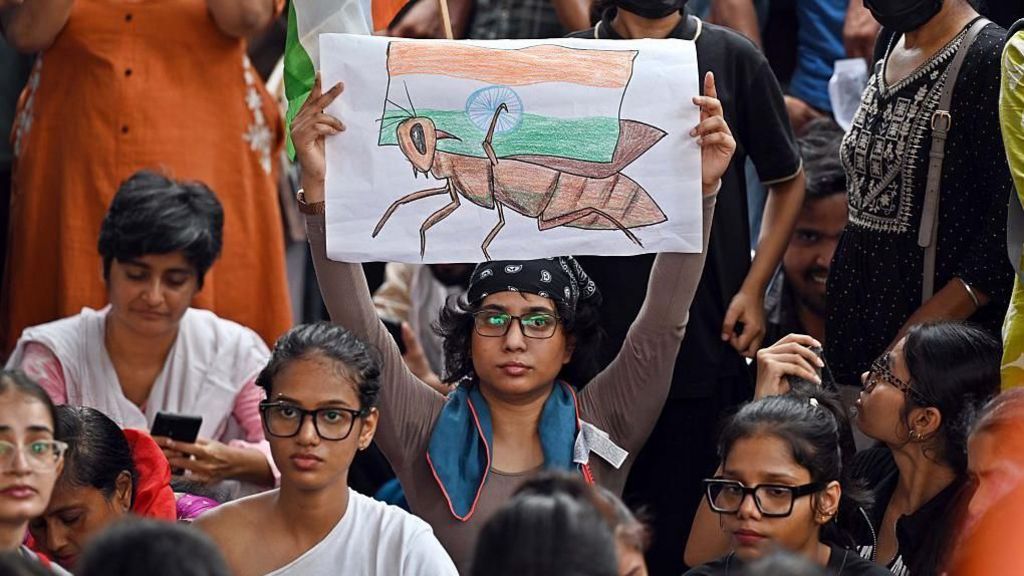
Even as heavy monsoon rains drenched New Delhi this week, thousands of determined demonstrators have refused to abandon their sit-in at Jantar Mantar, the historic central Delhi site that has become the heart of a growing grassroots movement demanding systemic education reform.
What began as a month-long protest camp has now escalated into one of the most significant challenges to Prime Minister Narendra Modi’s government in recent years, led by the youth-driven Cockroach Janta Party (CJP), an unregistered political movement born from public outrage over a controversial comment by India’s chief justice earlier this year. The CJP’s core demands are sweeping changes to India’s education system and the immediate resignation of Union Education Minister Dharmendra Pradhan.
The crisis boiled over on Monday, the opening day of India’s parliament monsoon session, when tens of thousands of CJP supporters marched on the national legislature to amplify their demands. In a swift crackdown, Delhi Police—reporting directly to Union Home Minister Amit Shah—deployed baton charges and tear gas to disperse the crowd, leaving at least 60 people injured, including both demonstrators and officers. Law enforcement also dismantled the protest stage and temporary encampment at Jantar Mantar, but demonstrators defiantly refused to evacuate the site, maintaining a continuous 24-hour sit-in through the overnight downpour.
The crackdown drew immediate condemnation from India’s main opposition bloc, which has rallied to the protesters’ cause. On Tuesday, senior Congress party leaders launched an unannounced protest outside Prime Minister Modi’s official residence, demanding the resignations of Pradhan, Shah, and Modi himself, as well as a formal government apology for the violence against demonstrators. Police responded by detaining key Congress leaders, including former party president Rahul Gandhi, dragging demonstrators into police buses to be transported to detention facilities before releasing them later the same day. Congress has publicly shared video footage of the detentions to highlight what it calls the government’s anti-democratic crackdown on dissent.
Speaking after his release, Gandhi accused the Modi government of blocking parliamentary debate on the education crisis. “We approached Speaker Om Birla to request time for a discussion on the issue, but the speaker told us he needed approval from the ruling government, and it was clear the government had no interest in debating the demands of students,” Gandhi said.
Union ministers have pushed back against these allegations, framing the opposition’s actions as unnecessary political theater. Federal Minister Jitendra Singh countered that the government had already agreed to a parliamentary discussion, but Gandhi moved the goalposts by adding a demand for Pradhan’s resignation, forcing an impasse. Singh also noted that the protest location outside the prime minister’s residence was not zoned for public demonstrations, rejecting the opposition’s claims of censorship.
In his first public statement since Monday’s violence, Pradhan accused the Congress party of shamelessly exploiting student protesters for political gain. “Even after the government conveyed its readiness for a comprehensive discussion, the Congress chose political spectacle over democratic debate,” Pradhan wrote in a post on X. “Their objective was never solutions for students, it was disruption for political headlines. We owe our students more than outrage. We owe them answers, reforms and accountability. That is exactly what our government remains committed to delivering.” The CJP has not yet issued a formal response to Pradhan’s comments.
The origins of the CJP stretch back to earlier this year, when India’s chief justice sparked national outrage after using the word “cockroach” to describe unemployed young people who entered journalism and political activism. Though the chief justice later clarified that he was only referring to individuals with “fake and bogus degrees,” the insult was adopted as a badge of honor by disaffected young Indians, who formed the movement to demand change.
The protest gained international attention last month when prominent education activist Sonam Wangchuk joined the Jantar Mantar encampment and launched an indefinite hunger strike to support the movement’s demands. Police forcibly removed Wangchuk from the protest site on Saturday and transferred him to a local hospital, where he has continued his fast.
As of Wednesday, the CJP’s campaign has expanded far beyond India’s capital, with solidarity protests held in major cities across the country, including Mumbai, Hyderabad, Bengaluru, and Ahmedabad. Senior opposition figures from across the ideological spectrum, including former Delhi Chief Minister Arvind Kejriwal and veteran politician Sharad Pawar, have also visited the Jantar Mantar site to express their support for the demonstrators, turning a youth-led protest into a broad coalition pushing for government accountability.