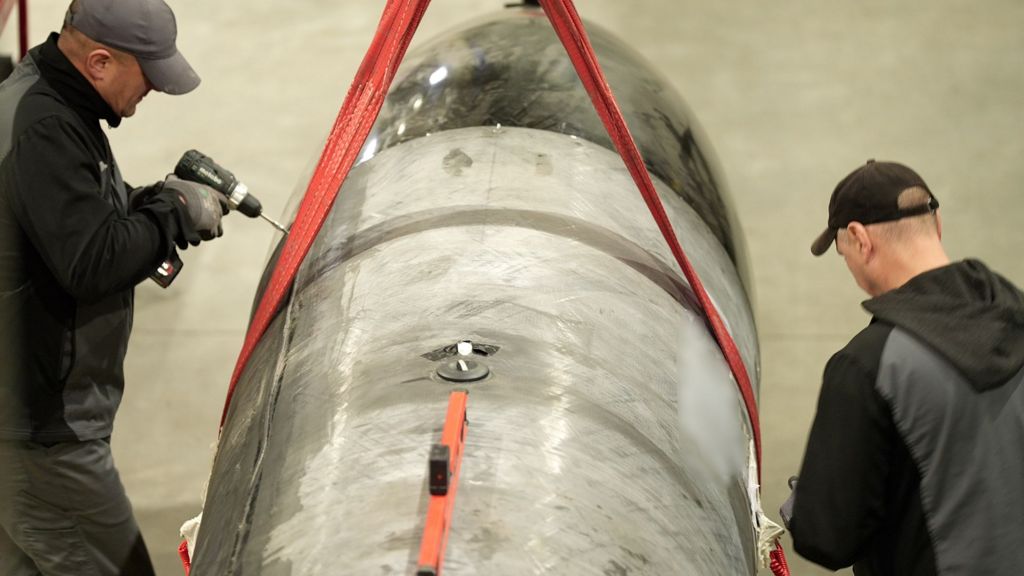
In a clandestine facility somewhere in Ukraine, a military transformation is underway under extraordinary secrecy. BBC correspondents, blindfolded during transport to protect the location, witnessed the production of Ukraine’s formidable Flamingo cruise missile – a domestically developed weapon system with an estimated 3,000km range capability.
The extreme security measures reflect Ukraine’s adaptation to wartime realities: production facilities for these critical weapons must remain hidden from Russian targeting. Two factories belonging to manufacturer Fire Point have already been struck, forcing the company to disperse and conceal its operations. Within the assembly area, workers’ identities are protected and architectural features cannot be filmed, all part of maintaining operational security while continuing production.
This represents a remarkable evolution in Ukraine’s defense capabilities. President Volodymyr Zelensky reveals that over 50% of weapons deployed on front lines are now domestically produced, with nearly all long-range systems originating from Ukrainian industry. This marks a dramatic shift from early dependence on Soviet-era stockpiles and Western military aid.
At the heart of this effort is Iryna Terekh, Fire Point’s 33-year-old chief technical officer. The former architecture student now oversees production of the black-painted Flamingo missile which she describes as designed to ‘eat Russian oil.’ The massive weapon, resembling a World War Two V1 rocket with a jet engine mounted on a tube the length of a London bus, provides Ukraine with deep-strike capabilities that Western nations have been reluctant to supply.
The strategic significance is substantial. With front lines stretching over 1,000 kilometers, Ukraine is increasingly targeting Russia’s war economy to slow advances. General Oleksandr Syrskyi, head of Ukraine’s Armed Forces, estimates long-range strikes have cost the Russian economy over $21.5 billion this year alone.
Ruslan, an officer in Ukraine’s Special Operations Forces, explains the strategy: ‘To reduce the enemy’s military capabilities and their economic potential.’ His forces have conducted hundreds of strikes deep inside Russian territory targeting oil refineries, weapons factories, and ammunition depots.
Despite impressive progress, disparities remain. Russia launches approximately 200 Shahed drones daily, while Ukraine’s response reaches about half that number. Fire Point, which didn’t exist before the full-scale invasion, now produces 200 drones daily at approximately $50,000 each – significantly cheaper than Russian equivalents.
The company deliberately avoids components from China and the United States, with Terekh explaining the emotional ‘roller coaster’ with American support. This self-sufficiency strategy emerges amid uncertain Western backing, particularly after the Trump administration halted nearly $70 billion in military support previously provided under President Biden.
Denys Shtilerman, Fire Point’s chief designer, acknowledges there is no ‘wonder weapon’ but emphasizes that ‘the game changer is our will to win.’ Terekh views domestic weapons production as Ukraine’s true security guarantee, dismissing current peace negotiations as ‘capitulation talks.’
She hopes Ukraine’s example will shock Europe into preparedness: ‘We are a bloody example in terms of being prepared for war,’ noting that most other nations would have ‘already been conquered’ facing similar onslaught.