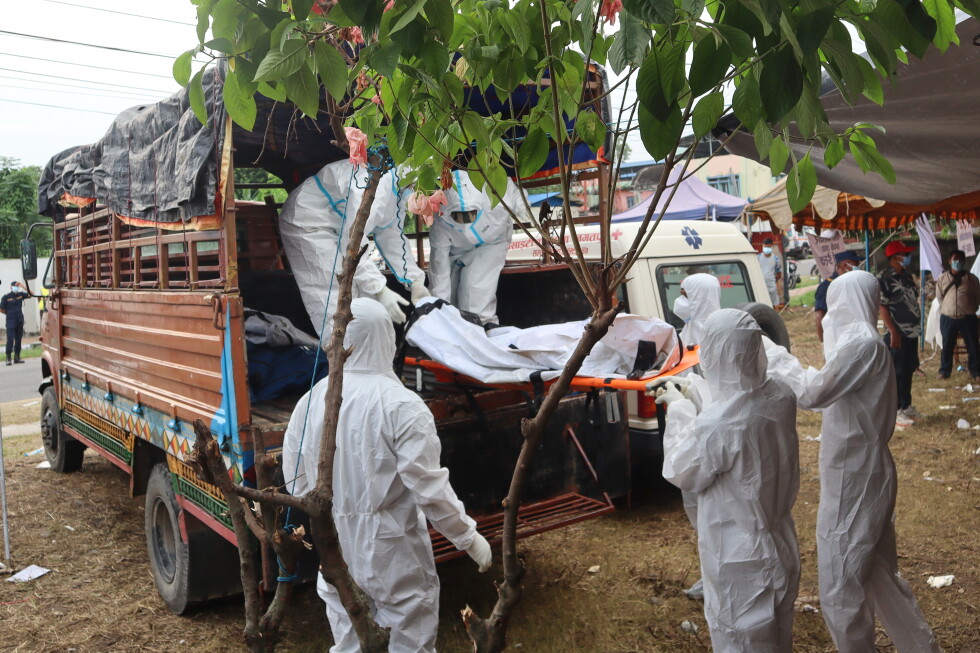
In the wake of catastrophic flash floods and mudslides that tore through the Himalayan region earlier this week, authorities in Nepal’s south-central Chitwan district have been forced to take unprecedented action: burying hundreds of unidentifiable disaster victims in temporary communal graves, a move that has sparked fierce public debate over cultural traditions and disaster response protocols.
The disaster, which struck Wednesday, has already claimed at least 800 lives across Nepal and the Tibet Autonomous Region of China, with more than 3,000 people still unaccounted for. Many of the bodies recovered in Chitwan were swept hundreds of kilometers downstream along the Bhotekoshi River from the flood’s hardest-hit epicenter, leaving local officials overwhelmed by the sudden influx of remains. As of Saturday, around 250 bodies were still waiting for identification, and officials confirmed that roughly 100 victims had already been laid to rest in hastily dug temporary trenches in a forested area of the district, with another 50 set for burial on Sunday after DNA samples are collected.
Local law enforcement coordinating the operation say the rushed burials are a necessary response to a cascade of overlapping crises. Anil Thapa, a police inspector leading the body management effort, explained that most remains spent up to four days submerged in rushing floodwaters, and decomposition was already well advanced by the time they were recovered. Compounding this challenge, Chitwan faces severe limits to its forensic infrastructure and morgue capacity, unable to accommodate the surge of bodies brought in by the flood. Sweltering heat and high regional humidity have further sped decomposition, and public health officials have warned that leaving decomposing remains unburied poses a serious risk of infectious disease outbreaks.
The logistical challenges have been exacerbated by fresh natural hazards in the region. On Sunday, new landslides blocked the key highway connecting Nepal’s capital Kathmandu to Chitwan, just one day after the route was partially reopened. This disruption has complicated both the movement of remains into the capital and the delivery of critical relief supplies to flood-impacted communities. Across the flood zone, the scale of destruction remains visible: homes, vehicles, and farm equipment are still left half-buried in thick mud deposited by the mudslides.
The decision to proceed with temporary burials has drawn sharp criticism from local residents, families of the missing, and prominent public figures, particularly given Nepal’s status as a majority-Hindu nation where traditional custom requires cremation of the dead, often conducted on riverbanks in the presence of immediate family. Ruby Chaudhary, a local resident who is still waiting for news of two missing relatives, said authorities had no right to proceed with burials without family consent. “The dead deserve to be treated with dignity,” Chaudhary said. “Our tradition is to cremate them on the riverbank, surrounded by their immediate family.”
Former Nepali prime minister Baburam Bhattarai also joined the criticism, arguing that disposing of unidentified bodies before search and rescue operations are concluded, and without broader consultation with affected families, is inappropriate. In a social media post Saturday night, Bhattarai noted that if permanent morgue space was insufficient, authorities could have mobilized emergency resources to set up temporary cold storage facilities instead of rushing to burials.
Nepali officials have defended the measure, emphasizing that the burials are only a temporary solution, not a permanent disposition of remains. Thapa stressed that authorities have taken steps to preserve future identification: DNA samples are collected from all victims, photographs of distinguishing features are taken, other identifying details are recorded, and each body is assigned a unique reference number to allow families to claim remains at a later date. “If someone is able to verify the identity later using the available information, they can take back the body and perform the appropriate funeral rites,” Thapa explained.
Amrit Bahadur Rai, Nepal’s foreign secretary, added that the process aligns with internationally accepted disaster management standards, including protocols established by the International Committee of the Red Cross. Speaking at a press briefing in Kathmandu, Rai confirmed that once identities are confirmed through matching records, families will be permitted to exhume the remains to carry out traditional funeral rituals.