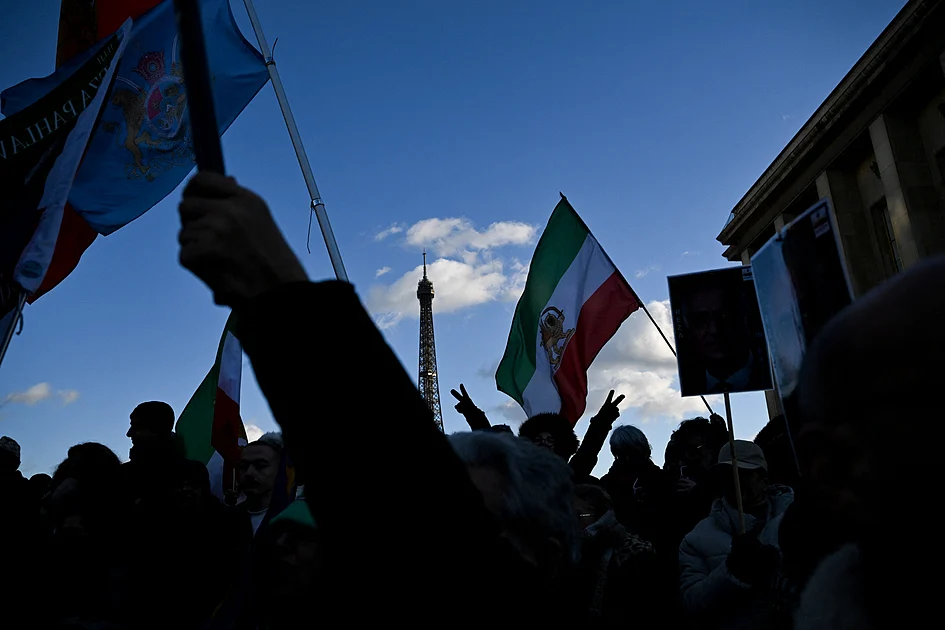
Iran’s theocratic leadership confronts its most formidable challenge in years as nationwide demonstrations evolve from economic discontent into explicit demands for systemic political change. The protest movement, which initiated with strikes at Tehran’s bazaar in late December, has rapidly escalated into mass rallies challenging the clerical establishment that has governed since the 1979 revolution.
According to international rights organizations, the government’s aggressive crackdown has resulted in hundreds of casualties, though the authority of 86-year-old Supreme Leader Ayatollah Ali Khamenei remains ostensibly intact. Analysts note that while the scale and political nature of these protests represent a significant threat to the Islamic Republic, predicting its immediate collapse would be premature.
Professor Nicole Grajewski of Sciences Po Centre for International Studies in Paris observed, “These protests arguably represent the most serious challenge to the Islamic republic in years, both in scale and in their increasingly explicit political demands.” She emphasized the resilience of Iran’s repressive apparatus as a critical factor in the regime’s stability.
Several key elements will determine the outcome of this crisis. The sustainability and growth of protests remain crucial, though current demonstrations haven’t reached the critical mass necessary for irreversible change. The cohesion within Iran’s political and military elite shows no significant fractures thus far, with all major institutions including the Revolutionary Guards maintaining allegiance to Khamenei.
International dimensions complicate the situation, with former US President Donald Trump implementing economic measures and not excluding military options. Any direct foreign intervention would fundamentally alter the crisis trajectory, according to analysts. Meanwhile, the opposition movement struggles with internal divisions and lacks cohesive leadership capable of unifying various factions.
The health and succession planning for Khamenei introduce additional uncertainty, with potential scenarios ranging from his son Mojtaba assuming power to a collective leadership structure or even a takeover by the Revolutionary Guards. The regime’s vulnerability appears heightened both domestically and geopolitically, reaching levels not seen since the Iran-Iraq war of 1980-1988.