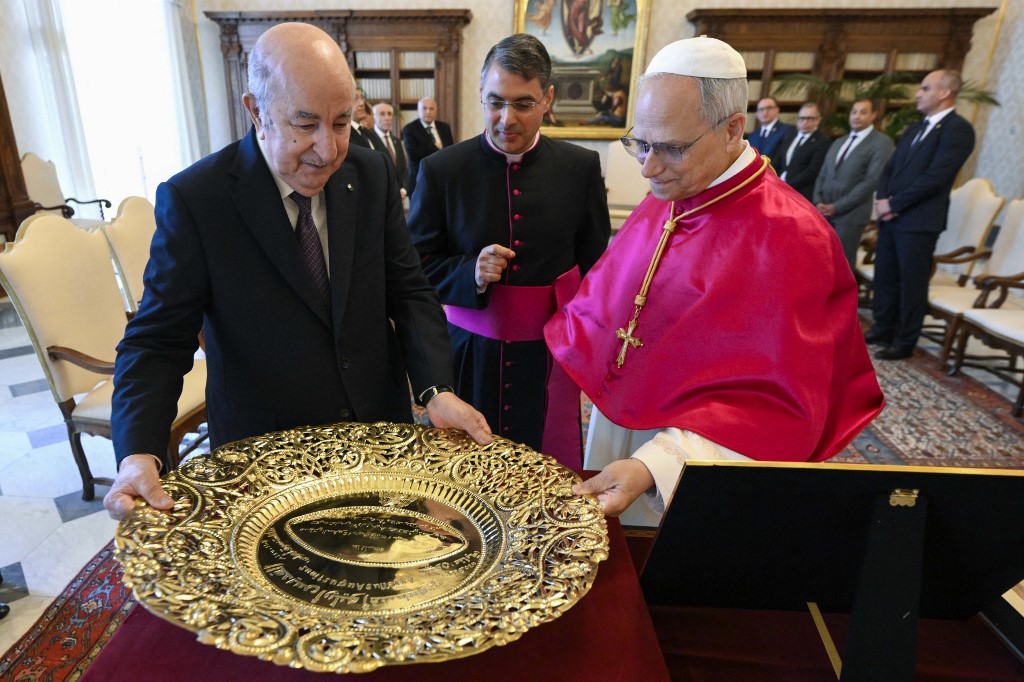
In a groundbreaking moment for the global Catholic Church, Pope Leo XIV will make the first official papal visit to Algeria this April, kicking off a multi-nation African tour that will also take him to Cameroon, Angola and Equatorial Guinea from April 13 to 15. The visit carries deep personal and historical meaning, tied closely to the pontiff’s lifelong connection to Saint Augustine, the iconic fourth-century theologian whose origins are deeply rooted in what is now northeastern Algeria.
Pope Leo, born Robert Francis Prevost in the United States, has identified himself as a devoted Augustinian from his earliest days in the Church. He joined the Augustinian Order at age 22 after studying mathematics and philosophy in Philadelphia, and eventually rose to lead the order as its prior general. His connection to Algeria stretches back more than two decades: in 2001, he first visited the North African country to attend an international symposium on Saint Augustine hosted by the University of Annaba. As Cardinal Jean-Paul Vesco, Archbishop of Algiers, revealed, he encouraged the newly elected pope to prioritize an Algerian visit within the first months of his pontificate.
Saint Augustine, one of the most influential thinkers in Christian history, was born in 354 CE in Thagaste, a Amazigh-Roman settlement that is today the Algerian city of Souk Ahras. He later served as bishop of Hippo Regius, the ancient name for Annaba, the second stop on Pope Leo’s upcoming itinerary. In his first public address after his election in Rome’s St. Peter’s Square last May, the pope highlighted his Augustinian identity, quoting the theologian’s famous words: “With you I am a Christian, and for you I am a bishop.” The remark resonated strongly in Algerian media, which has emphasized the new pope’s deep reverence for the North African-born scholar.
For Algerian historian Abdenasser Smail, author of the recently published *Saint-Augustin, un Nord-Africain universel*, the visit is as much an act of historical reckoning as it is a religious pilgrimage. “Augustine is a figure rooted in North African geography and culture. Yet, this essential dimension has long been obscured, both in Western representations and in contemporary Algerian national narratives,” Smail explained. He argues that the pope’s tribute to Saint Augustine corrects this historical erasure, noting that even in majority-Muslim Algeria, citizens can take pride in the thinker as a native son. “Being proud of one’s history doesn’t mean adopting another faith. It means recognising that this land has produced multiple great figures. To deny this is not to defend Islam. It is to impoverish our own memory,” Smail added.
Pope Leo’s itinerary reflects the dual religious and historical significance of the trip. After arriving in the capital Algiers, he will deliver a public address at the Martyrs’ Monument, a memorial to those who died in Algeria’s war of independence from French rule, followed by a meeting with the country’s top government leaders at the Great Mosque’s conference center. In Algiers, he will also pray at the chapel dedicated to the 19 Christian religious figures killed during Algeria’s brutal 1992–2002 civil war, a period known locally as the “Black Decade.” These victims, which included Bishop Pierre Claverie of Oran and the seven monks of Tibhirine, were declared martyrs by former Pope Francis and beatified in 2018 in the first such ceremony ever held in a Muslim-majority nation. The trip will conclude with a visit to Annaba’s Saint Augustine Basilica, which is currently undergoing maintenance in preparation for the pontiff’s arrival.
Algerian authorities have placed exceptional importance on the historic visit, with President Abdelmadjid Tebboune personally overseeing all preparations. Annaba has undergone extensive public works, including road resurfacing, street cleaning and infrastructure upgrades along the route to the basilica, to welcome the pope.
Beyond honoring Saint Augustine, the visit also offers a gesture of support to Algeria’s small but deeply rooted Catholic community. Out of Algeria’s total population of 46 million, just around 4,200 Catholics live across the country’s four dioceses, a sharp decline from the colonial era when thousands of European Catholics resided in the territory. Most current faithful are foreign migrants from sub-Saharan Africa, with only a few hundred native Algerian Catholics remaining. The community traces its modern evolution to the work of Cardinal Leon-Etienne Duval, who served as Archbishop of Algiers from 1954 to 1988. Duval famously condemned French colonial torture and massacres just one year after the outbreak of Algeria’s independence war, supported Algerian self-determination, and transformed the Catholic Church in the country from a colonial institution into a locally rooted, state-recognized organization that retained its social service missions after independence in 1962.
Today, the small Catholic community coexists peacefully with Algeria’s majority-Muslim population, and its status as an officially recognized religious body allows it to operate openly, even running schools and medical clinics that serve all Algerians. “I live my faith discreetly, as required by the fact that I live in a Muslim society, but I have never received a single derogatory remark,” said Simon, an Ivorian student studying in Algiers who attends weekly mass and participates in the community’s charitable outreach for disadvantaged Algerian children. For Algeria’s Catholic faithful, the pope’s visit is a momentous occasion. “It’s a gift, a grace, for our little flock here in Algeria,” Simon added.
However, the visit also brings forward unresolved issues around religious freedom and human rights that have drawn international attention. While the Catholic Church enjoys official recognition, other Christian groups face severe restrictions. A 2006 Algerian decree requires all religious communities practicing faiths other than Islam to obtain state authorization for their activities and places of worship. The Protestant Church of Algeria, despite official recognition in 2011, has seen all its public places of worship closed by authorities, who accuse evangelical Protestants of proselytizing and unlawful conversions – activities banned under Algerian law. Multiple pastors face legal prosecution, and many minority religious adherents decline to speak publicly for fear of government reprisal. The restrictions also extend to other minority groups, including the Ahmadiyya community, whose members are labeled heretics by the Sunni majority.
In advance of the visit, three major international human rights NGOs – EuroMed Rights, Human Rights Watch and the MENA Rights Group – issued an open letter urging Pope Leo to raise these concerns, as well as the issue of widespread arbitrary detention, during his meetings with Algerian leaders. “Hundreds of protesters, activists, journalists and human rights defenders have been arbitrarily detained, unjustly prosecuted and sentenced to prison terms for exercising their rights to freedom of expression and peaceful assembly,” the groups wrote, calling on the pontiff to press Algerian authorities to end religious discrimination and release unjustly detained individuals.