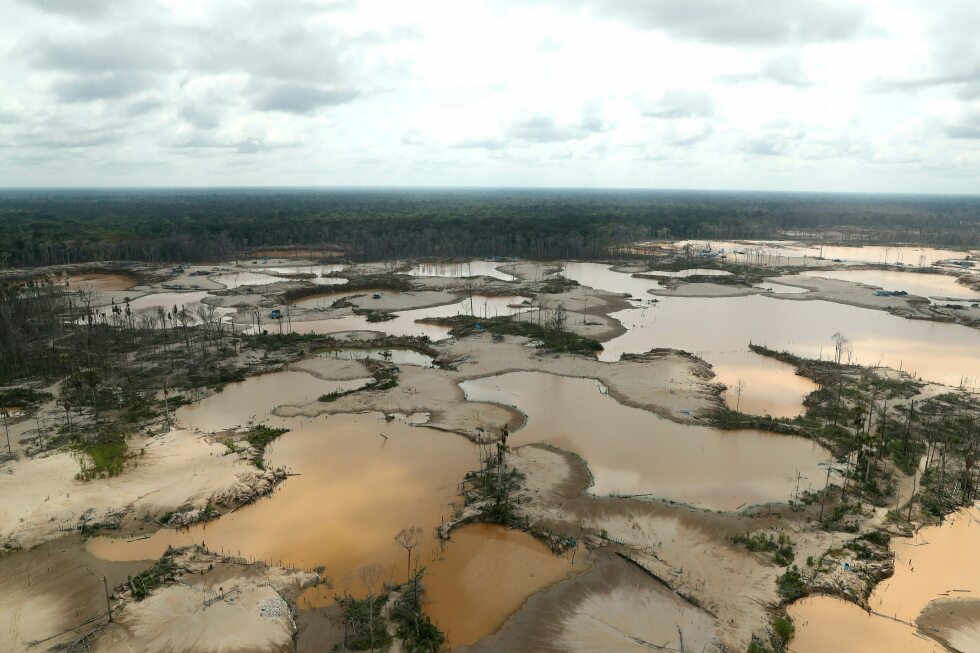
COLOMBIA — A devastating wave of illegal gold mining operations is rapidly infiltrating previously untouched regions of Peru’s Amazon rainforest, creating an escalating environmental and public health emergency that experts warn could cause irreversible damage to one of the world’s most biodiverse ecosystems.
The destructive industry, once concentrated primarily in Peru’s southern Amazon region of Madre de Dios, has now expanded northward into Loreto, Ucayali, and along the Ecuador border. This alarming expansion marks a dangerous new phase for Amazon destruction, as operations penetrate remote river systems and Indigenous territories with increasing sophistication.
Rodolfo García Esquerre, Peru’s high commissioner against illegal mining, acknowledged the severity of the crisis during a February television interview, stating: ‘Unfortunately, we have illegal mining in all regions of Peru.’
The mining techniques employed are exceptionally destructive: bulldozers strip away pristine forest, excavators carve massive pits into flood plains, and floating dredges suction river sediment in search of gold. The process leaves behind toxic, mercury-contaminated water pools and severely eroded riverbanks, while access roads enable deeper penetration into previously intact wilderness.
Environmental lawyer César Ipenza attributes the accelerated expansion to surging gold prices, with the precious metal trading at approximately $2,000 per ounce in 2026—near historic highs and roughly double its value from a decade earlier. ‘Illegal mining has increased considerably,’ Ipenza confirmed, noting that higher prices make operations economically viable in increasingly remote areas.
The environmental transformation occurs with alarming speed. Research professor Luis Fernández of Wake Forest University’s Sabin Center for Environment and Sustainability observed: ‘You’ll see changes in weeks to months once the machinery comes in… sediment plumes in the rivers almost immediately.’
At the Panguana Biological Station in Peru’s central Amazon—a private conservation area protecting exceptionally biodiverse forests—administrator Fernando Malatesta described dramatic changes: ‘Where there were once intact forests… the rivers are now murky. You used to see crystal-clear water, but not anymore.’ He recounted visiting a nearby area recently deforested by dozens of machines, describing it as ‘an unrecognizable place.’
The crisis extends beyond environmental damage to include serious threats to human safety. Malatesta and his team were forced to abandon their research station in 2025-2026 after facing escalating threats and confrontations with armed individuals. Researchers connect this violence to growing involvement of organized criminal networks, with illegal gold mining becoming a significant revenue source for transnational crime organizations.
Julia Urrunaga, Peru program director for the Environmental Investigation Agency, noted the activity is ‘deeply linked to the political forces in the country right now,’ complicating enforcement efforts.
While Peru’s government established a high-level multisector commission in late 2023 to combat illegal mining and formalize small-scale operations, environmental defenders consider enforcement inadequate despite recent operations seizing equipment valued at over $16 million.
Indigenous communities face particularly dire circumstances. Julio Cusurichi, an Indigenous leader from Madre de Dios, reported that more than 30 Indigenous leaders have been killed in recent years while defending their territories. Some communities, facing economic pressure, have reluctantly participated in mining operations, selling land for short-term gain despite long-term consequences.
The most insidious threat may be mercury contamination. Used extensively in gold extraction, mercury pollutes rivers and enters food chains, particularly affecting communities that rely on fish as a dietary staple. Claudia Vega, mercury program coordinator at the Amazon Center for Scientific Innovation, warned that contamination levels could approach those of Japan’s Minamata disaster, which caused widespread neurological damage, deformities, and sensory loss.
Scientists caution that continued expansion could push the Amazon toward an ecological tipping point, potentially converting vast rainforest areas into degraded savanna-like ecosystems. Urrunaga emphasized that international gold buyers ‘need to be accountable for the destruction that their consumption is generating in terms of the environment, but most importantly in terms of human lives.’
As Malatesta solemnly noted: ‘Every tree that falls, every river that is contaminated and every animal that disappears remind us that we are losing an irreplaceable treasure.’