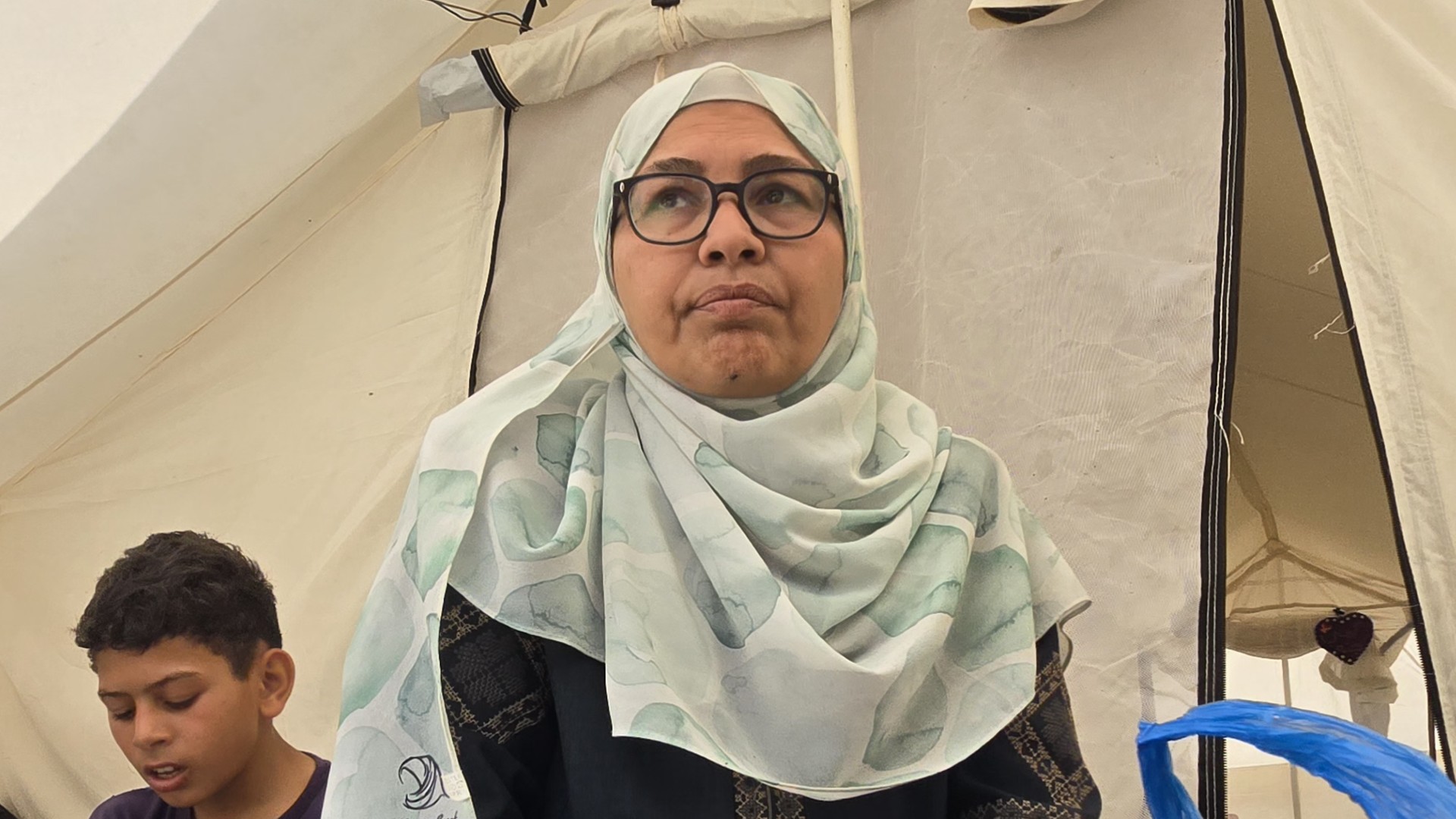
It was supposed to be a simple, ordinary trip to gather cooking fuel for the family evening meal. For 14-year-old Anas al-Sayed, that June 2025 outing in northern Gaza would turn into a missing person case that has left his family trapped in a nightmare of unknowing that has stretched on for 10 months.
Anas left the damaged, makeshift refuge his family occupied in Gaza City’s Shati refugee camp at around 4 p.m. on June 24, accompanied by his 12-year-old cousin, who also needed firewood for his own household, his mother Naima al-Sayed recalled in an interview with Middle East Eye. The pair traveled to a stretch of land located close to an Israeli military outpost. What should have been a quick foray soon turned to chaos when Israeli artillery opened direct fire on the two boys, forcing them to flee in separate directions to seek safety.
“My nephew ran west toward the sea, while my son turned east, deeper into territory closer to Israeli forces,” Naima, 49, explained. The cousin managed to take cover behind large boulders, calling out for Anas repeatedly, but got no response. By roughly 10 p.m., the young boy returned to the family alone, with no clue what had become of Anas.
Panicked, Anas’s father immediately set out to search for the teen, but was turned back by an Israeli quadcopter that appeared overhead and opened fire on the area. He returned home with a warning that the zone was far too dangerous to enter. “I didn’t sleep a wink that night. I counted every minute until the sun came up,” Naima said. At dawn, she set out on foot, walking for hours, asking every person she encountered if they had seen her son. Rumors swirled: some said Anas had been detained, others claimed he had been killed. That same day, the family made three trips to al-Shifa Hospital to cross-reference his name with incoming bodies, but found no trace. Anas had vanished without a clear explanation.
Anas’s case is not an isolated tragedy. According to the Palestinian Centre for the Missing and Forcibly Disappeared (PCMFD), roughly 2,900 Palestinian children have been reported missing across the war-ravaged Gaza Strip since Israel launched its military campaign in October 2023. Overall, the group estimates that nearly 8,000 Palestinians of all ages remain unaccounted for across the enclave.
Of the 2,900 missing children, PCMFD data suggests around 2,700 are likely killed, their bodies still trapped beneath the thousands of tons of collapsed rubble that litter Gaza following months of intensive airstrikes and ground operations. Another 200 children have simply disappeared without a trace across different areas of the Strip. “These children are either detained and forcibly disappeared by the Israeli military during operations, or killed in targeted strikes that left their remains in dangerous, inaccessible areas including aid distribution sites and zones under direct Israeli military control,” explained Mona Abunada, PCMFD’s media coordinator. “Families don’t even get the closure of knowing whether their child is dead or alive. Many have told us they would accept any answer — they just can’t bear this endless uncertainty.”
Since the start of Israel’s ground invasion in October 2023, Israeli forces have detained thousands of Palestinians from their homes, at military checkpoints, and in areas near force deployments. Israeli authorities have consistently refused to release information about people in their custody, including minor detainees, and have rejected repeated requests from the International Committee of the Red Cross (ICRC) for access to detention facilities and details on detainee whereabouts.
Ten months after Anas went missing, his family has reached out to multiple international humanitarian organizations, including the ICRC, for help tracing the teen, but none have been able to confirm where he is or what has happened to him. The family has combed through every list of released detainees, searching for Anas’s name. “I check the ages first. I look for 15 now, because he would have turned 15 by now,” Naima said. They have shown Anas’s photo to every recently released detainee they can meet, but no one has been able to confirm they saw him in custody.
Patrick Griffiths, an ICRC spokesperson for Israel and the occupied Palestinian territories, confirmed the organization’s inability to assist desperate families. “We have had no access to Israeli detention facilities since October 2023, and we have not received any notification of people being detained,” Griffiths told Middle East Eye. “That creates an information black hole — we can’t share any details with families who are waiting for news of their loved ones.”
For those who may be killed and trapped under rubble, the situation is no less intractable. Thousands of bodies remain buried beneath destroyed buildings across Gaza, and rubble removal operations are severely limited by a lack of equipment and extreme safety risks. “There are almost no functional heavy machines to clear debris. We’re talking one or two working bulldozers for the entire habitable part of Gaza, and the whole area is littered with unexploded ordnance that makes clearing rubble incredibly dangerous and slow,” Griffiths added.
When the al-Sayed family was forced to flee northern Gaza for the relative safety of southern Gaza’s Khan Younis, Naima packed a plastic bag of Anas’s clothes to bring with her. Today, she keeps the bag beside her sleeping space in the family’s makeshift tent, holding onto the only tangible piece of her son she has left.
“I wish we knew whether he was dead or alive — just to know whether we are looking for a detained child or a body,” Naima said. “I don’t know if he’s in prison, hungry, being tortured, or if his body is already decaying. The anguish I feel is unbearable. I feel like I am going crazy.”