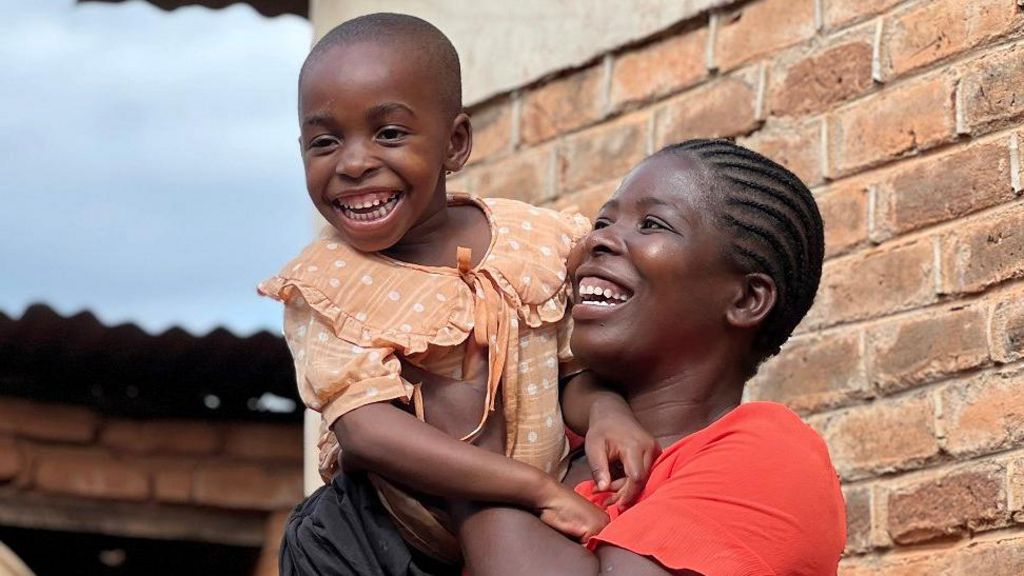
Two years ago, Martha Ongwane, a 33-year-old mother living in Mzuzu, northern Malawi, stood on the brink of an unthinkable act. She had poured poison into a cup, prepared to end the life of her young autistic daughter Rachael, overwhelmed by despair that had consumed her family. Today, that dark chapter feels like a distant nightmare. As Martha chops maize for the national staple nsima on her living room floor, four-year-old Rachael climbs giggling onto her lap, wrapping her arms around her mother’s face in a warm embrace – a transformation that would have been impossible just a few years ago.
When Rachael was first diagnosed with autism, the young girl presented severe behavioral challenges: she was non-verbal, struggled to stay seated, and often bit herself or others. With no access to guidance or support, Martha slowly crumbled under the weight of caregiving, sinking into deep depression. Neighbors in her community shunned the family, blaming Martha for Rachael’s behavior and demanding she lock the child inside their home. Widespread misunderstanding of neurodevelopmental disorders left Martha completely isolated, with nowhere to turn for help.
“I told myself it would be better if she died because that would mean she would rest and that would be the end of our problems,” Martha recalled softly, staring down at her hands. “[But] my heart didn’t let me. I changed my mind and cried so much.”
The turning point came when the family was referred to Saint John of God, a Catholic Church-funded non-profit organization that provides community-focused mental health services and runs a school for children with special educational needs. For Martha and her husband, the organization became a lifeline: they received specialized counseling, connected with a peer support network, and Rachael began accessing tailored behavioral and educational support. One year later, the change in Rachael is staggering. When her name is called in class at the Saint John of God school, she jumps up eagerly, grabs her friend’s hand, and joins in group singing – a far cry from the non-verbal, overwhelmed toddler of two years ago.
But Martha and Rachael’s happy ending remains a rare exception in Malawi, a lower-income east African nation facing a catastrophic shortage of autism resources and awareness. According to the World Health Organization, over 60 million people globally live on the autistic spectrum, a neurodevelopmental condition that affects how the brain processes information, communicates, and builds relationships, varying widely in presentation and intensity from person to person. While many autistic people possess unique strengths including intense focus, exceptional memory, and innovative thinking, low- and middle-income countries like Malawi rarely prioritize neurodevelopmental support, leaving most affected families to cope alone.
Currently, Malawi’s population of more than 22 million people is served by just two developmental pediatricians and three consultant psychiatrists nationwide. There is no term for autism in Chichewa, the country’s most widely spoken language; the condition is typically lumped under translations meaning “mentally challenged” or “troublesome,” reinforcing deep-seated stigma. Widespread misconceptions, including the common belief that autism is caused by witchcraft, push many desperate families to seek unproven, sometimes harmful treatments from traditional healers instead of clinical care.
Natasha Lusinje, a mother living outside the capital Lilongwe, 300 kilometers south of Mzuzu, represents this all-too-common reality. Her five-year-old son Shalom is non-verbal and cannot feed himself, and repeated community claims that the boy was cursed by witchcraft led Natasha to turn to a traditional healer for a cure. Granted rare access to the process, BBC Africa Eye documented the healer’s unfounded claim that autism comes in two forms: one from God that cannot be changed, and one from Satan that she can cure. She classified Shalom as the latter, charged Natasha 26,500 kwacha ($15), and put the boy through three weeks of daily herbal baths, forced herbal drinks, and skin cutting treatments. When no improvement appeared, the healer simply admitted she had failed. Natasha brought Shalom home, still clinging to the belief that a cure will come, with no access to the evidence-based support her son needs.
Saint John of God is working to reverse these harmful narratives one community at a time. The organization hosts regular autism awareness sessions, bringing together Christian and Muslim religious leaders to unpack common misconceptions and explain that practical, evidence-based support can drastically improve outcomes for autistic people. Christopher Mhone, a program lead at Saint John of God, argues that the systemic failure to address autism is a national failure. “For a woman to come to a point where she feels like she should kill her child – as a nation we have failed her. Her burden has become so impossible to bear that she does not have the emotional and psychological capacity to cope,” he said.
Currently, almost all autism support in Malawi is provided by non-governmental and charity groups. The national Disability Act does not even mention autism, a gap Mhone says reflects the general invisibility of the condition. “If you don’t know you have this problem, there’s no way you can begin to sort it out,” he explained. The BBC reached out to Malawi’s Health Minister Madalitso Baloyi to request comment on national autism provision, but received no response.
At its Mzuzu facility, Saint John of God currently supports more than 600 children and young adults with disabilities a year, including people with Down syndrome, cerebral palsy, and autism. Mhone says the organization’s goal is to reframe public understanding of disability: “Disability is ability, in a different way. And if society begins to understand that, then there will be less stigmatisation, and they will be looking at the positive things that can come out of those with disabilities.”
For Martha, the joy of having her thriving daughter comes with a quiet guilt, and a mission to help other families avoid the despair she faced. “When I look at her, I feel so guilty. Every day I think about the fact that my daughter could have been dead,” she said. “I adore her now.” She has shared her story publicly in the hope that more families will learn that support is available, and that no one has to walk the path of caring for an autistic child alone.