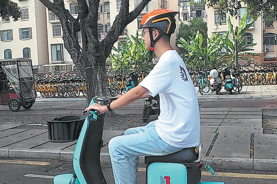
In the streets of Chengdu, Sichuan province, a transportation revolution is quietly unfolding as residents embrace a novel form of clean mobility. The city has become the testing ground for hydrogen-powered shared bicycles, locally nicknamed ‘hydrogen ponies,’ which are transforming urban transportation with their innovative technology and impressive performance metrics.
Qinglv Technology, a Chengdu-based startup, has deployed 11,000 hydrogen bicycles since August, accumulating over 550,000 registered users and facilitating more than 3.5 million rides. This represents one of the world’s first large-scale commercial operations of hydrogen-powered mobility solutions.
The bicycles operate on a sophisticated hydrogen fuel cell system that generates electricity to power the vehicle. Each unit carries a compact storage tank containing 100 grams of hydrogen, enabling an impressive range of nearly 100 kilometers—approximately double the distance of conventional shared e-bikes. The pricing structure remains accessible at 2.5 yuan (36 cents) for the initial 10 minutes, with an additional one yuan charged for every subsequent five minutes.
According to Yang Hao, co-founder of Qinglv Technology, the hydrogen bicycles employ groundbreaking solid-state hydrogen storage technology that combines hydrogen with a specialized metal powder. This innovative approach maintains internal pressure at just 2 MPa, significantly lower than conventional high-pressure hydrogen tanks that operate at 35-70 MPa. ‘This technology ensures that even in the unlikely event of a leak, it would occur gradually and pose minimal safety risks,’ Yang explained.
The technological advantages become particularly evident in colder climates. While lithium batteries experience rapid energy depletion in low temperatures, hydrogen fuel cells maintain consistent performance regardless of temperature variations, making them ideally suited for northern winters.
With strong governmental support, Qinglv Technology plans to expand its fleet by 15,000-30,000 additional bicycles within Chengdu this year. The company has also established partnerships to launch services in multiple Chinese cities including Hangzhou, Jinan, Sanya, Shenyang, and Ganzhou.
International interest has surged, with the company securing orders for 50,000 units from markets across the Middle East, Europe, the United States, and Southeast Asia. These export models will require design modifications to accommodate local preferences and regulations.
To support this growing demand, the company is constructing a new production facility in Xindu dedicated to manufacturing small-power hydrogen fuel cell systems specifically for bicycles. The facility, scheduled for completion by July, will boast an annual production capacity of 300,000 units.
Yang acknowledges that current market penetration faces challenges due to the higher costs associated with onboard power generation and hydrogen storage systems. However, he projects that achieving mass production scale will drive costs down to levels comparable with lithium battery-powered alternatives.
This innovation emerges against the backdrop of China’s massive electric bicycle market, which reached 380 million units in operation as of September 2025 according to the China Bicycle Association. LeadLeo Research Institute forecasts continued market expansion, with annual sales expected to grow from 51.2 million units in 2025 to 59.3 million units by 2030.
‘Our objective isn’t to replace lithium battery-powered bicycles with hydrogen alternatives,’ Yang emphasized. ‘There exists ample space for both technologies to coexist and complement each other within the evolving urban mobility landscape.’