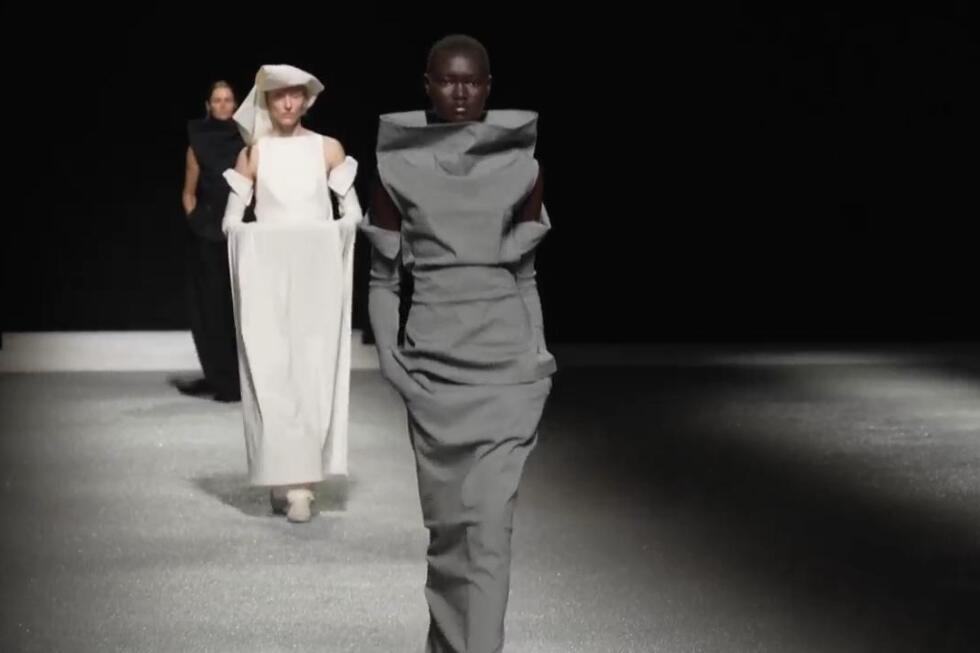
PARIS — At the Carrousel du Louvre on Friday, the Issey Miyake fashion house posed a profound question rarely addressed in the industry: When should a designer cease designing? Under creative director Satoshi Kondo’s guidance, the fall-winter collection titled ‘Creating, Allowing’ provided a contemplative answer through garments that balanced structured design with organic freedom.
The presentation began in atmospheric minimalism, with sparkling dust particles drifting across the runway as models moved with deliberate slowness. The collection explored the essential tension between actively shaping clothing and allowing fabric and body to interact naturally—a philosophical approach deeply rooted in the Japanese concept of ‘ma’ (the significance of space between objects) that founder Issey Miyake championed until his passing in 2022.
Initial pieces demonstrated restrained elegance with oversized off-white sweaters featuring architecturally sloped shoulders and dark suits adorned with asymmetrical front panels that resembled unfinished thoughts. Voluminous black trench coats were cinched with belts evoking martial arts attire, while fabric headpieces wrapped tightly around models’ skulls created a monastic aesthetic.
The collection’s color palette remained deliberately muted until carefully orchestrated moments of visual explosion. A vibrant yellow pleated wrap dramatically cut through the monochrome environment, its pleats hand-wrung then machine-set to create dynamic movement. Most striking were the rigid bodices and peplums in solid red, crafted through an innovative technique called Urushi Body. These pieces were constructed from lacquered washi paper—hand-torn sheets layered onto 3D-printed molds by Echizen region craftspeople, then finished with multiple lacquer coats by Kyoto artisans. The resulting forms contouring the body with armor-like authority represented a fusion of ancient Japanese craftsmanship with cutting-edge technology.
In a Paris Fashion Week season characterized by sensory overload, Issey Miyake delivered a powerful statement through disciplined minimalism. The collection celebrated the confidence to leave designs intentionally unfinished, transforming negative space and silent moments into profound aesthetic statements.