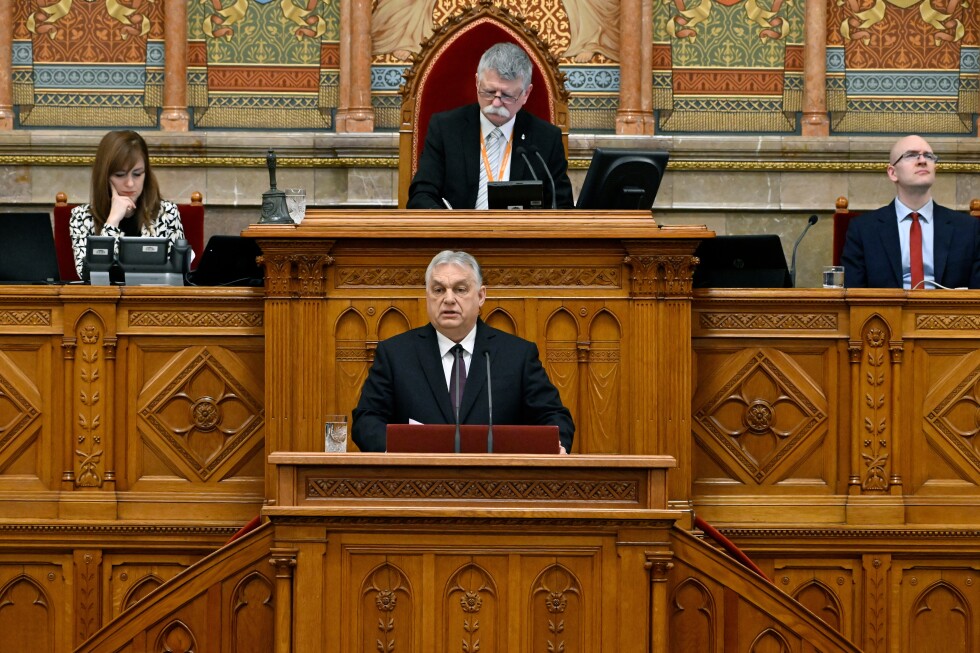
BUDAPEST, Hungary — In a dramatic escalation of pre-election tensions, Hungary’s government announced Thursday it would declassify a national security report that Prime Minister Viktor Orbán claims will demonstrate illegal Ukrainian financing of his primary political rival. With crucial elections approaching on April 12, Orbán faces the most significant challenge to his leadership from Péter Magyar’s center-right Tisza party, which currently leads in most opinion polls.
The nationalist leader, who maintains warm relations with the Kremlin, has intensified an aggressive campaign alleging that Ukraine, the European Union, and the opposition Tisza party are conspiring to overthrow his government. During a recent interview on commercial broadcaster ATV, Orbán asserted without providing evidence that “significant” sums had been transferred from Ukraine to support Tisza’s IT development and voter mobilization efforts.
Gergely Gulyás, Orbán’s chief of staff, confirmed at a Thursday news conference that “the declassification process is underway” and the report would be released “in the foreseeable future.” This development occurs amid growing voter dissatisfaction with Hungary’s stagnant economy, deteriorating social services, and widespread corruption allegations.
Orbán’s campaign strategy portrays the election as existential for Hungary’s future, warning that a new government would bankrupt the country through support for Ukraine against Russia’s invasion and potentially send Hungarian youth to fight on the front lines. The government has employed sophisticated disinformation tactics, including AI-generated imagery and publicly funded billboards featuring a manipulated image of Ukrainian President Volodymyr Zelenskyy with a sinister smile and the caption: “We won’t let Zelenskyy have the last laugh!”
Meanwhile, Magyar, a 44-year-old lawyer and former Fidesz party insider, has countered with warnings about potential Russian intelligence interference aimed at securing Orbán’s victory. The Tisza party has denied all allegations of Ukrainian financing.
Hungary’s government has consistently opposed EU financial and military assistance to Ukraine, vowing to veto any steps toward Ukrainian EU accession. Recent actions include blocking a €90 billion EU loan package for Kyiv and vetoing new sanctions against Russia, retaliation for interrupted Russian oil shipments through Ukraine.
The tensions escalated further last week when masked Hungarian counter-terrorism commandos detained seven Ukrainian state bank employees and seized $82 million in cash and gold during a routine transfer from Austria to Ukraine. Although the employees were deported after more than a day in detention, Hungary retained the assets, prompting Ukraine’s foreign minister to accuse Hungary of “state terrorism” and “taking hostages.”